 NexScrm官方博客
Treating automation as a shortcut to save labor often lets ineffective dialogues consume free quotas and expose incorrect responses. The correct sequence for private domain customer refinement operations is segmentation first, then automation, because the fields generated by segmentation determine whom automation triggers and what it sends; automation is merely the executor of segmentation results. Without fields, the system can only trigger on all contacts, causing quotas to be consumed across the board.
Segmentation determines whom automation triggers and what it sends
Every trigger condition in automation essentially reads a field, such as source, stage, or activity status. Without fields, you can only trigger on "all conversations," which technically means setting the default grouping to all customers. In the past, this crude setup had minimal trial-and-error cost, but after billing rule changes, indiscriminate triggering spreads expenses across all customers.
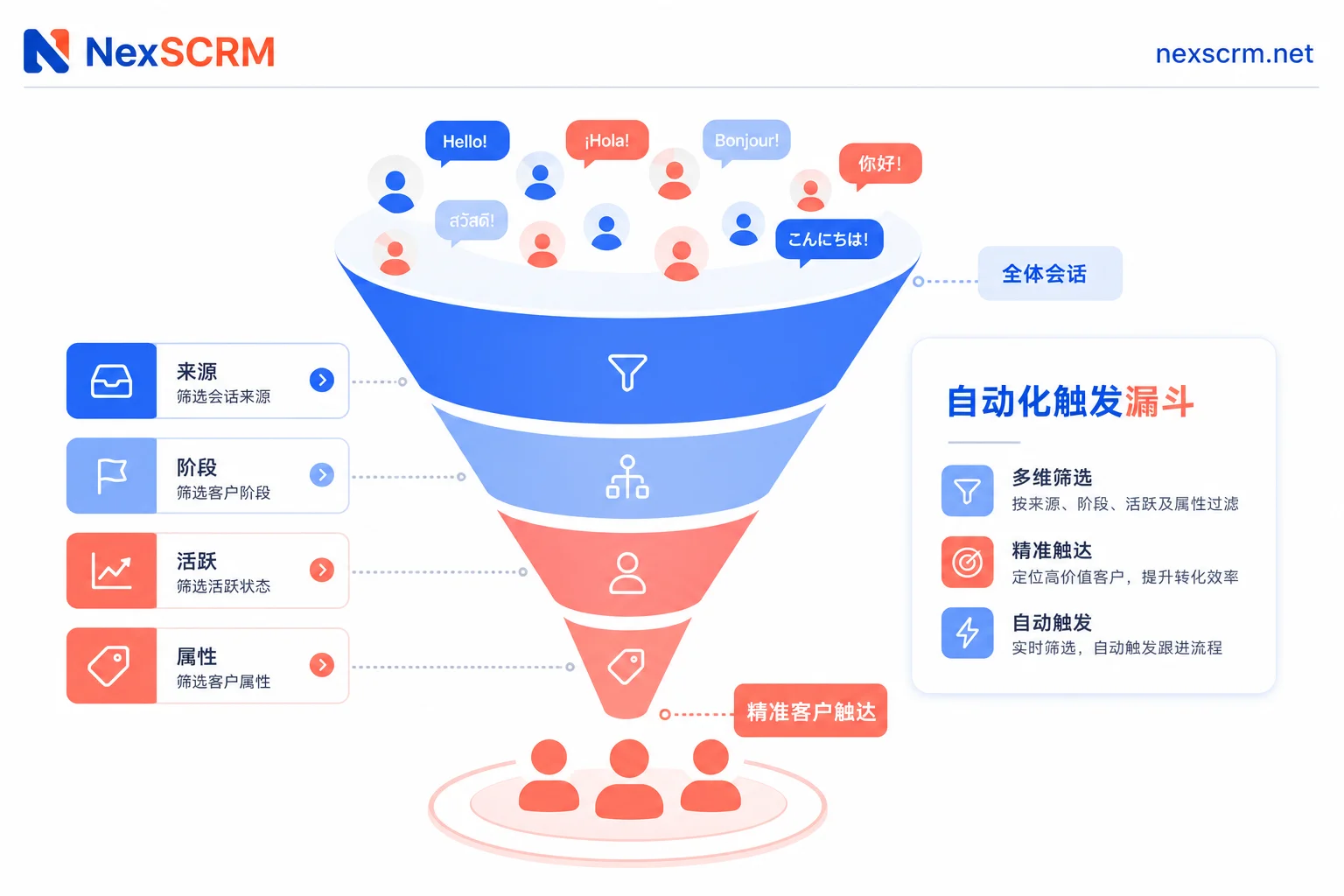
What segmentation signals can be captured at first touch
Segmentation basis doesn't have to wait until after a deal; you can capture it natively at first touch. Telegram Bot API versions 10.2 and 10.3 introduced the can_send_welcome_messages group welcome message permission, rich text media blocks, and temporary message mechanisms. Bots can send customized onboarding and interactive buttons when new members join a group, capturing first-touch signals like source and product category. These native interactions can replace some manual questioning, but complex purchase intent still requires human annotation in the conversation.
How does the cost of automation change with per-message service window billing?
Starting October 1, 2026, Meta charges per message for non-template service messages and Utility templates within the 24-hour service window on WhatsApp, with only 1,000 free messages per business phone number per month. The free quota is per business number, not per team. Country-specific pricing isn't fully published yet, but the cost structure has changed. The cost of indiscriminate automated Q&A equals the number of triggers multiplied by the average conversation turns. If automation lacks segmentation filtering, all incoming customers consume quotas, quickly exhausting the free allowance. The key to controlling turns is to use segmentation fields to filter out low-intent customers and only offer multi-turn automated dialogues to high-intent ones.
Key differences between segmentation-first and automation-first paths
The differences between the two paths determine whether a team can transition smoothly with limited manpower.
| Difference Dimension | Segmentation First, Automation Second | Automation First, Segmentation Second |
|---|---|---|
| Trigger Target Scope | Precisely targets high-intent customers by field | Indiscriminately triggers on all incoming customers |
| Control over Message Turns | Can set turn limits based on segment | Turns spiral out of control, easily exhausting free quotas |
| Free Quota Consumption | Concentrated on high-value conversations | Spread thinly across all customers |
| Error Exposure Speed and Impact | Errors only affect specific segments; discovery slower but impact smaller | Errors reach all customers; discovery fast but impact large |
| Rework Cost | Low; just adjust fields | High; need to rebuild trigger conditions and scripts |
| Impact on Customer Experience | Precise responses, less disturbance | Feels mechanical, easily triggers annoyance |
| Upfront Investment and Time to Launch | Requires manual annotation; delayed launch but later stable | Quick launch but requires rework later; high long-term cost |
Segmentation fields and trigger conditions sit on the same conversation data
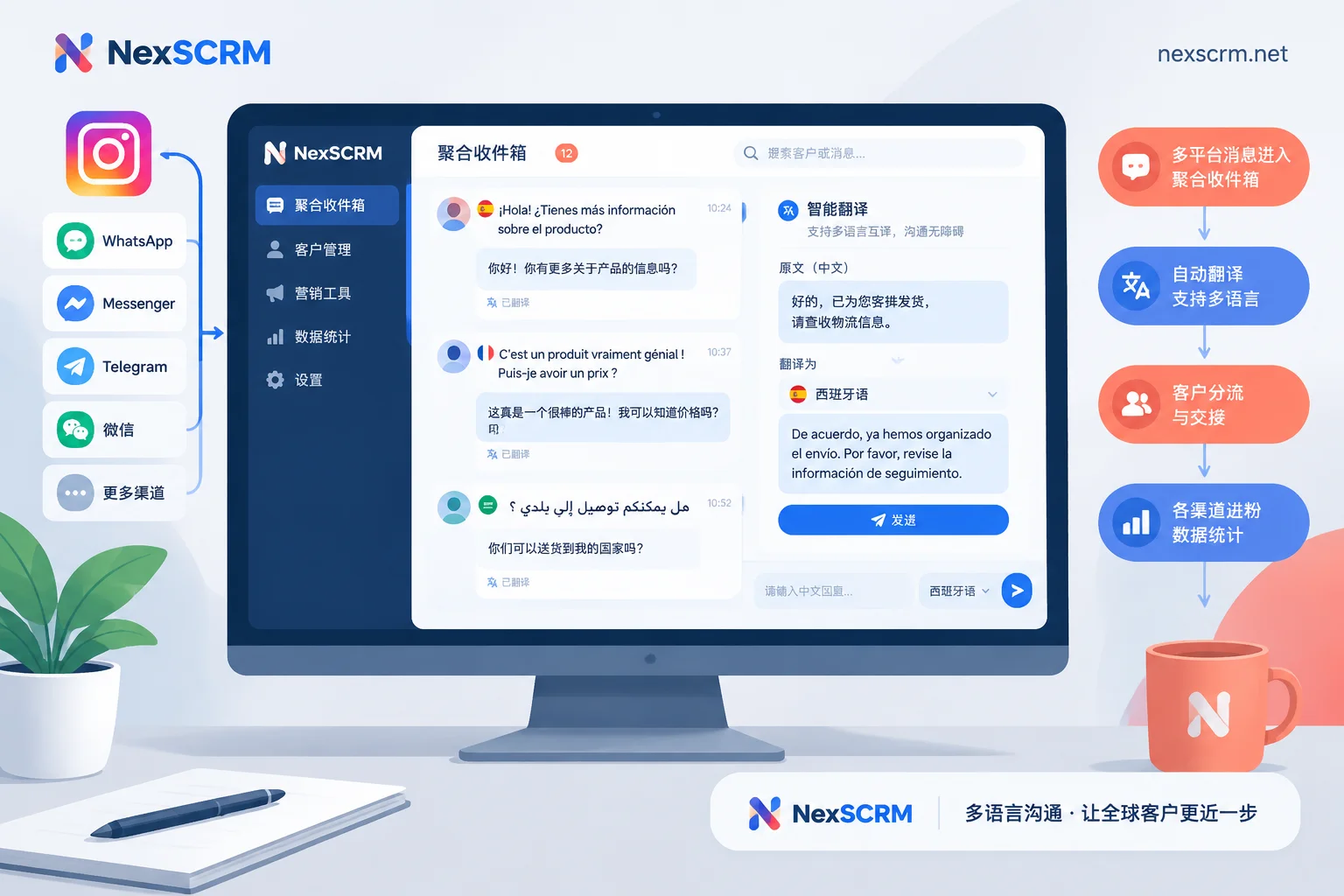
Following the discussion on trigger conditions in the previous section, how many layers are appropriate for segmenting private domain customers? The minimal viable design is four groups: static attributes, source channel, purchase stage, and activity status. Too many tags cause trigger conditions to conflict, leaving automation unsure which rule to respond to. The operational action is to bind tag fields and automation trigger conditions to the same reviewable conversation record. In multilingual scenarios, both original and translated texts must be archived together to avoid ending up with only machine-translated fragments during review. NexSCRM can aggregate and archive multi-platform conversations, store originals and translations together, and let tag fields serve directly as trigger conditions for reply workflows, rather than being scattered across personal phones without review. For specific classification methods, see WhatsApp Foreign Trade Customer Tag and Category Management Methods.
Choose what to do first based on team size and customer volume
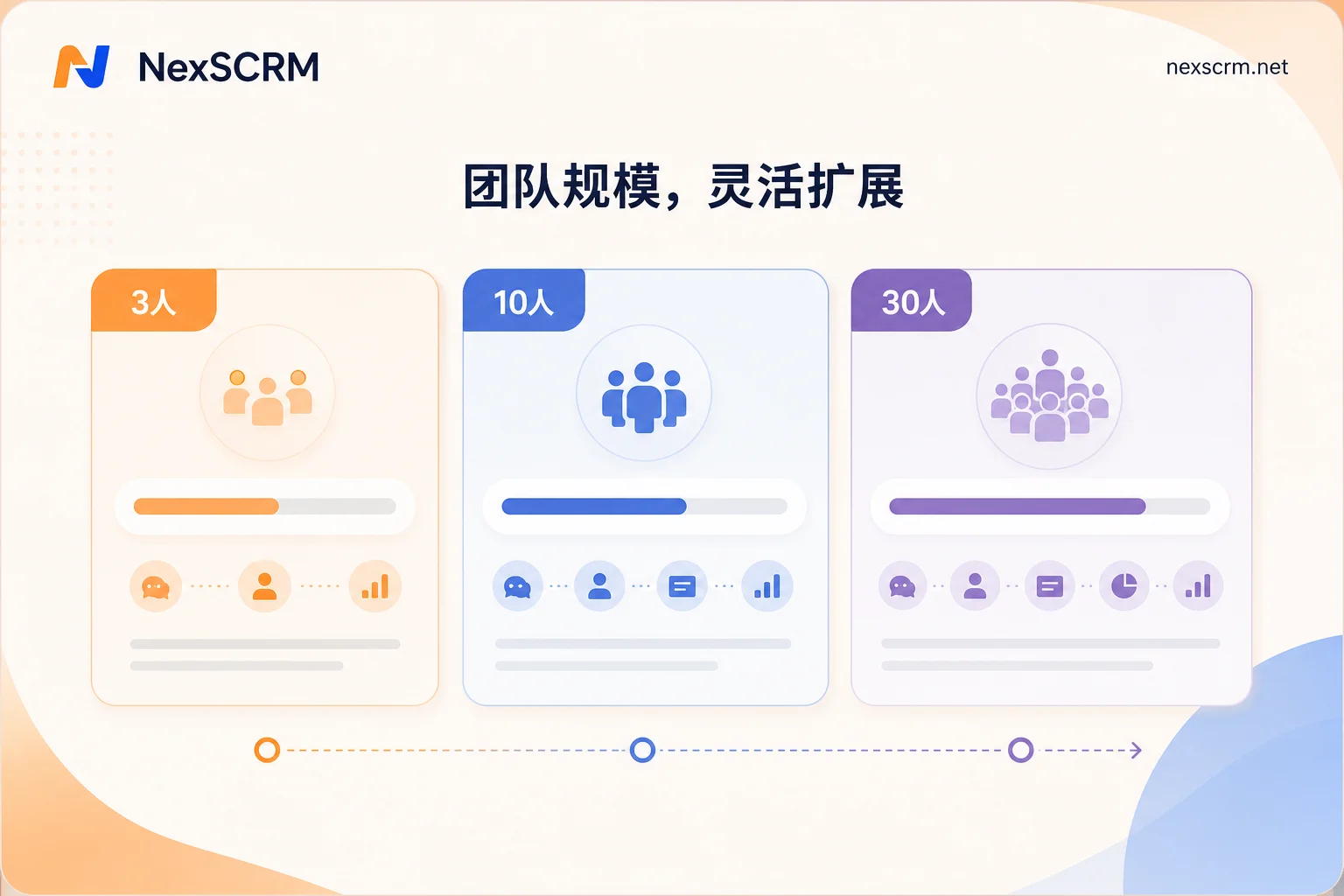
Teams of different sizes have clear differences in implementation order, requiring judgment based on signal availability and cost constraints.
| Team Size | Implementation Order | First Thing to Do | Can Be Deferred | Monthly Review Data Points |
|---|---|---|---|---|
| 3-person team | Pure manual segmentation | Establish four field groups and annotate manually | Any automation configuration | Field coverage rate, manual response time |
| 10-person team | Segmentation plus semi-automation | Use Telegram welcome messages to capture first-touch signals | Complex multi-turn dialogue bots | Free quota consumption rate, first-touch conversion rate |
| 30+ person team | Segmentation and automation in parallel | Configure trigger conditions and turn limits by stage | Unified copy library across all channels | Segment interception rate, average turns per customer |
FAQ
How many layers are appropriate for private domain customer segmentation?
"Layers" are logical groupings, while "field groups" are the dimensions supporting those groupings. Four field groups are the bottom line: static attributes, source channel, purchase stage, and activity status. Fewer than four can't support automation triggers; more than six tends to cause conflicts. A 3-person team should start with two groups, while teams of 10+ should implement all four, checking field coverage monthly.
If a customer doesn't reply, should we keep following up?
Decide based on activity status segmentation. For customers with a "quoted" purchase stage, trigger one Utility template wake-up after 7 days of silence; for those at the "inquiry only" stage, stop following up after 14 days of silence. The 7/14-day thresholds are operational parameters you can adjust, not industry standards. Utility templates also cost money, and their relationship with the service message free quota hasn't been officially clarified—verify it yourself. Avoid indiscriminate bulk sending to all silent customers, which would consume the free quota.
Is WhatsApp charging for replies within the service window?
Starting October 1, 2026, non-template service messages and Utility templates will be charged per message, with 1,000 free messages per business number per month. Country-specific pricing hasn't been announced yet; you'll need to verify it yourself. Exceeding the free quota incurs charges based on country rates, and indiscriminate automated Q&A will accelerate quota depletion.
How to set up welcome messages for new Telegram members?
Use the can_send_welcome_messages permission introduced in Bot API 10.3. This permission is a group permission item; please refer to the official changelog for calling conditions. Configure rich text media blocks and interactive buttons to send non-spammy, customized onboarding when new members join, capturing their source and product category.
Which has a higher conversion rate: bulk or one-on-one messaging?
The determining factor is segmentation precision, not the channel format. Bulk messaging based on purchase stage and activity status filters can outperform blind one-on-one. One-on-one without field support risks becoming ineffective annoyance. Look at field coverage first, then decide on the format. For automation configuration details, see Customer Service Automation; for ROI evaluation, see How to Evaluate the ROI and Conversion Rate of Overseas Social Media Private Domain Operations.
We recommend spending a week running your existing customers through the four field groups before deciding where automation connects. If conversations are scattered across multiple platforms and phones, making it impossible to review fields uniformly, use NexSCRM's aggregated conversation and tag fields to consolidate the data first, then talk about automation.


Comments(0)