 NexScrm官方博客
Let's start with the conclusion: traditional CRM manages how far a deal has progressed, while cross-border social media SCRM manages how a conversation is currently being handled, by whom, and what has been said.
If your team's customer communication mostly happens in instant messaging apps like WhatsApp, Telegram, LINE, and Zalo, traditional CRM cannot solve problems like missed replies, not understanding foreign languages, or losing records during handover. If your team's biggest headaches are long-cycle B2B contracts, quote approvals, and payment tracking, traditional CRM is still the better fit. Many foreign trade teams use both types of tools, each handling one part.
Where the Two Types of Tools Differ
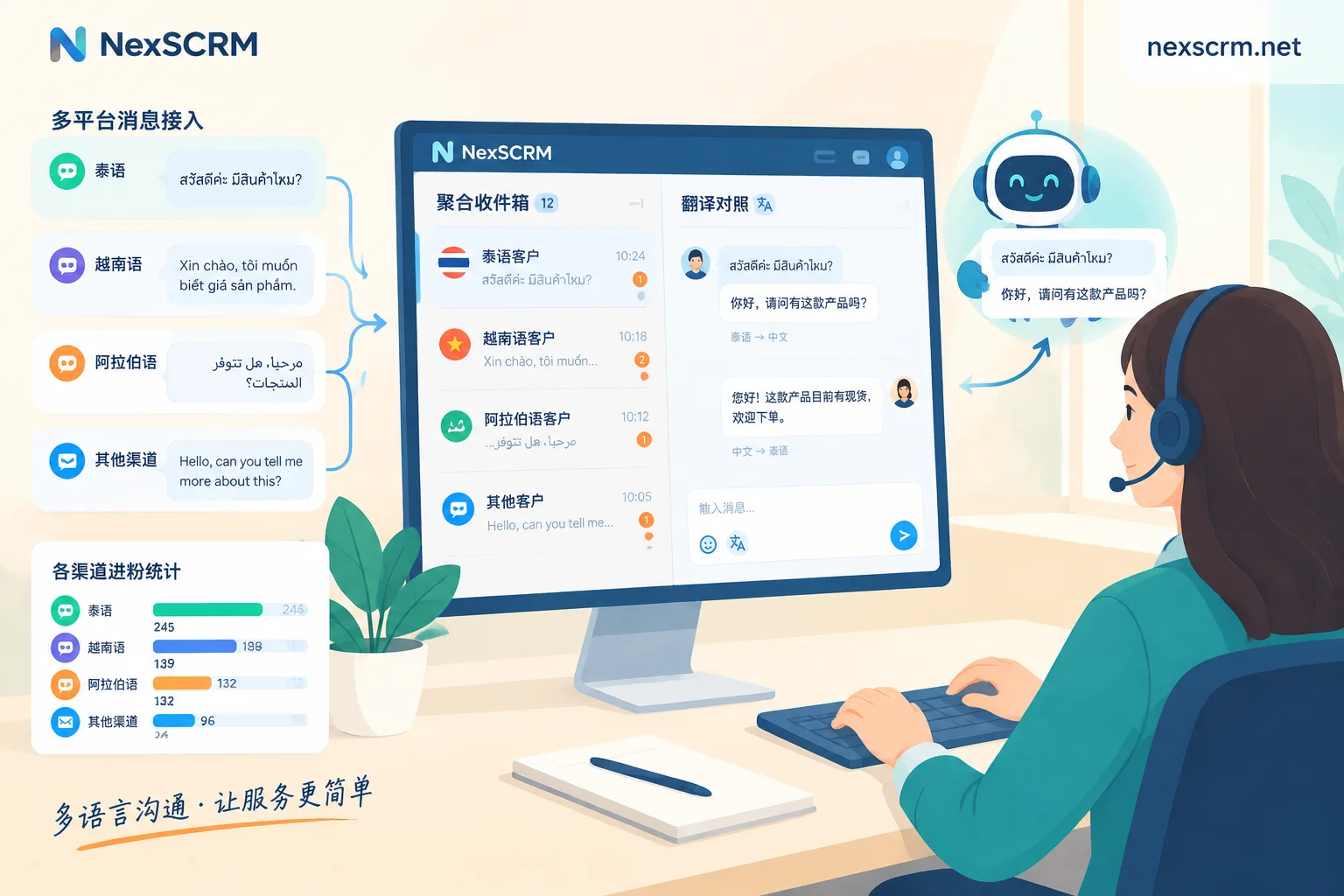
Compare a typical morning. A foreign trade salesperson opens their computer and finds over twenty unread messages across three WhatsApp accounts and one Telegram account, including a Spanish voice message and a Portuguese image quote.
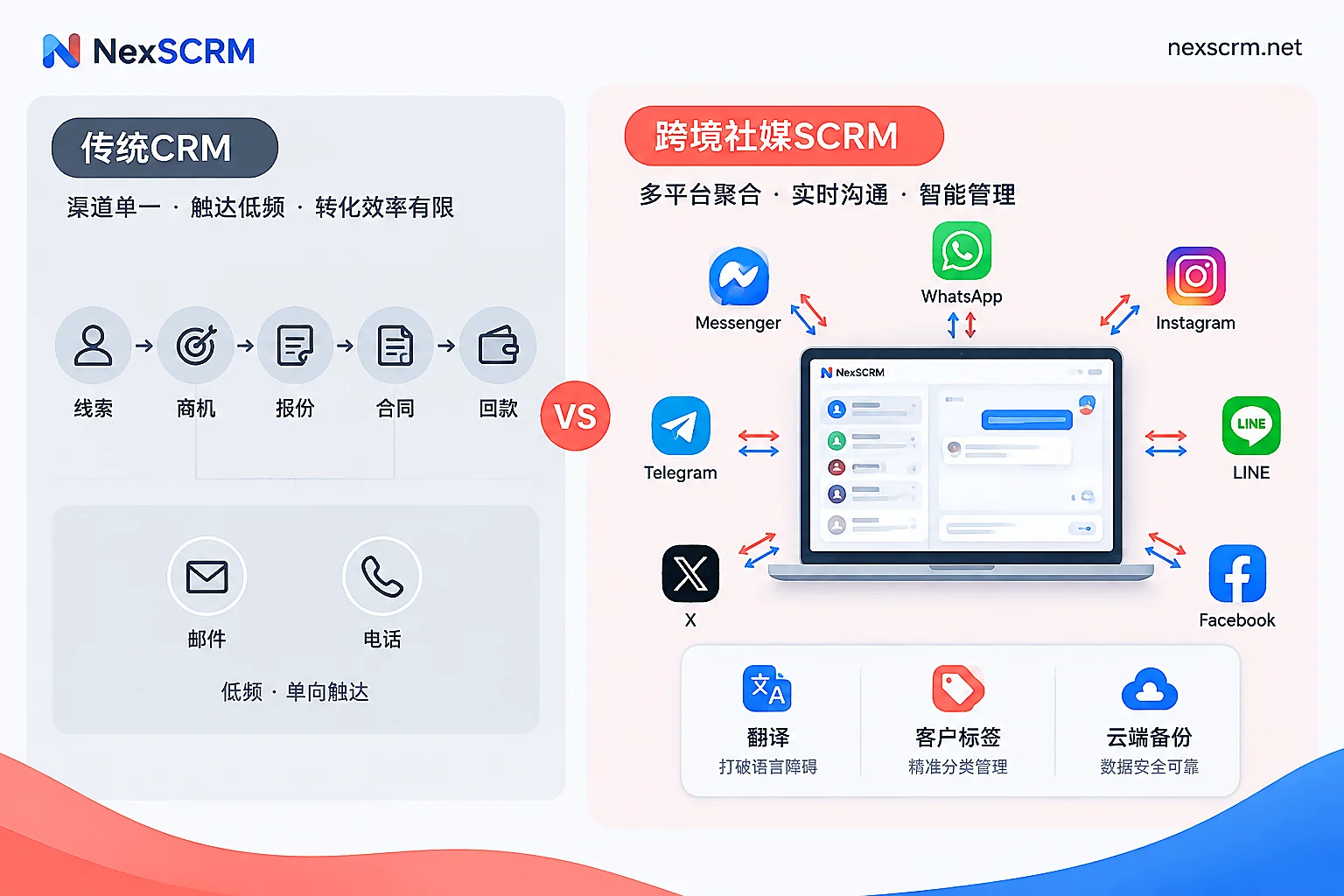
In a traditional CRM: Systems like Salesforce, HubSpot, and Zoho record customer profiles, opportunity stages, quotes, and payment milestones. Communication channels are mainly email, phone, and tickets, with a low-frequency rhythm that mostly follows preset processes. Those twenty-plus chats are invisible to it. The salesperson has to switch between several apps, then manually enter key points into the CRM after each chat—and when things get busy, they often don't.
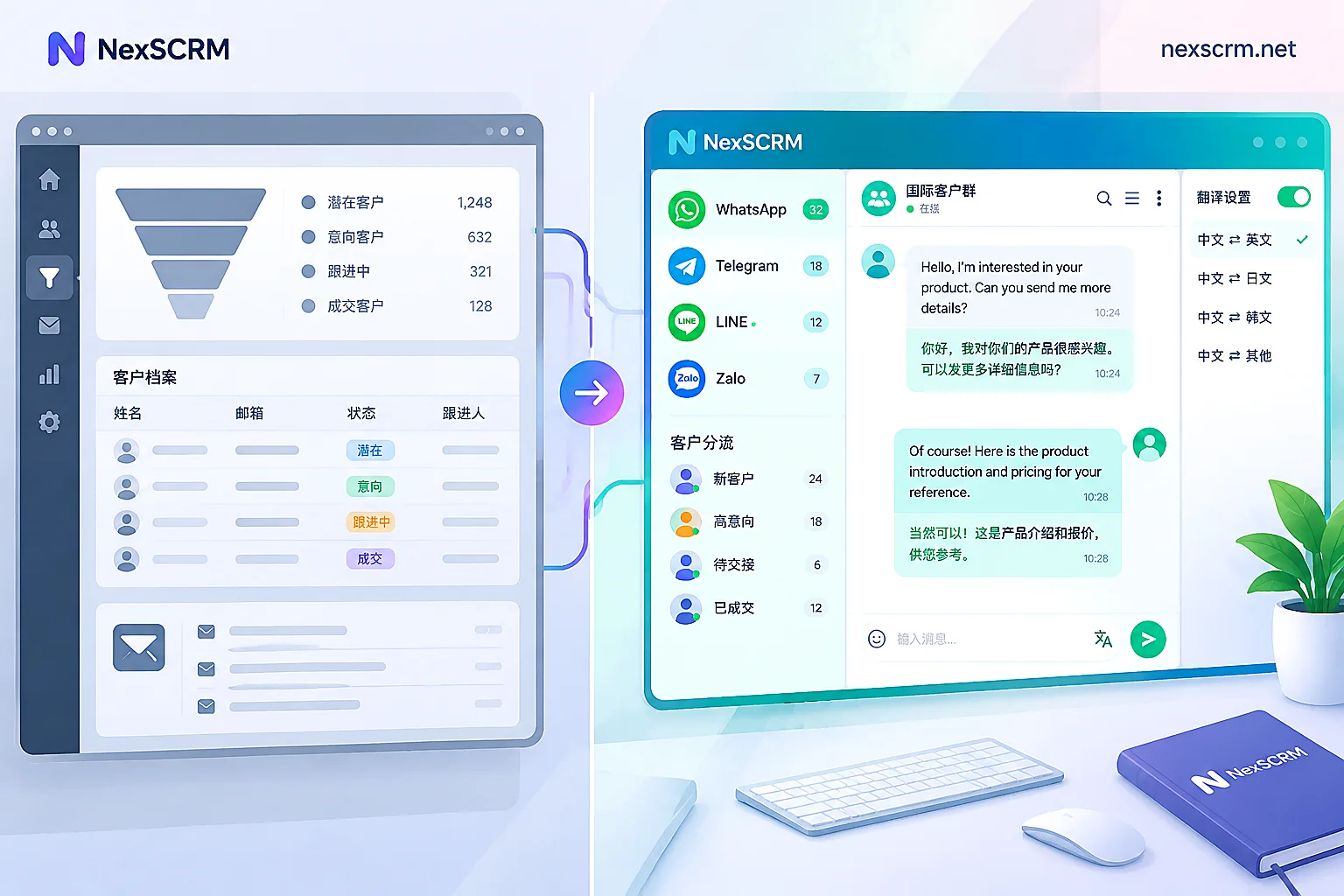
In cross-border social media SCRM: Messages from these accounts enter the same workspace, with translation and customer tags right next to the conversation, and the chat history itself serves as the customer profile.
Breaking it down, there are four main differences:
- What it revolves around: Traditional CRM centers on deals and internal processes; social media SCRM centers on customer interaction, placing more emphasis on response speed and building trust instantly.
- What the data looks like: Traditional CRM handles structured forms, profiles, and transaction history. Social media SCRM must handle large amounts of unstructured content, including text, voice, images, and tags that update with conversations.
- Communication rhythm: Traditional CRM outreach is low-frequency and somewhat one-directional; social media communication is high-frequency, two-way, and real-time.
- Where customer assets stay: Traditional CRM only contains what has been entered. If social media communication is not taken over by a tool, records are scattered across employees' personal devices, and when an employee leaves or changes devices, customers and context may be lost along with them.
First Determine Which One You Need More
Better suited to traditional CRM as the primary tool: High average order value, deal cycles measured in months, quotes requiring multi-person approval, contracts and payments requiring reconciliation, and main communication via email and meetings.
Better suited to social media SCRM as the primary tool: Inquiries mainly come from social media ads, communities, and instant messaging; one person has to manage multiple accounts simultaneously; customers speak many languages; and customer service or sales staff turnover is relatively frequent. Teams doing cross-border e-commerce retail customer service usually have high inquiry volume and low order values, so social media SCRM carries more weight.
Both needed: This is very common in B2B foreign trade. Early-stage communication on WhatsApp to discuss requirements and confirm samples, then moving to CRM once formal quoting and contract stages begin. In this case, agree on handover points first, such as synchronizing key information to CRM when the customer confirms specifications or requests a formal PI, to avoid mismatched records between the two sides.
During actual selection, the weighting depends on your lead volume and average order value. For the checkpoints below, verify the priorities based on your team's actual business.
Seven Questions to Verify When Choosing a Cross-Border Social Media SCRM
1. Can you send and receive across all platforms and accounts you use in one workspace?
First list clearly the platforms and number of accounts the team actually uses, log into all of them during the trial, and confirm messages can be received, replied to, and not missed. If this problem isn't solved, the later features won't matter.
2. Can translation be embedded in the conversation?
Look at four things: whether both sending and receiving directions can be translated in real time; whether text, images, and voice are all covered; whether there are multiple translation routes to switch between; and whether the original and translated text are both preserved. The point of preserving the original is that when there are disputes over quantities, prices, or delivery dates, you can look back at the customer's exact words, reducing disputes caused by machine mistranslation.
3. Is the login environment for each account independent?
When multiple people and multiple accounts log in under the same device and network, environment fingerprints and IPs get mixed together, and one account's problem may affect others. Confirm whether the tool can provide an independent environment for each account and whether it can bind a separate proxy for each session. An independent environment can only reduce the association risk caused by environment mixing; it cannot replace compliance with platform rules. The quality of the proxy itself also needs to be evaluated separately.
Take NexSCRM as an example: multiple platforms and accounts are aggregated for sending and receiving in one Windows client, each account has an independent fingerprint environment, and session-level proxies can be bound. Translation covers text, images, and voice, with multiple routes to choose from, and both the original and translation are preserved. For details, see multi-account aggregation feature description.
4. When someone takes over, can the context be handed over completely?
Confirm whether chat records are centrally backed up in the cloud, whether they can be searched by customer or keyword, and whether a new colleague can see the complete historical conversation and customer tags after taking over. Contact deduplication and follow-up reminders also belong here; otherwise, the same customer may be followed up by two people at once.
5. How far can internal controls go?
Pay attention to sensitive word and sensitive behavior monitoring, customer information masking, and payment control. These mechanisms target risks such as privately adding contact info or collecting payments privately, but they cannot see everything. Before launch, understand their boundaries; you can refer to the three types of actions sensitive behavior monitoring can catch and four blind spots.
6. How many people came in from each channel, and who were they assigned to?
Teams doing ad traffic or community promotion need split-link statistics, lead counters, and ticket assignment to know how many inquiries each channel brings and whether they are evenly distributed to reception staff. Note that this type of data counts inbound leads and lead additions, not revenue attribution. For how to track click data and lead data separately, see how to set up data tracking for independent sites and social media traffic.
7. Does the billing model match your usage?
Traditional large CRMs often charge by annual enterprise fee plus custom deployment, with high trial-and-error costs. Social media SCRMs mostly charge by port or seat subscription. When billing by port, a port refers to the number of accounts online simultaneously, not the number of employees; for the calculation, see how many ports one customer service agent occupies. Also check which operating systems the client supports; if some team members use Mac, confirm in advance.
How to Arrange the Trial Period So Differences Become Visible
- Test with real work: Pick two or three accounts currently in use, cover the team's most common one or two customer languages, and handle normal reception for a week.
- Deliberately create a handover: Have another colleague take over one of the customers and check whether they can continue the conversation without asking the predecessor.
- Check the backend on the weekend: Compare lead statistics, sensitive behavior records, and chat backups to see whether the data matches reality.
- Then decide the scale: Estimate ports based on the actual number of accounts online simultaneously, and expand to the whole team after confirmation.
If you want to formalize the reception process after the trial, you can refer to the five-stage process of a cross-border B2B private domain operations SOP. NexSCRM offers a free trial; for port tiers and feature differences across versions, refer to the pricing and trial page.


Comments(0)