 NexScrm官方博客
Recently, two major adjustments rolled out by WhatsApp in succession are profoundly changing the daily lead acquisition and response logic of foreign trade and cross-border e-commerce teams.
The first is the upgrade of privacy mechanisms: WhatsApp has officially advanced the username mechanism. When an overseas buyer enables a username, the customer service side will not be able to directly see the other party's phone number when they initiate an inquiry to a business for the first time. The second is the rising cost of message communication: starting in October 2026, the WhatsApp Business platform will change its previous strategy of free unlimited replies within the 24-hour customer service window, adjusting service messages and utility templates to per-message billing.
These two changes combined sound a warning bell for going-global teams that rely on WhatsApp for customer acquisition: the old rough-and-ready model of "identifying people by phone number and closing deals by spamming messages in turn" no longer works.
At a time when complete numbers are invisible and every pointless sentence consumes budget and energy, foreign trade and cross-border teams urgently need a WhatsApp SCRM system capable of refined operations, upgrading "blind reception" into a standard closed loop of "accurate identification, efficient deal closing, and asset retention."
1. Three New Pain Points Facing Cross-Border Teams Under Recent Rule Changes
In daily operations, whether teams use regular WhatsApp numbers or Business accounts to receive traffic, team leaders and frontline salespeople have recently been frequently encountering the following dilemmas:
- Number hiding leads to "failure to identify people and frequent duplicate claims"
In the past, salespeople were used to judging a customer's location by country code and checking duplicates in spreadsheets by phone number suffix. Now customers come in under a custom username. Without combining historical interactions and channel sources, two salespeople may follow up with the same buyer on different accounts without knowing it, and may even give contradictory quotes. - Ineffective back-and-forth pushes up communication and time costs
In the per-message billing era, "toothpaste-squeezing" chat is the last thing you want. Because customer service cannot understand small-language images, cannot understand dialect voice messages, or cannot find accurate product materials, they split one sentence into five. This not only directly increases bills on API channels, but also causes high-intent inquiries to churn quickly on regular and Business accounts due to slow responses and low professionalism. - Private domain assets hang in the air and are wiped out when accounts or personnel change
When phone numbers are no longer the only explicit identifier, the customer's core asset is fully concentrated in the "conversation relationship chain" and "process tags." If teams still stop at employees each using their own phones or scattered web versions to chat, once a foreign trade salesperson leaves or the environment becomes abnormal, the company will not even have a chance to trace back who the customer was.
2. First Breakthrough Step: Do Routing, Duplicate Checking, and Profiling Well in "No-Number Identifier" Scenarios
Since teams can no longer rely solely on visually checking phone numbers, they must have the system automatically complete identity anchoring and asset filing the very second a customer comes in. Regarding the basic counting logic, we broke it down in "Still Manually Counting Fans with Excel? How Cross-Border Teams Can Use "Automated Counting" for Precise Traffic Traceability." In the new regulatory environment, it is even more necessary to deeply combine routing and profiling.
Through NexSCRM's customer operations and routing features and lead counter, teams can reconstruct the reception flow from the source:
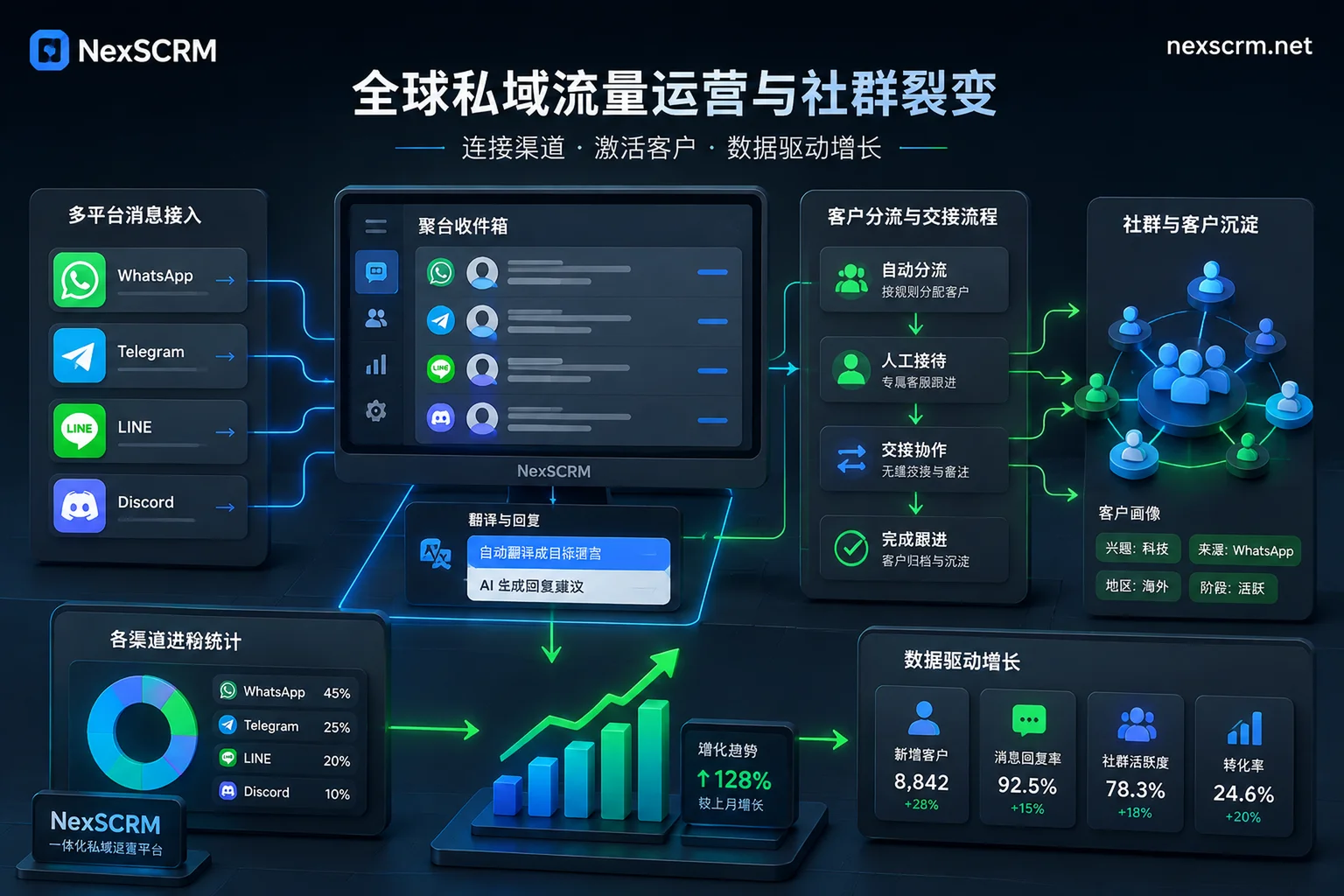
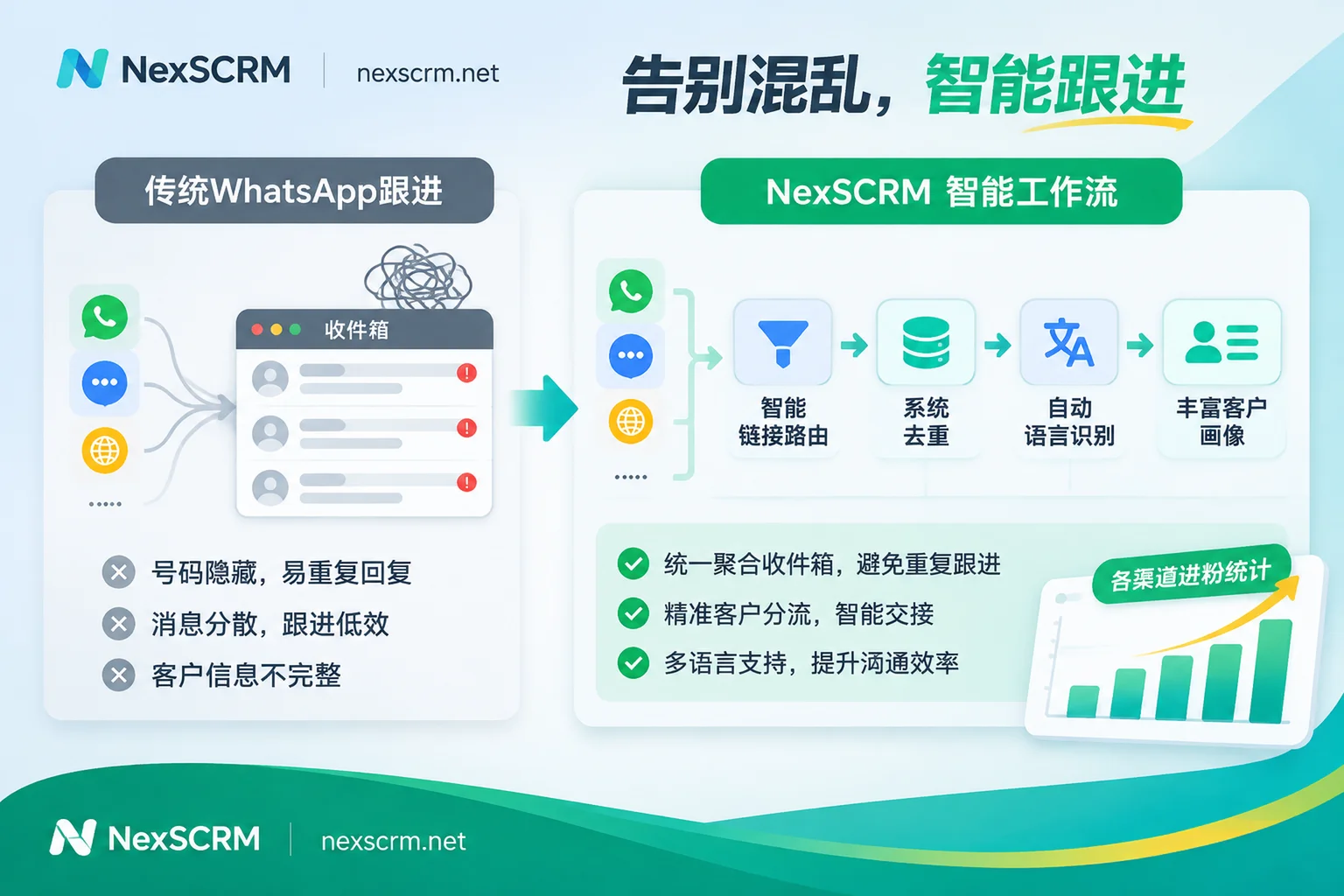
- Intelligent routing and system automatic duplicate checking: When running ads or social media traffic, use routing links to automatically assign customer service based on source channels, preset tags, and historical records. At the moment of entry, the system supports ticket deduplication and system duplicate checking across a single or all sub-accounts. Even if the buyer hides their number, the system can identify that this is an existing customer already handled by another colleague, completely avoiding internal duplicate claims and price undercutting.
- Automatic language identification replacing country code judgment: If you cannot see the phone number's country code, how do you know which country the customer is from? NexSCRM's built-in multilingual real-time translation automatically identifies the other party's language when the customer sends their first sentence and binds the translation language separately by contact, with no need to guess country codes or install plugins.
- Three-dimensional customer profile retention: On the right side of the chat window, salespeople can add multi-dimensional tags to customers at any time, fill in follow-up notes, and record source channels. Combined with the system's automatically counted customer activity and interaction history, a vague "username" is quickly restored into a three-dimensional buyer profile with clear needs and a defined stage.
3. Second Breakthrough Step: Compress 5 Pointless Sentences into 1 Precise Reply to Maximize the Value of Each Conversation
Whether to respond to the per-message billing trend or to capture the golden attention of overseas buyers, the core iron rule of WhatsApp operations in 2026 is: reduce ineffective pleasantries and hit the customer's pain point in one strike.
To make customer service "say less nonsense and produce more effective replies," you cannot rely only on verbal urging. You need tool empowerment in the workspace:
1. Real-Time Two-Way Translation Across Text, Image, and Voice Formats
When foreign trade customers inquire, they extremely often directly take a photo of packaging or a nameplate with local text, or send a voice message of a few dozen words. The traditional approach is for customer service to screenshot it and send it to translation software, or repeatedly ask the customer "Can you type in English?", wasting multiple rounds for nothing.
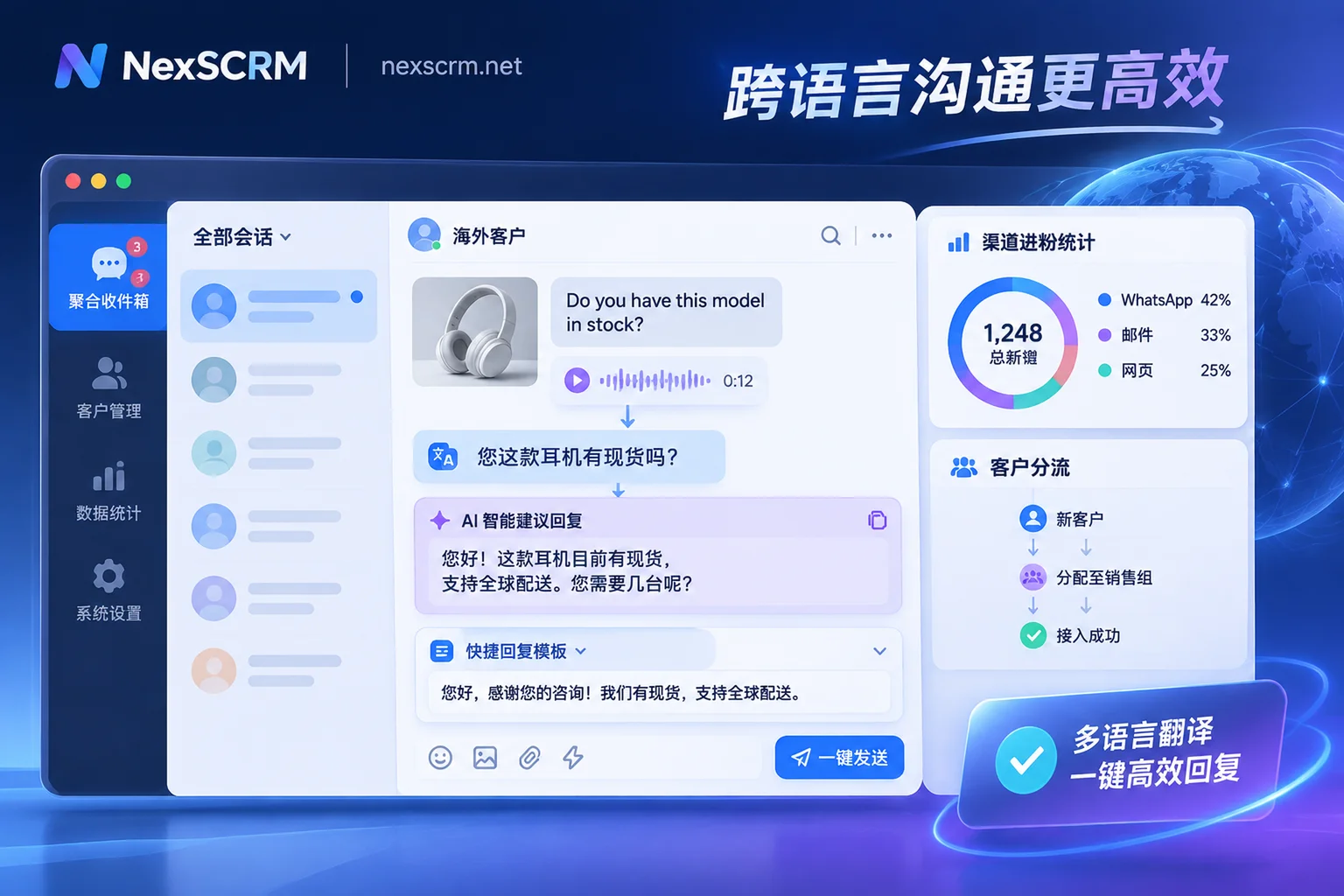
NexSCRM directly integrates multiple translation routes from Google, Microsoft, DeepL, and AI large models within the client. It not only automatically translates incoming and outgoing text in both directions (keeping both the original and translated text), but also supports image translation and voice message translation (available by version). Customer service can understand the need at a glance and provide a complete answer in one go.
2. AI Script Suggestions and Structured Template Collaboration
To avoid customer service making errors or omissions when improvising language on the spot, teams can enable AI scripts and auto-replies. When a customer raises an after-sales or pricing question, AI generates high-quality reply suggestions based on the current customer question and historical conversation. Customer service only needs to confirm or fine-tune before sending (for how to avoid AI replying blindly, see "How Can Cross-Border Teams Make Good Use of AI Customer Service Assistants? Avoid the "Fully Automated Hallucination" Trap and Build a High-Conversion Human-Machine Collaboration Loop").
At the same time, with public quick-reply templates that support variable replacement and keyword triggers, plus a unified media asset library, customer service can integrate "quote parameters + real photos + transaction terms" into one high-quality reply, greatly reducing communication rounds and improving inquiry conversion rates.
4. Third Breakthrough Step: Secure Multi-Account Aggregation and Internal Control to Keep Conversation Relationships in the Company
Many foreign trade companies hesitate to fully open up multi-account matrices because they fear account bans caused by environment association, and because they fear customer relationships are all tied to individual salespeople.
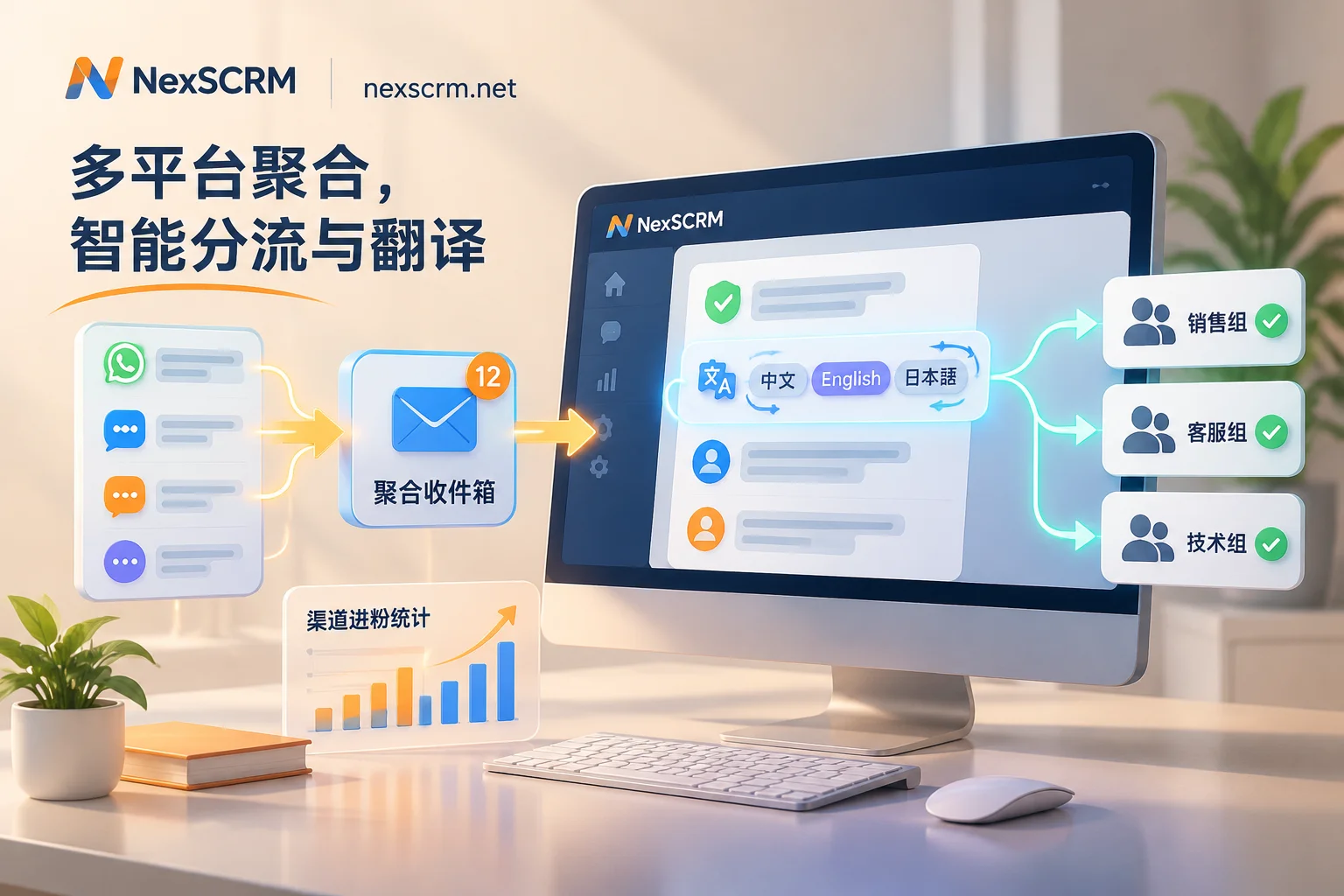
In the multi-account aggregation workspace, NexSCRM supports simultaneous login to regular WhatsApp numbers and Business accounts, and can also synchronously aggregate mainstream cross-border platforms such as Telegram, LINE, Zalo, Instagram, and TikTok. Each account runs in an independent fingerprint environment and supports binding session-level proxy IPs. Login status is automatically saved, so restarting the software does not require repeatedly finding a phone to scan a QR code (for more desktop anti-lag details, see "WhatsApp Multiple Instances Lagging and Dropping Connections? Avoid Browser Clones and Plugin Conflicts and Build a High-Concurrency Customer Service Workspace").
More importantly, in the trend where customers' plaintext phone numbers are invisible, enterprises must lock down absolute control over the "conversation channel" and "chat process":
- Prior permission isolation and desensitization: The main account uniformly allocates ports and permissions, sub-accounts divide visible scopes by role, and data desensitization is enabled. Customer service can follow up and chat normally but cannot batch export or peek at core materials outside their responsibilities.
- In-process interception of sensitive behavior: Through employee internal control and data dashboards, the system conducts real-time monitoring of sensitive words, private contact information sharing, and private payment collection. Once triggered, custom alerts are issued immediately (see "Foreign Trade Anti-Deal-Sniping Cannot Rely Only on Reviewing Records After the Fact: A Guide to In-Process Interception of Private Payments, Small-Language Blind Spots, and Sensitive Behavior").
- Post-event cloud backup and seamless handover: All chat records, media files, customer profiles, and follow-up records are automatically saved in the enterprise cloud and support second-level retrieval by time, contact, and keyword. Even if an employee leaves, the new colleague who takes over can log in to the sub-account and see the complete context history and follow-up reminders, achieving zero-gap handover.
Conclusion: Use a Deterministic Workspace to Cope with Platform Uncertainty
Whether WhatsApp hides numbers or adjusts billing and compliance rules, in essence it is forcing going-global enterprises to bid farewell to rough harassment and move toward refined private-domain cultivation.
While competitors are still duplicate-claiming because they cannot identify customers and talking at cross purposes because of language barriers, teams that are first to use NexSCRM to run through "intelligent routing and duplicate checking + cross-language AI collaboration + enterprise-level internal control and retention" can steadily capture every wave of overseas traffic at a lower cost per conversation.
You can now visit the NexSCRM download page to get the client. No credit card binding is required to start a limited-time free trial. You can also go to the pricing and versions page to flexibly choose a port plan based on the number of accounts your team has online simultaneously and quickly build your own high-conversion cross-language social workspace.