 NexScrm官方博客
In the second half of cross-border going global, more and more brands and foreign trade teams have realized: directing public domain traffic to instant messaging apps is only the first step of a long march. According to recent industry observations and private domain research reports, over 80% of enterprises have incorporated private domain into their core growth system, but teams that truly scale private domain often do not rely on 'endlessly buying traffic and adding people', but rather on a self-circulating loop from single-customer conversion to community retention, and then to old-customer referral.
However, in actual practice, many teams' overseas private domain operations get stuck in the middle: customer service adds hundreds of friends daily on WhatsApp, Telegram, LINE, or Facebook, but after closing a deal, the customer becomes a 'zombie fan'; when they want to build groups for welfare-driven referrals, they don't know how to select the first batch of seed users, how to count group members, or how to manage multi-language group chats.
If we have already solved the basic loop of ad traffic and old customer reactivation, then today let's shift perspective and talk about how to upgrade isolated '1-on-1 chats' into a highly sticky 'community and referral network'.
I. Why Has Your Overseas Private Domain Become a 'One-Time Contact List'?
Many cross-border sellers directly copy the domestic WeChat private domain playbook to overseas markets, ignoring the particularities of the overseas social ecosystem, resulting in a stagnant private domain pool. Common issues concentrate in the following three points:
- Only single-point communication, lacking venue for water storage
1-on-1 chats are suitable for high-ticket inquiries or customized after-sales, but they consume a lot of customer service energy. For consumer goods with short repurchase cycles or brands that need to build trust endorsement, without the resonance of groups or channels, customers find it hard to develop brand belonging, and no matter how many promotional messages are sent, they are easily blocked as spam. - Blind group cold start, confusing data on group joins
To import fans from TikTok or Instagram into private domain groups, operators often use giveaways or referral links. But who brought in how many people? Who are the 'freeloaders' who join multiple groups repeatedly? Counting heads manually on phones is not only inefficient but also prone to errors in reward calculation leading to customer complaints. - KOCs (Key Opinion Consumers) buried in massive conversations
Overseas consumers highly value word-of-mouth recommendations from real buyers. Those active customers who are willing to share their purchases and speak up for the brand in groups should be core nodes for low-cost referrals, but because customer service does not tag and segment them or record interactions, they end up mixed with ordinary inquiries and forgotten.
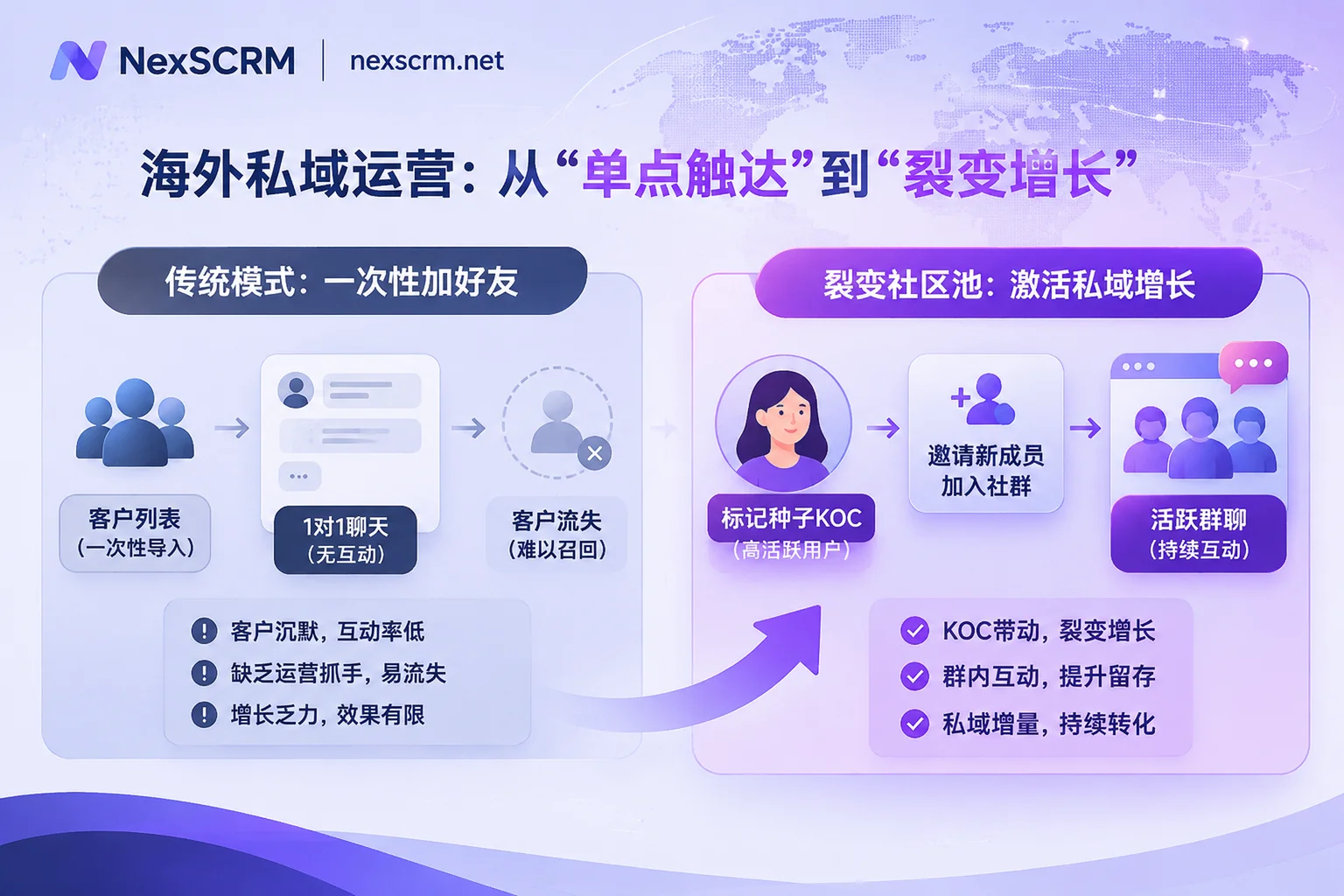
II. First Breakthrough: Use Detailed Profiles to Screen 'Seed Users' and Complete Community Cold Start
The biggest taboo in building groups is 'forced pulling'. On platforms like WhatsApp or Zalo, adding strangers to group chats without permission not only leads to high leave rates but also easily triggers platform risk control and account bans (for account environment security, refer to the WhatsApp environment stabilization and reception loop guide).
A healthy community cold start must be built on trust screening through 1-on-1 chats:
1. Tag private domain contacts with 'referral potential'
When handling daily inquiries or after-sales, teams need to use professional customer operations tools to complete customer profiles in real-time on the chat sidebar. In addition to basic 'country/region' and 'intended category', it is recommended to add interaction tags such as:
已晒单好评: Customers who proactively send buyer shows after receiving goods (you can conveniently save high-quality images to the system's media library for reuse by the whole team);高活跃度: Customers who frequently ask about new products or are highly sensitive to discounts;批发/分销意向: Potential promoters with small-B attributes or social circle influence.
2. Precise invitations with variable scripts, say goodbye to stiff mass messages
After screening the first batch of high-intent seed users, customer service can categorize them through conversation groups and use quick reply templates from the public script library to send group invitations. Using the template's 'variable replacement' function to automatically embed the customer's real name or historical interaction details, and leveraging the built-in multi-language real-time translation to convert it into authentic target language, can greatly increase the join rate of the first core group members.
III. Second Breakthrough: Open Up the 'Refer-a-Friend' Referral Chain and Use Automated Counting to Account for Every Traffic
Once the community has its first batch of seed users, the next step is to expand through 'refer-a-friend' or influencer distribution. At this stage, the biggest challenge for operations teams is traffic traceability and anti-cheating.
If the team is still manually registering who invited whom in spreadsheets, take a look at how automated counting achieves precise traffic traceability. In actual referral campaigns, you can lock down the data loop through the following NexSCRM modules:
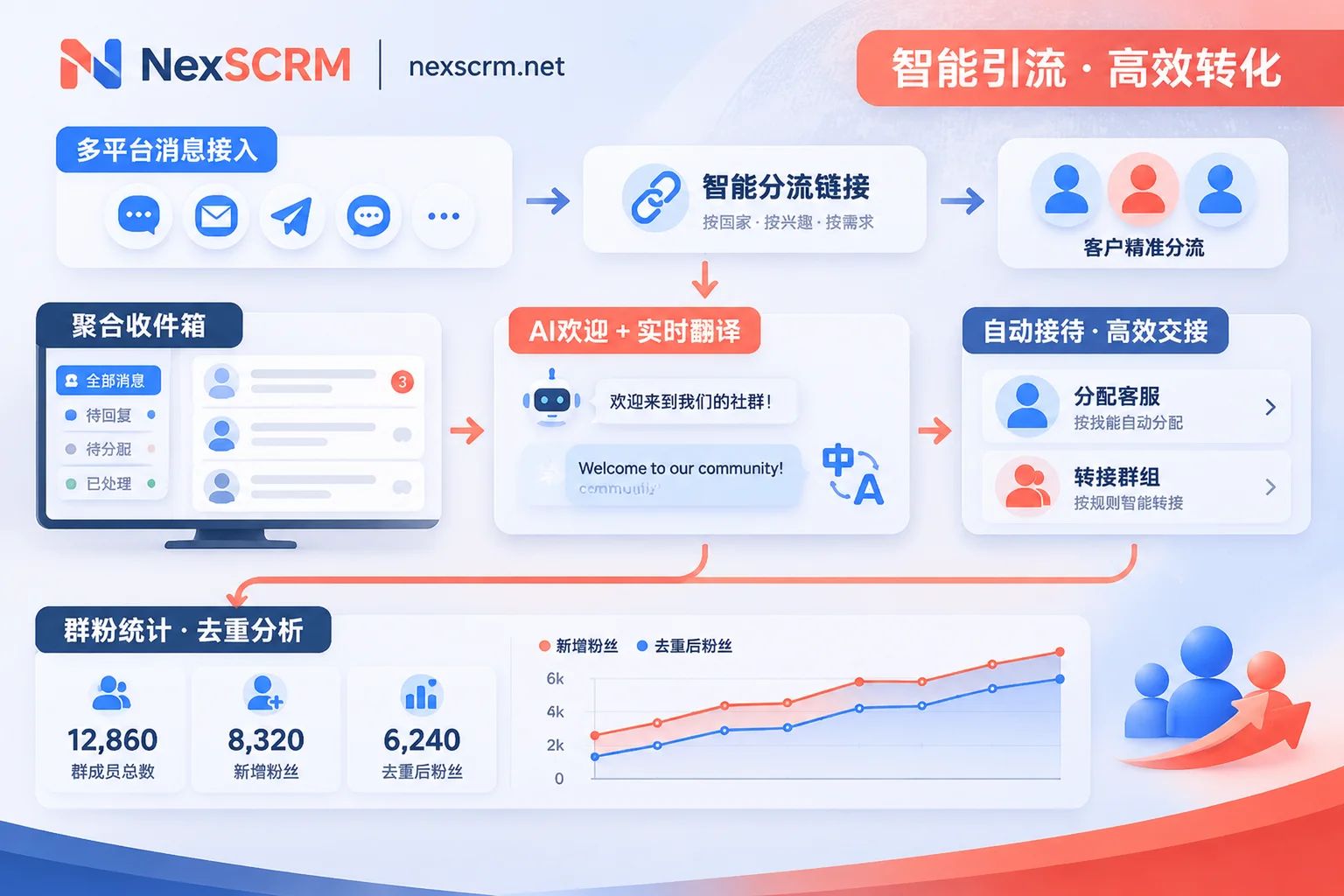
- Split links for precise reception by source: Configure dedicated split links for different overseas KOCs, influencers, or old-customer referral campaigns. When new fans click the link to enter, the system can automatically assign them to the appropriate dedicated customer service based on source, tags, and history, avoiding mixing traffic from multiple channels.
- Group fan counting and system deduplication: For community referral scenarios, NexSCRM's fan counter (work order counter) not only supports main account fan counting but also specifically supports group fan counting. More importantly, through work order deduplication (supports single or all sub-accounts) and system deduplication, operations managers can one-click remove duplicate fans who repeatedly leave and rejoin groups or add multiple customer service accounts to fraudulently claim gifts. For special offline traffic, manual fan supplementation is also possible, and statistical data can be exported in one click as a basis for reward settlement.
- AI auto-greeting to stabilize first response: Referral campaigns often bring pulse-like fan influx in a short time. After enabling AI scripts and auto-replies, new customers directed to private messages can receive automatic welcome messages or activity rules from AI, combined with keyword auto-replies, ensuring that the first wave of interaction retention is maintained even when customer service is overwhelmed.
IV. Third Breakthrough: Multi-Platform Group and Private Chat Synergy, Safeguarding Community Activity and Risk Control
As the number of communities increases, a mature overseas private domain team often manages dozens of groups and personal accounts across WhatsApp, Telegram, Discord, and other platforms simultaneously. If management cannot keep up, group chats can easily become a disaster area for spamming advertisers, and even internal employees may divert orders.
1. Flexible window splitting and seamless cross-language control
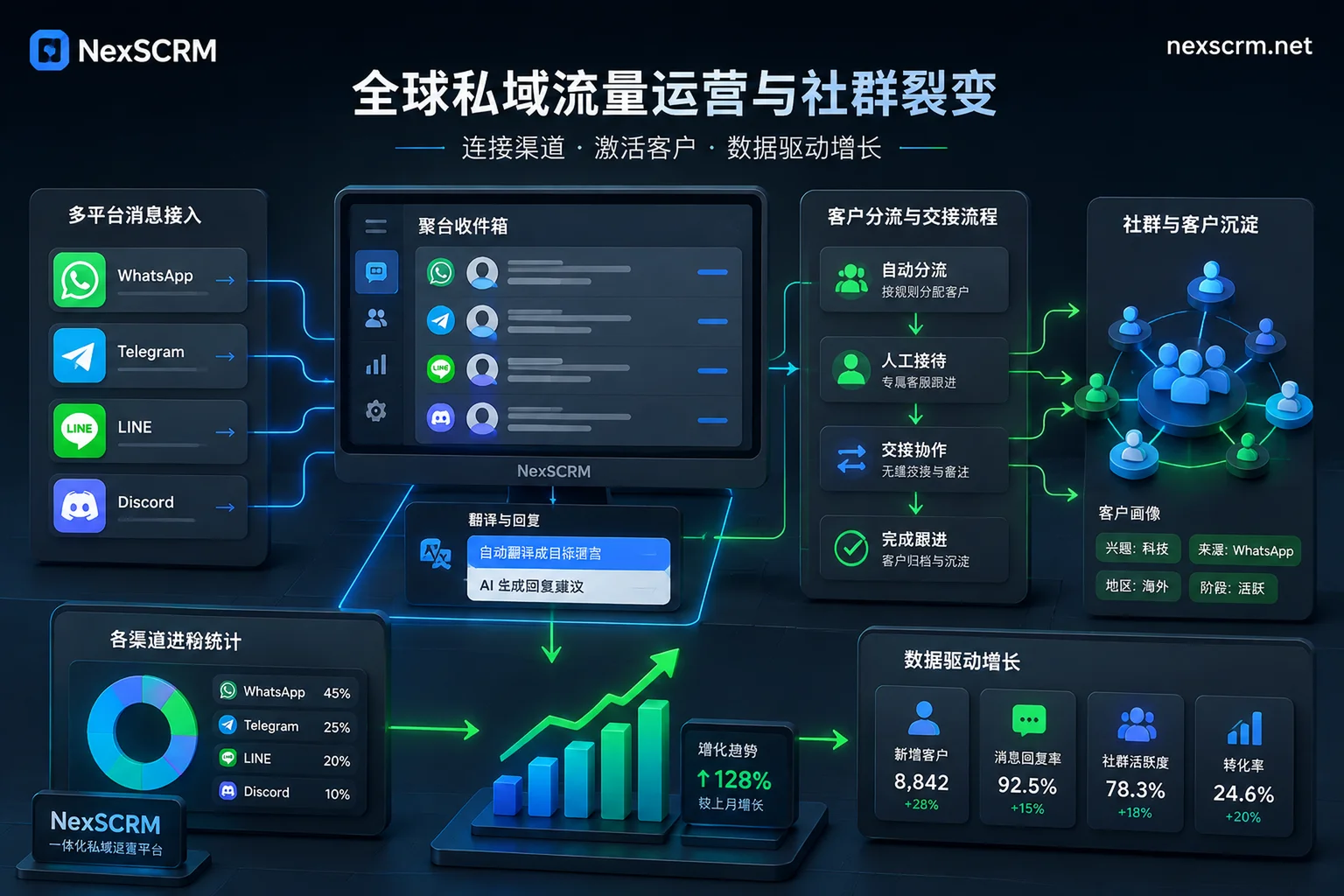
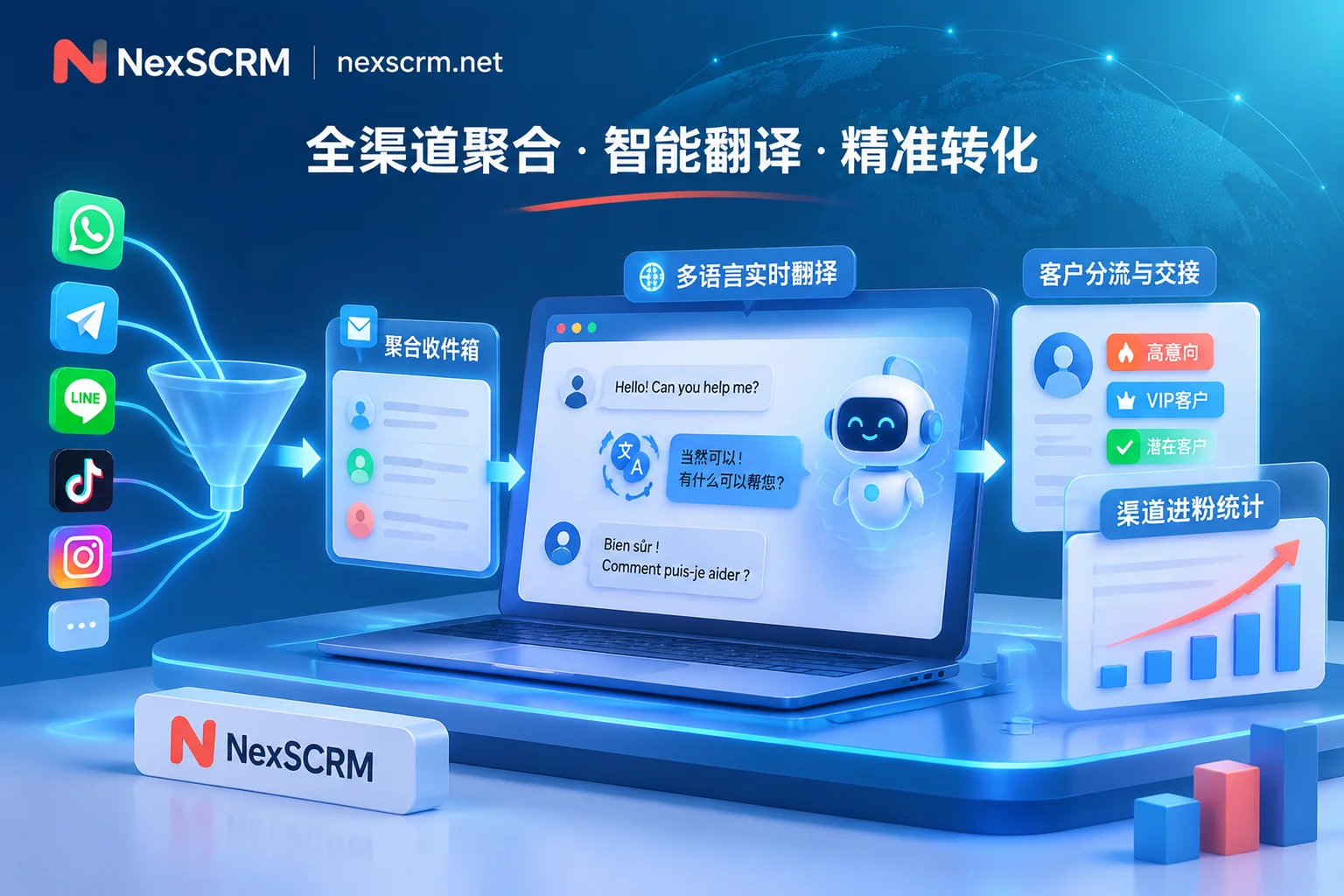
In NexSCRM's multi-account aggregation workbench, customer service does not need to switch back and forth between multiple web pages and apps. For key active groups, you can split the chat window separately and fix it on one side of the screen for real-time monitoring, while merging or hiding low-frequency windows. When group members from different countries discuss in local languages, the built-in two-way translation can automatically recognize the language and keep the original and translated text side by side; when group members send screenshots of product errors or voice questions, you can also quickly understand through image and voice translation functions (available by version), and then combine with AI-generated reply suggestions for efficient control.
2. Prevent competitors from poaching and internal private order loss
Once the community grows, the security of customer resources becomes paramount. On one hand, each account in NexSCRM runs in an independent fingerprint environment and supports binding session-level proxy IPs, with login status automatically saved, reducing the risk of group owner accounts being banned due to frequent cross-location QR code scans; on the other hand, through strict employee internal control and data backup mechanisms, enterprises can enable data masking (hiding customers' real numbers) and real-time monitoring and custom alerts for sensitive words and behaviors (such as privately adding contact info or receiving payments privately) (for more details, refer to the foreign trade anti-order-diversion in-process interception guide).
All group interactions, private chat follow-up records, and the high-value KOC profiles retained are automatically synced to cloud backup. Even if the employee responsible for community operations leaves, these hard-earned overseas private domain assets remain intact with the team.
Conclusion: Turn Private Domain from a 'Reservoir' into a 'Living Spring'
True overseas private domain operations is by no means just building a few groups and sending hard ads, nor letting customer service mechanically handle daily inquiries. It requires an underlying tool that connects 'cross-platform multi-account reception, barrier-free multi-language interaction, precise fan counting, and customer profile retention'.
If you also want to escape the private domain dilemma of 'only adding people, no referrals', why not go to the NexSCRM official website to download the client now. The software adopts a flexible subscription model billed by port (can be upgraded or downgraded at any time, and supports stacking unlimited-time translation character packs). Register now to start a limited-time free trial without binding a credit card, and quickly build a highly sticky, referable overseas private domain growth engine!