 NexScrm官方博客
In the出海 cycle where traffic costs are constantly rising, many cross-border sellers still define their customer service team as a "firefighting squad"—as long as they don't exceed time limits or cause disputes and negative reviews, the task is considered complete. However, the latest overseas consumption trends show that overseas buyers' purchasing decisions are becoming highly rational; over 60% of buyers prioritize fulfillment certainty and after-sales experience over price. A smooth, warm after-sales interaction can boost a buyer's lifetime value (LTV) by more than 25%.
Meanwhile, overseas buyers' touchpoints are increasingly fragmented. They watch reviews on TikTok, place orders on independent sites or platforms, and when they encounter package delays, size issues, or installation problems, they habitually reach out to the brand's WhatsApp, LINE, Instagram, or Messenger private messages to complain.
If cross-border e-commerce customer service remains at the stage of "passively taking complaints and mechanically sending return addresses," it is not only wasting high acquisition costs but also pushing opportunities to convert customers into loyal repeat buyers to competitors. To transform the after-sales cost center into a private domain repurchase center, the customer service team must overcome three major hurdles: response consistency, cross-cultural contextual nuance, and lifecycle touchpoint follow-up.
First Hurdle: Break Multi-Platform Fragmentation and Stabilize Buyer Trust with "Second-Level Consistent Response"
When cross-border sellers adopt a multi-channel layout, the most common pitfall is "each platform fighting its own battle." Industry research shows that customer churn due to inconsistent service standards and delayed responses across platforms is as high as 35%.
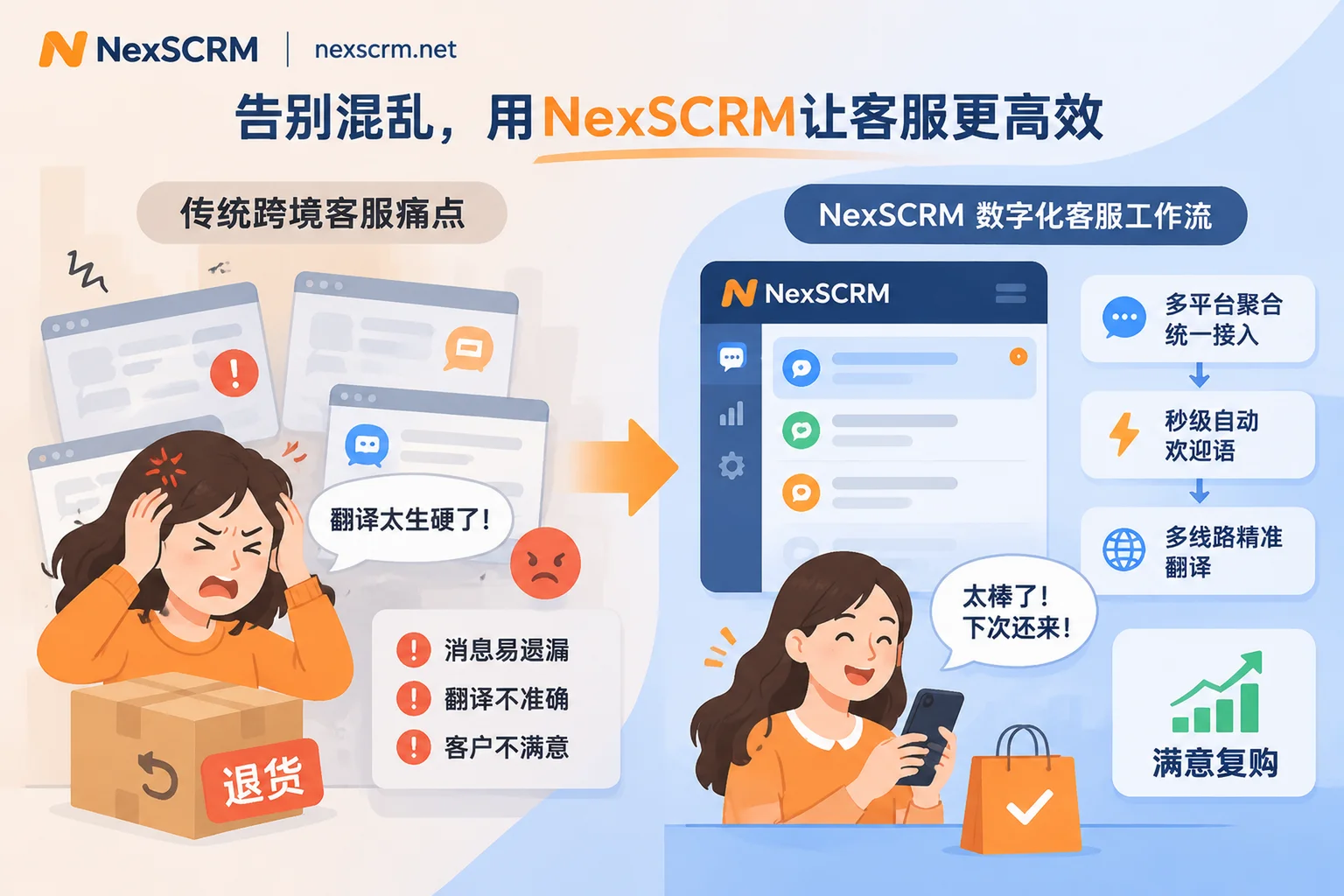
Imagine a real scenario: a buyer receives the goods and finds missing accessories. They first leave a message on Instagram but get no reply, then scan the QR code on the package card to add the WhatsApp after-sales account. If customer service agents have to switch between four or five web backends and mobile devices, missing messages is almost inevitable. The longer the buyer waits, the more anxious they become; a small problem that could have been solved by sending an accessory escalates into a platform dispute or credit card chargeback.
To eliminate this experience gap, the customer service foundation must achieve "unified entry and aligned standards":
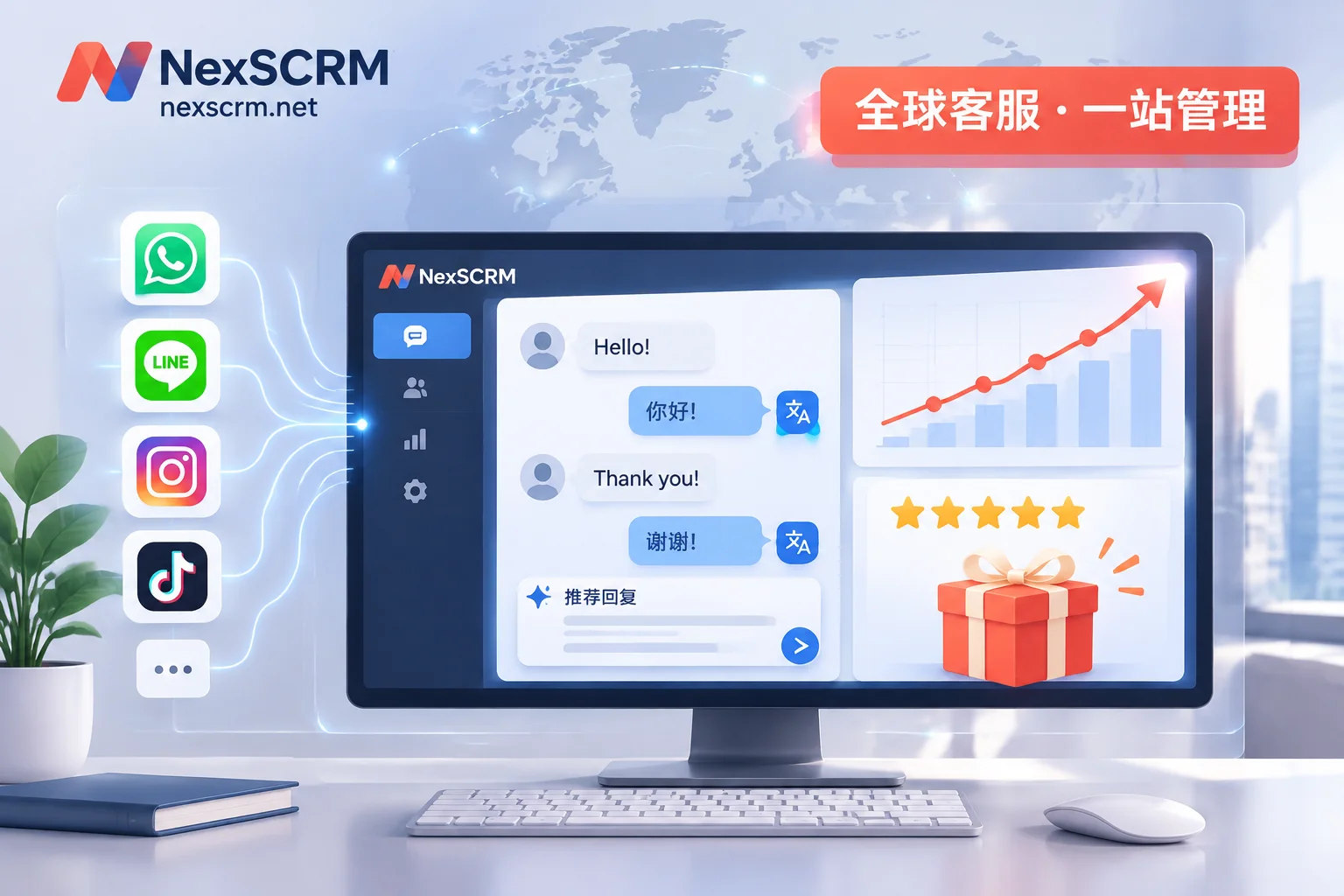
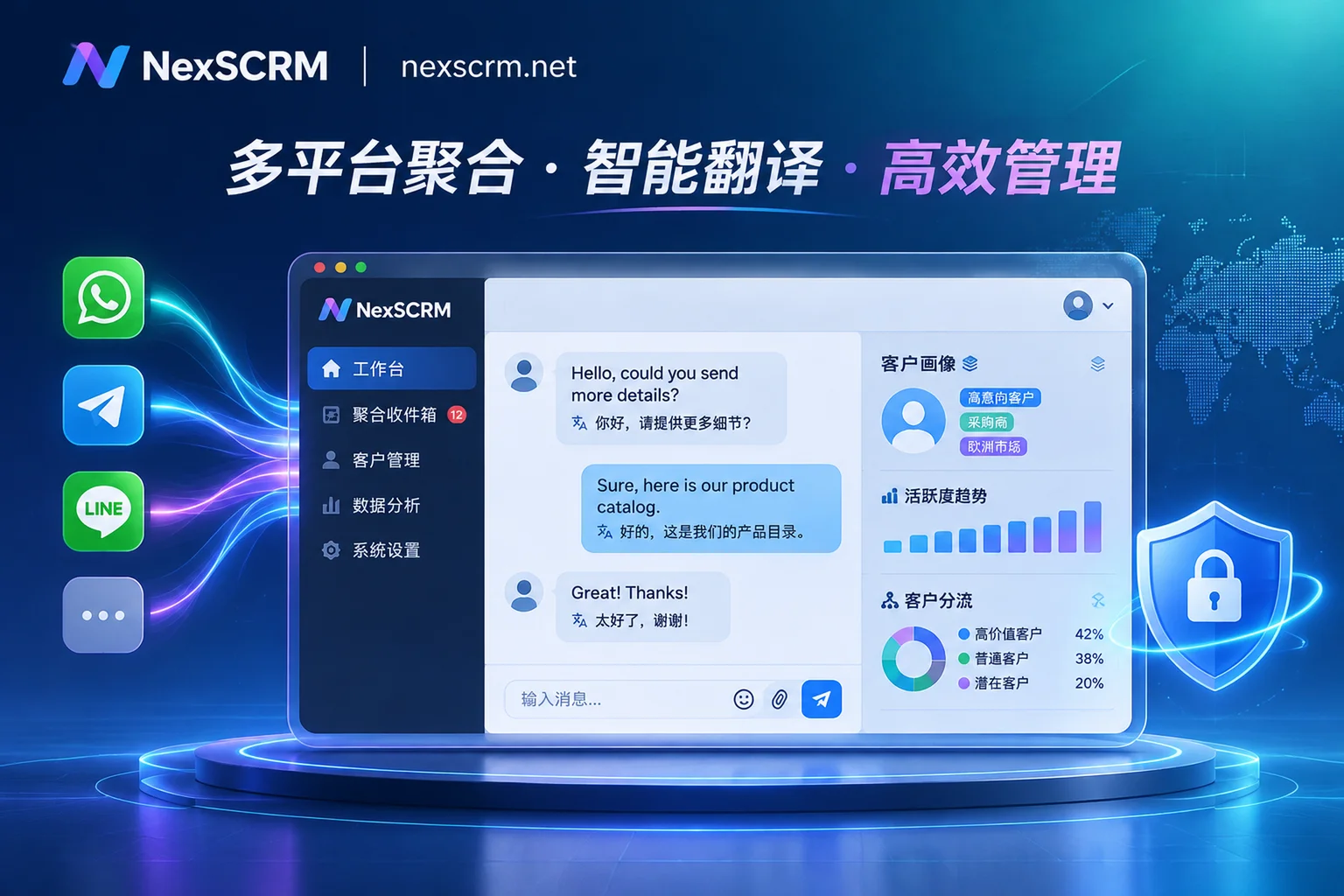
- Consolidate all-channel private message entries: Rather than having agents play hide-and-seek among tabs, use the NexSCRM multi-account aggregation workstation to gather multiple accounts from mainstream overseas social platforms such as WhatsApp (including regular and Business accounts), Telegram, LINE, Zalo, Messenger, Instagram, and TikTok into one desktop client. Unread messages from all channels are unified in alerts; chat windows can be split, merged, or hidden as needed; login status is automatically saved, so you don't need to scan QR codes repeatedly after restarting the software. For underlying differences among tools, refer to our article "How to Choose a Social Media Aggregated Customer Service System? Avoid the 'Pseudo-Aggregation' Trap: 4 Practical Details Cross-Border Teams Must Check."
- Independent environment ensures stability of after-sales accounts: After-sales accounts often accumulate hundreds or thousands of real paying buyers. If an account is banned due to environment association from switching multiple accounts, the repurchase assets are instantly wiped out. Configure an independent fingerprint environment for each account within the workstation and bind session-level proxy IPs to fundamentally isolate login risks.
- Cover first response at night and peak hours: There is a natural time difference between Europe/America and China, and nighttime is the peak for overseas buyers to unpack and request after-sales. Use keyword auto-replies and welcome messages for first-time inquirers to automatically pop up soothing scripts and guide buyers to take photos of the product or provide order numbers when they send high-frequency words like "Damaged," "Size," or "Track," using certainty to calm their anxiety.
Second Hurdle: Bridge the "Consumption Context" Gap with "AI Scripts + Multi-Engine Translation" to Defuse Customer Complaints
In after-sales communication, there is a huge cross-cultural context gap between "understanding the literal meaning" and "properly solving the problem." This is why many sellers still have high complaint escalation rates despite using translation plugins.
For example, when a European or American buyer asks "Is this true to size?" before trying on, on the surface they are asking about size accuracy, but actually they are worried about the hassle of returns and exchanges and need specific wearing advice based on local body types. German buyers tend to be direct when expressing demands, which often sounds blunt literally; if customer service is misled by machine translation and replies defensively, it can lead to disaster. When facing Japanese LINE buyers, using the wrong level of honorifics in an apology can directly cause a brand PR crisis.
Given the high cost of building an in-house native-speaking team for all languages (for team model comparisons, see "Should You Hire In-House Minor Language Staff, Outsource Customer Service, or Use a Multilingual Customer Service System? Cross-Border Teams Should Do These Three Calculations Before Deciding"), cross-border e-commerce customer service needs a collaborative tool that balances "authentic expression" and "controlled messaging":
- Multi-engine translation precisely captures language nuances: With the built-in multilingual real-time two-way translation, messages are automatically displayed with original and translated text side by side without copy-paste. For routine logistics inquiries, Google or Microsoft engines can handle quickly; when facing emotional after-sales complaints or buyers from Japan, Korea, or Europe who require high honorifics, agents can switch to DeepL or AI large model translation engines with one click, or even lock the target language for individual contacts. For buyers who prefer to send voice complaints or photos of damaged packages, the system also supports image and voice message translation (available by version), allowing agents to grasp the core issue immediately.
- Human-machine collaboration outputs high-EQ replies: When facing tough return/exchange negotiations, novice agents often don't know how to gracefully reject unreasonable requests or how to propose retention offers like "keep the item for a partial discount/gift card." By enabling AI scripts and auto-replies, AI generates appropriate reply suggestions in real time based on the buyer's current issue and historical conversation context, which human agents review and send with one click. This "AI drafting + human review" mechanism avoids compliance risks of pure AI reception talking nonsense, while enabling ordinary domestic agents to communicate at a level close to native-speaking customer service (for practical details, see "How Can Cross-Border Teams Make Good Use of AI Customer Service Assistants? Avoid the 'Fully Automatic Hallucination' Trap and Build a High-Conversion Human-Machine Collaboration Loop").
- Align standards with public script and material libraries: Store validated high-conversion retention scripts and return/exchange process explanations in public quick reply templates (supporting variable replacement and keyword triggers), and unify product installation videos and size charts in the media material library. Regardless of which shift's agent takes over, the policies and visual explanations sent remain highly consistent.
Third Hurdle: Seize Two Golden Touchpoints to Turn One-Time After-Sales into Long-Term Repurchases
Solving after-sales problems only brings customer satisfaction back to a passing level; what truly brings net profit increments to the store is completing private domain profiling and secondary marketing while the service warmth remains.
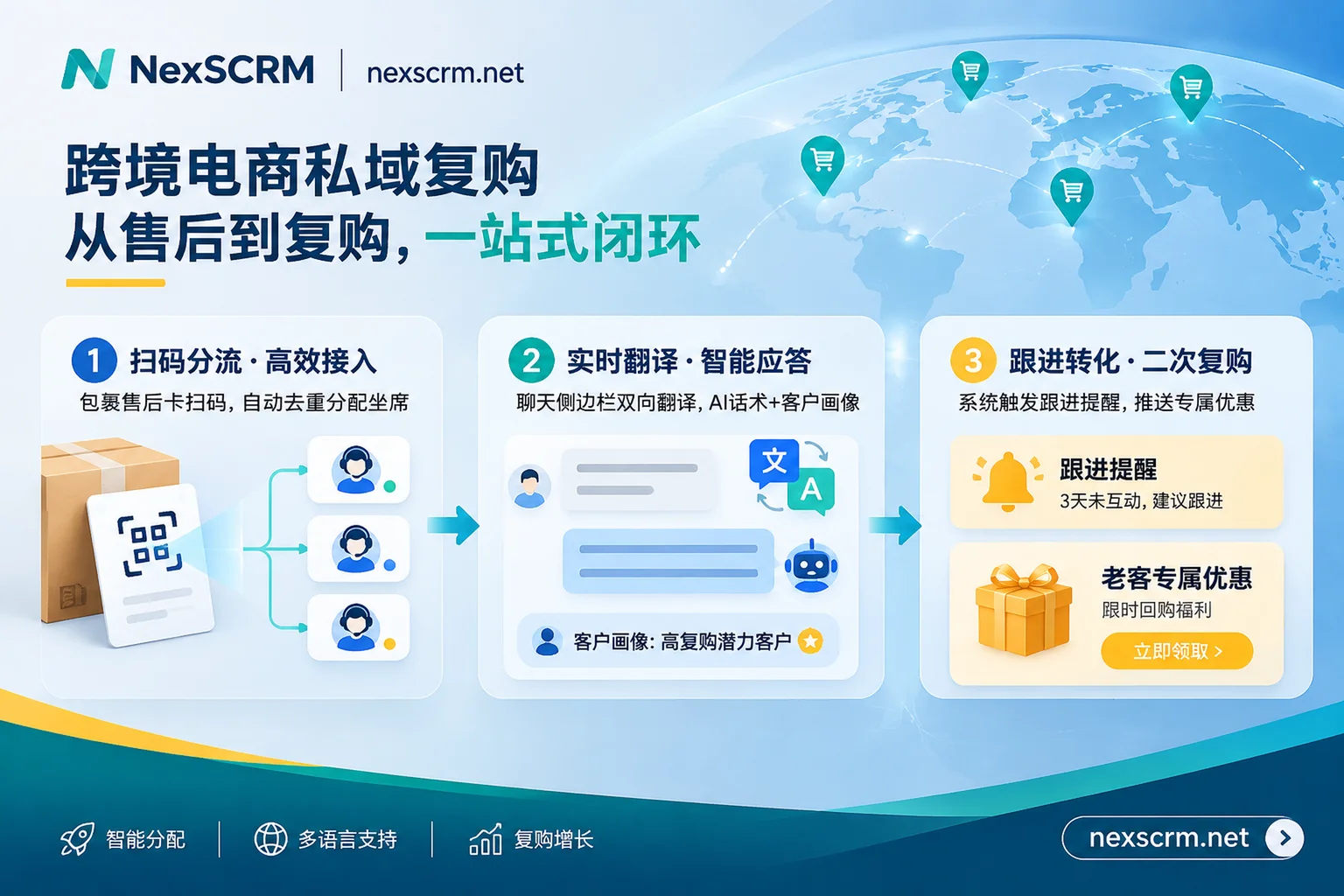
According to实战 data from cross-border private domain operations, there are two golden windows with extremely high conversion in the buyer lifecycle: within 24 hours after delivery confirmation (pushing usage guides and maintenance pairing suggestions, with conversion rates of 8%–12%), and the repurchase window after first purchase based on category consumption cycles. To reliably catch these two touchpoints, customer service cannot rely on memory; it must rely on systematic customer operations and follow-up features:
1. Smart Routing Lets Regular Customers Find Their "Dedicated Advisor"
When a buyer adds via the diversion link on the package after-sales card, the system can automatically assign them to the appropriate agent based on source channel, tags, and history, and perform contact deduplication. If the buyer had previously consulted about pre-sales questions, the original agent takes over directly, so the buyer doesn't have to repeat the entire order history.
2. Build Profiles While Chatting, Accumulate Three-Dimensional Customer Personas
While resolving installation questions or size exchanges, agents can casually tag buyers with multi-dimensional labels in the chat sidebar (e.g., 尺码偏大已换L码, 家有大型犬, 偏好露营配件, 高意向复购), recording source channel and interaction history. Combined with conversation grouping, manage "pending complaints," "resolved awaiting follow-up," and "VIP high-value regulars" in separate categories.
3. Follow-Up Reminders Hit the Repurchase Wake-Up Rhythm
After-sales completion does not mean the conversation ends. After handling exchanges or answering questions, agents can directly set a follow-up reminder for 7 or 30 days later in the workstation. When the time comes, the system automatically reminds the agent to proactively greet: "Is the replacement accessory working well? By the way, this weekend we have an exclusive private discount on matching consumables for old customers..." This caring outreach based on real service records feels completely free of hard-sell stiffness, and repurchase conversion naturally follows.
Fourth Hurdle: Calculate Acquisition Costs, Manage Compliance, and Protect the Private Domain Assets Accumulated by the Team
When a cross-border e-commerce customer service team starts handling large volumes of after-sales diversion and private domain repurchase tasks, team leaders often face the final management question: Who do the incoming fans belong to? If an agent leaves or has ulterior motives, will they take all the old customers with them?
In the refined operations stage, the customer service backend must have transparent data accounting and strict internal control guardrails. Through the fan counter and employee internal control system, managers can tighten the fence from three dimensions:
- Accurately calculate the fan acquisition rate of each after-sales card: Whether it's diversion links on different batches of package cards or social media homepage traffic, the built-in fan counter supports diversion link statistics, main account and group fan counts, and features such as ticket deduplication for individual or all sub-accounts, system duplicate checking, and fan supplementary recording. Statistics can be exported at any time, making the traffic effect of each after-sales channel traceable.
- Data dashboard provides insight into agent service quality: The management dashboard visually displays each agent's conversation volume, fan acquisition, response time, and performance. All chat records and media files are automatically synced and backed up to the cloud, searchable and reviewable by time, contact, or keyword, completely eliminating the management blind spot of "agents deleting records leaving no evidence."
- Strict internal control prevents private deals and asset loss: To address risks of私下 refunds or order diversion in after-sales scenarios, the system provides customer contact data desensitization, sensitive word and behavior monitoring (e.g., privately adding personal accounts, private collections), payment control, operation log auditing, and custom alerts. More importantly, all chat records, customer profiles, and follow-up records are stored on the enterprise side. Even if agents leave, the accumulated overseas old customer assets remain intact within the team (for more defense details, see "How to Prevent Order Diversion in Foreign Trade? Manage These Four Defense Lines: Account Ownership, Number Desensitization, and Departure Handover").
Conclusion: Use a Handy Workstation to Turn Your Customer Service Team into a Profit Center
In the second half of cross-border e-commerce competition, it's no longer about who can write more exaggerated ad copy, but who can retain and serve every overseas buyer acquired at great cost. While your peers are still struggling with missed messages across platforms and negative reviews caused by rigid machine translation, cross-border e-commerce customer service teams that have armed themselves with digital tools are quietly building a high-repurchase brand moat through every patient after-sales answer.
If you also want to help your team say goodbye to multi-webpage switching and inefficient machine translation, and manage after-sales and inquiries scattered across WhatsApp, LINE, Instagram, TikTok, and other platforms as one cohesive whole, you can now visit the NexSCRM official download page to get the client (limited-time free trial, no credit card required), or go to the Pricing and Plans page to view detailed configurations for flexible port-based subscriptions, and build your team's overseas private domain conversion loop with your own hands.