 NexScrm官方博客
When an overseas business expands from the single English-speaking Europe and America region to Latin America (Spanish, Portuguese), Southeast Asia (Thai, Vietnamese, Indonesian), Japan, South Korea, and the Middle East, team leaders often hit a realistic wall: ads are running, and hundreds of inquiries in different languages flood in daily on WhatsApp, LINE, Zalo, and Telegram, but the team only has operations and sales staff who know basic English.
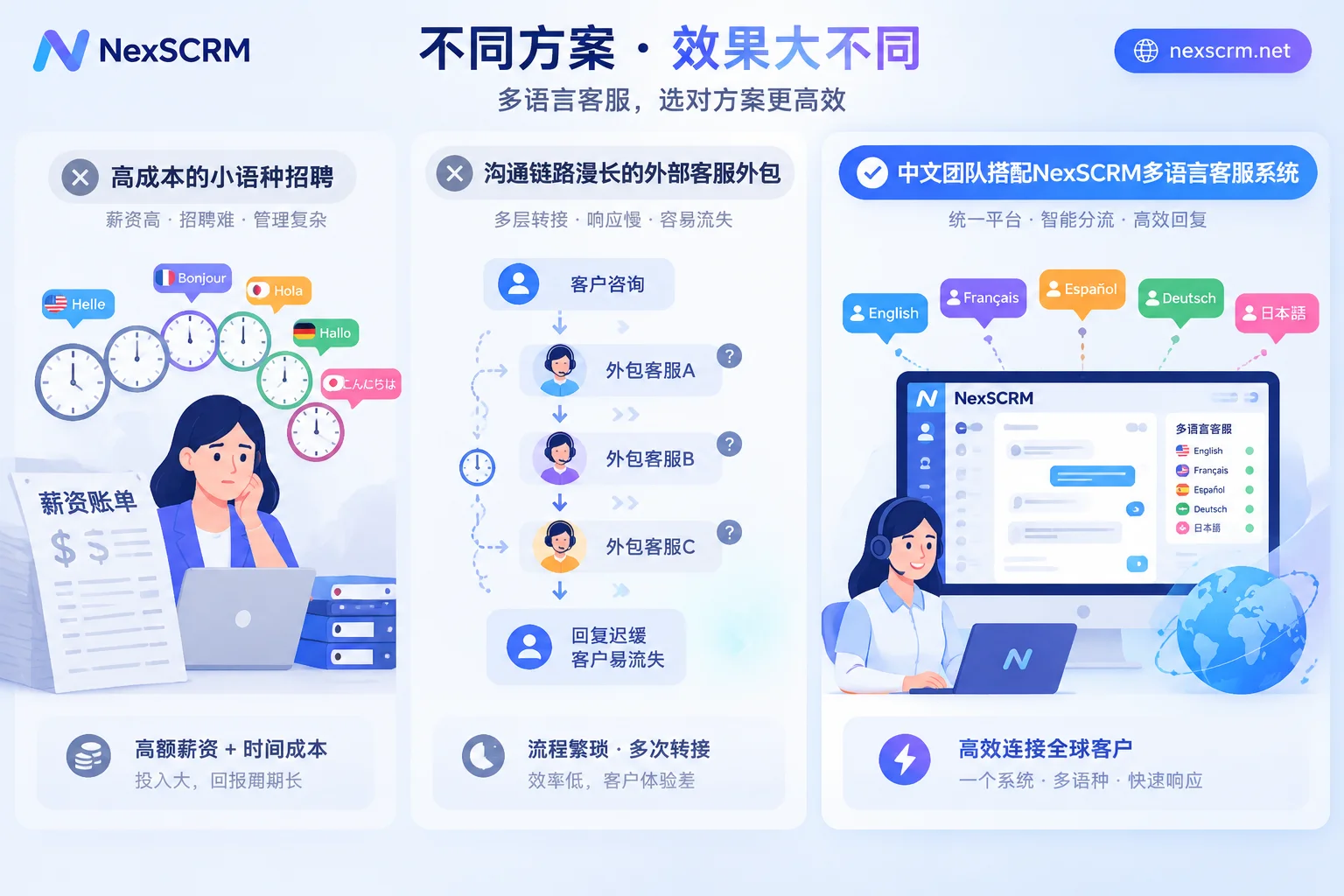
Facing the multilingual reception gap, the mainstream solutions on the market are nothing more than three paths: hiring multilingual specialists at high salaries, purchasing cross-border customer service outsourcing services, or equipping the existing Chinese team with a multilingual customer service system.
Industry research and selection analysis generally point out that the penetration rate of large models and real-time translation technology in cross-border customer service scenarios has exceeded 70%; at the same time, the customer service outsourcing market is also subdividing into local native-language outsourcing, domestic overseas agents, and "AI + human" hybrid models. There are more choices on paper, but many teams find after a round of trial and error: money is spent, but inquiry response speed or conversion rate has not improved.
To make a decision that fits the business stage, you cannot just look at the monthly agent quote or software subscription fee; you must calculate labor and management costs, multi-channel handling efficiency, business professionalism transmission, and customer asset security together.
First Account: Where Are the Hidden Costs of Hiring Multilingual Staff or Finding Customer Service Outsourcing?
Many teams, when facing a surge of multilingual inquiries, first think of "finding someone who knows the language to chat." But in the scenario of social media private domain transactions (not simple standard e-commerce after-sales), relying purely on "stacking native-language manpower" often encounters three bottlenecks.
1. In-House Multilingual Customer Service: High Salary and Difficult to Cover Multiple Time Zones and Languages
Recruiting a composite talent in China who is proficient in Spanish, Japanese, or Arabic and also understands foreign trade order tracking or private domain closing techniques has a salary threshold far higher than that of ordinary English customer service. If the business is testing markets in 3 to 5 countries simultaneously, with two shift workers per language, fixed labor expenses alone can eat up most of the profit. More troublesome is that once a multilingual product line is adjusted, the transfer and placement of dedicated language staff becomes a heavy burden for the team.
2. Cross-Border Customer Service Outsourcing: Knows the Language, But Not Necessarily Your Product and Closing Rhythm
To reduce fixed labor costs, some companies consider overseas native customer service outsourcing. The advantage of outsourcing teams is authentic native expression and coverage of local time zones, but in social media private chat scenarios that highly depend on interaction depth, the disadvantages are equally obvious:
- Business understanding gap: Non-standard questions such as foreign trade customization parameters, wholesale tiered pricing, and special shipping channel descriptions are difficult for outsourced agents to answer fluently like internal senior sales; complex inquiries still need to be packaged and transferred back to the domestic team, and the communication chain is actually lengthened.
- Account and environment handover risks: Overseas customers are accustomed to chatting directly on social apps like WhatsApp, LINE, Zalo, and Telegram. Handing over social media accounts that have accumulated old customers to an external team for remote login not only risks triggering platform risk control due to frequent device changes (for further reading: WhatsApp account bans tightening, losing customers? Use WhatsApp SCRM to stabilize the environment, back up chats, and close the reception loop), but also makes it extremely difficult to align chat data ownership and compliance control.
3. The Breakthrough Logic of "Experienced Chinese Staff + Multilingual Customer Service System"
Rather than letting new hires who know foreign languages learn products and sales skills from scratch, it is better to use tools to bridge the language barrier and let the domestic sales staff who best understand the business, products, and have the strongest conversion ability directly serve global customers. This is also the fundamental reason why more and more cross-border private domain teams are shifting their focus to professional multilingual customer service systems.
| Evaluation Dimension | In-House Multilingual Specialist | Cross-Border Customer Service Outsourcing | Chinese Team + NexSCRM Multilingual Customer Service System |
|---|---|---|---|
| Fixed Labor Cost | Very high (base salary and commission stacked by language) | Medium-high (billed by agent/ticket, premium during peak seasons) | Low (reuse existing Chinese sales/customer service team) |
| New Market Response Speed | Slow (recruitment + training cycle usually 1-2 months) | Medium (requires scheduling and SOP training) | Instant (switch translation language to handle new markets) |
| Product and Closing Professionalism | High (long-term internal training) | Weak (only suitable for standard FAQ and basic after-sales) | High (internal experienced staff directly manage conversations) |
| Multi-Social Account Security | Good (internal network controllable) | Higher risk (external remote login difficult to control) | High (independent fingerprint environment + session-level proxy IP binding) |
| Customer Asset Retention | Retained internally (need to prevent personal deletion) | Loss during external handover | Automatic cloud backup, profiles and records belong to the enterprise |
Second Account: What Should a Qualified Multilingual Customer Service System Look Like for Overseas Social Media Private Domains?
There are many products on the market labeled "multilingual customer service system," but many traditional ticket systems are designed for web pop-ups (LiveChat) and email (Email) (for the difference between traditional systems and social media tools, please refer to: What is the difference between traditional CRM and cross-border social media SCRM? First look at where customer communication happens, then choose based on seven questions).
If your customers are mainly on overseas social platforms such as WhatsApp, Telegram, LINE, Zalo, Instagram, Messenger, TikTok, etc., you must focus on the practical performance of the following four core modules when selecting.
1. Built-in Multi-Line Real-Time Two-Way Translation, Say Goodbye to Plugin Lag and Context Deviation
Many junior teams try to cope with multilingual chats using "web version social media + browser translation plugin," but often encounter plugin failures, layout confusion, or translations of colloquialisms with industry jargon that are completely off.
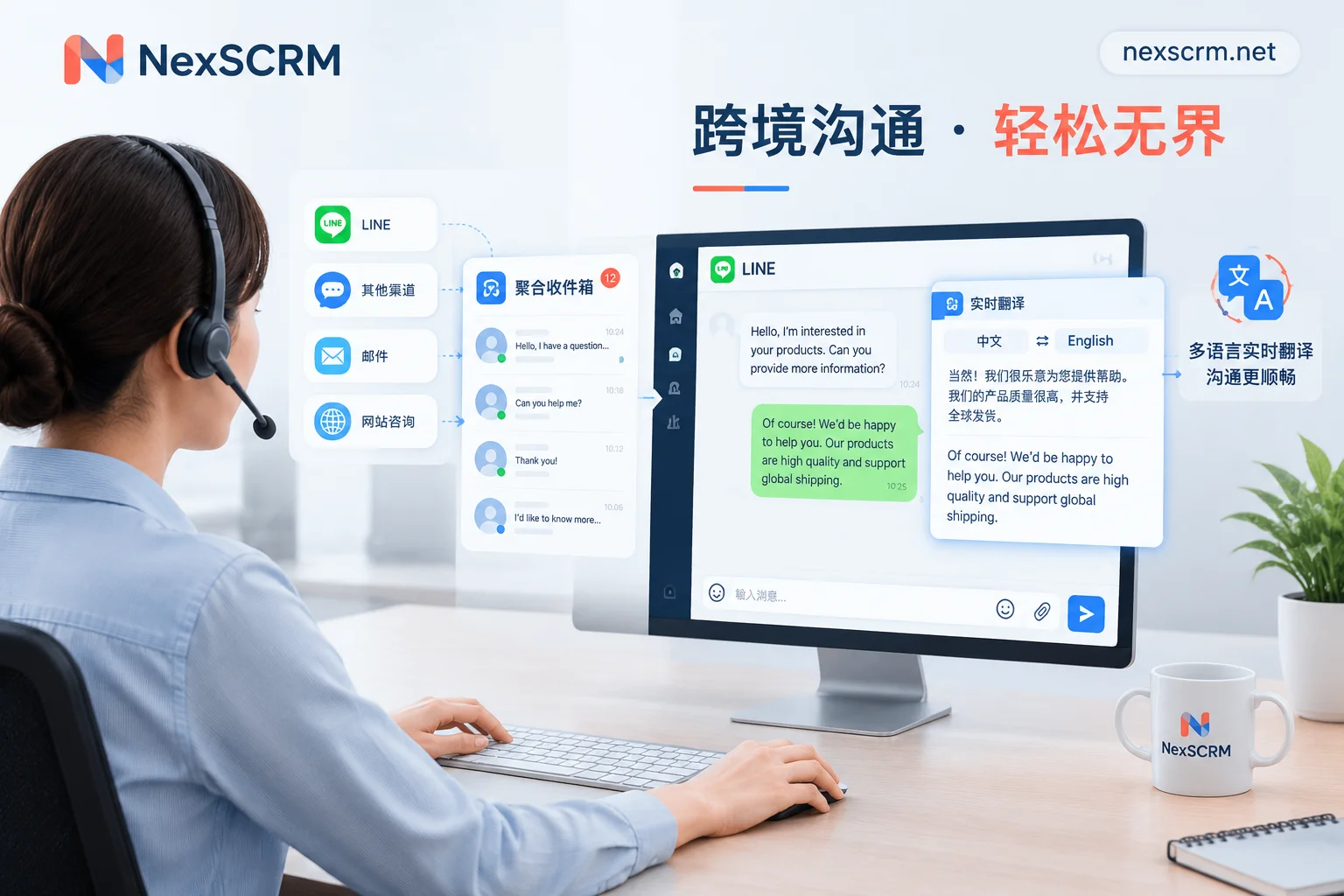
In the multilingual real-time translation module of NexSCRM, translation capabilities are built directly into the desktop client's底层, without any external browser plugin:
- Automatic language recognition and independent configuration: When a customer sends a message, the system automatically recognizes the other party's language and translates it into Chinese. The interface retains both the original text and the translation, making it easy for customer service to verify key numbers and proper nouns; it also supports locking the target translation language separately for different contacts.
- Free switching between multiple translation lines: Built-in multiple translation channels such as Google, Microsoft, DeepL, and AI large models. When facing long European and American business sentences or Southeast Asian toneless spoken language, customer service can switch to a more accurate line at any time based on contextual performance.
- Multimodal message coverage: Not only supports two-way translation of regular text, but also supports translation of image and voice messages (available by version) for Latin American and Southeast Asian buyers who love to send voice messages and product photos, completely eliminating the awkwardness of holding a phone to the screen to take photos for translation.
2. Multi-Platform Multi-Account Aggregated Workbench, Stabilize the Environment and Avoid Missing Orders
Teams doing cross-border lead generation often have more than one platform and more than one account. If a customer service computer's taskbar has a dozen different software windows open simultaneously, missing replies and account mix-ups are almost inevitable.
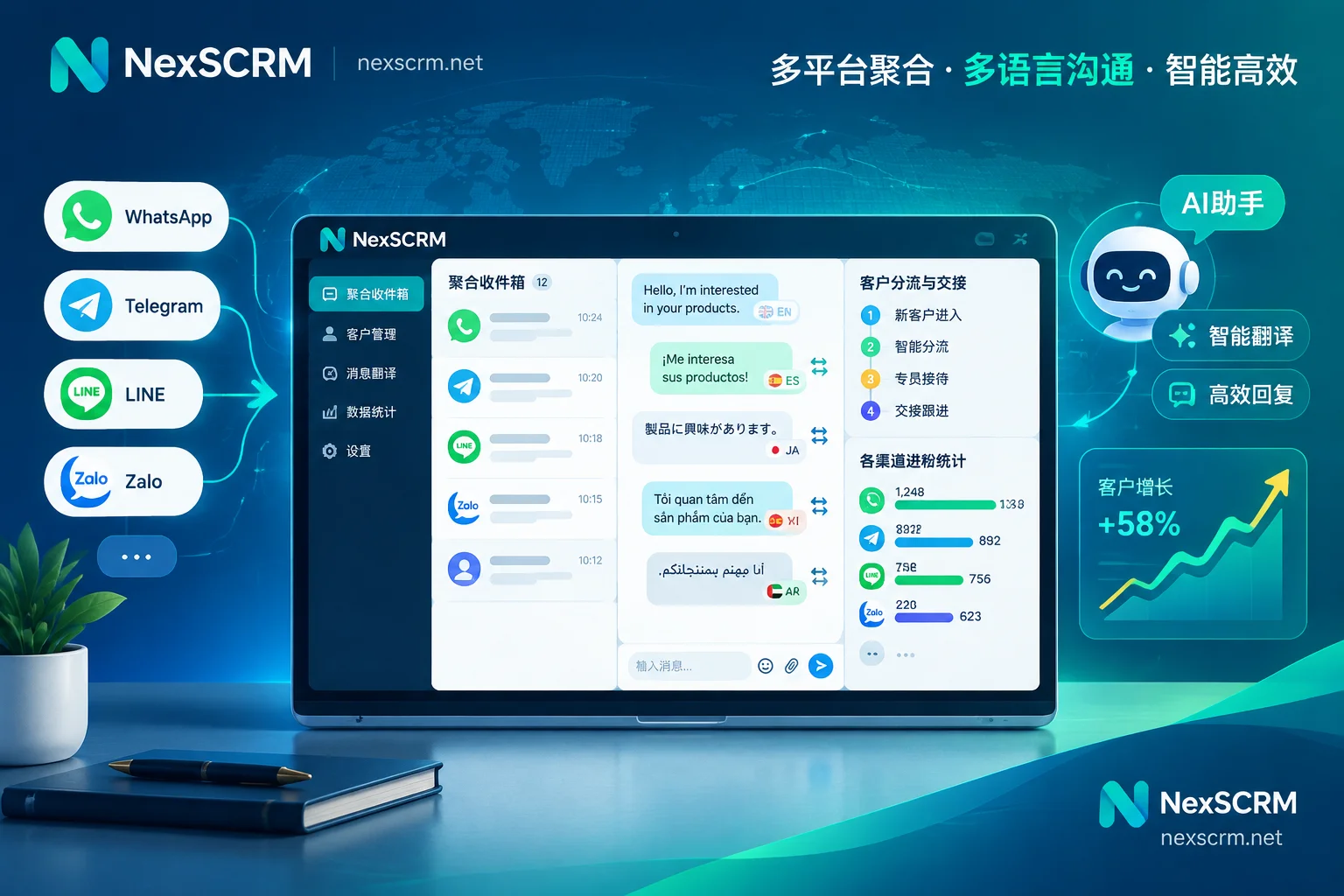
The multi-account aggregation workbench of NexSCRM supports simultaneous access to multiple accounts on mainstream platforms such as WhatsApp (including regular and Business accounts), Telegram, LINE, Zalo, Facebook, Messenger, Instagram, TikTok, X (Twitter), Discord, and Signal within one desktop client:
- Unified reminders and flexible windows: Unread messages from all platforms are centrally reminded, and chat windows can be freely split, merged, or hidden according to customer service operation habits; login status is automatically saved, so there is no need to repeatedly find a phone to scan the code when restarting the software daily.
- Underlying environment isolation: Each social account runs in an independent fingerprint environment and supports binding an independent session-level proxy IP, fundamentally avoiding association risk control caused by multiple accounts logging in together.
- Main and sub-account collaboration: Administrators can uniformly purchase and allocate ports and permissions through the main account; sub-accounts support multi-device login and strictly divide visible ranges by role.
3. AI Script Assistance and Intelligent Reception, Put Human-Machine Collaboration into Practice
Letting robots completely take over social media private chats can easily kill high-intent big customers with stiff answers; but relying entirely on manual typing for every cross-language reply is simply unmanageable during peak times (extended reading: How to implement multilingual automated customer service without hurting customer experience: draw boundaries, use approved scripts, and leave a handover exit).
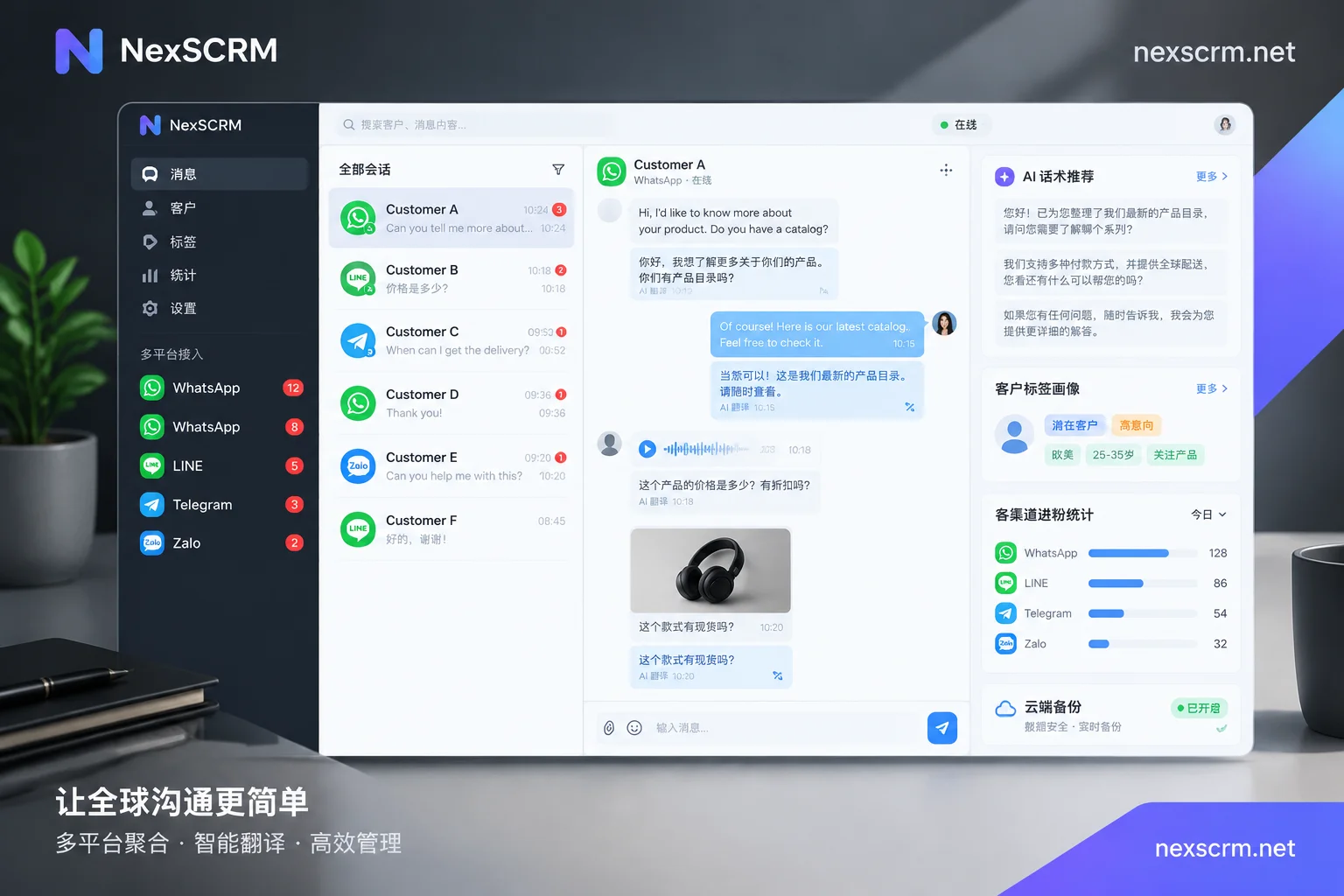
A more reliable "human-machine collaboration" strategy is to let AI be the greeter and strategist, while keeping the final send button in human hands. With NexSCRM's AI scripts and auto-reply and customer operations features:
- Automated first response reception: For new customers coming from ad lead generation, the system can automatically trigger a welcome message or have AI greet them automatically; for common inquiries about logistics, sizes, business hours, etc., keyword auto-replies provide second-level response, stabilizing the first response rate across time zones.
- AI reply suggestions and public script library: In the deep communication stage, AI generates real-time reply suggestions based on the customer's current question and historical conversation context, and customer service can translate and send with one click after verification or minor adjustments. Verified high-conversion AI openers and answers can be directly saved into the enterprise public script library, paired with variable-replacement quick reply templates and media material library, enabling new hires to perform like top sales.
4. Routing Count, Customer Profiles, and Employee Internal Control, Protect Enterprise Digital Assets
A multilingual customer service system should not only manage "communicating smoothly," but also "calculating clearly" and "retaining securely."
On the front-end reception, NexSCRM provides intelligent routing links that automatically assign new incoming customers to the corresponding customer service based on source channel, tags, and historical reception records, and completes cross-sub-account lead counting and ticket deduplication at the moment of entry. Main account leads, group leads, supplementary entries, and routing statistics are clear at a glance, and data can be exported for verification at any time.
On the back-end control, as the customer service team expands, account handover and internal compliance must be prioritized (reference: How to prevent foreign trade order snatching? Control the four defense lines: account ownership, number desensitization, and departure handover):
- Cloud data retention: All chat records, voice and image media files, and customer profiles (tags, notes, source, follow-up records) are automatically synchronized to the enterprise cloud backup, supporting quick search by time, contact, and keywords. Even if front-line customer service leaves, customer relationships and historical context remain fully within the team.
- Comprehensive internal control defense: Supports customer number data desensitization, sensitive word and sensitive behavior monitoring (such as intercepting private addition of personal contact information, private collections, etc.), payment control, and operation log auditing, with immediate alerts when rules are triggered; managers can intuitively grasp the conversation volume, lead count, response time, and customer service performance of each language channel through data dashboards.
Conclusion: Start Flexibly by Port, Test Global Markets with Deterministic Tools
In the wave of multilingual overseas expansion, heavily investing in building native-language teams for multiple countries or blindly signing long-term outsourcing contracts often means high trial-and-error thresholds. In contrast, building a multilingual customer service system with NexSCRM that integrates multi-platform multi-account aggregation, multi-line real-time two-way translation, AI-assisted responses, and enterprise-level risk control backup can quickly equip the existing Chinese team with global reception capabilities.
NexSCRM adopts a flexible subscription model billed by port (i.e., the number of simultaneous online accounts). Teams can upgrade or downgrade ports at any time according to peak season expansion or market testing pace, and use them with unlimited-time translation character packs.
If you are planning to expand into new non-English overseas markets, or are troubled by slow responses to multi-platform, multilingual private messages, you might directly visit the NexSCRM download page to get the Windows client (limited-time free trial, no credit card required), or check the pricing and version plans, and first run a cross-language reception loop with a few of your main social media accounts.


Comments(0)