 NexScrm官方博客
In the past, to prevent order grabbing in foreign trade, owners or sales managers could block most of it by monitoring email CCs and reviewing quotations and PIs (proforma invoices). But in recent years, overseas buyers' communication habits have changed—at trade shows they add WhatsApp, and independent sites and social media ads drive traffic to Telegram, LINE, or Messenger. Inquiries, price negotiations, and payment slips that used to go clearly through email now all go into private chat windows of instant messaging apps.
Once the communication battleground shifts to overseas social media, the traditional "email CC + manual entry in traditional CRM" fails on a large scale. Why do precise inquiries that the company spent real money on ads and exhibitions to get suddenly go silent midway? When a senior salesperson leaves, why do several old customers they managed stop reordering?
In the scenario of social media chatting, to truly do a good job in foreign trade order grabbing prevention, you cannot rely only on rules and regulations and post-hoc accountability via non-compete agreements, nor on confiscating work phones and playing games with employees every day. Instead, you need to embed risk control into the daily chat workflow and hold the following four lines of defense.
I. Why is order grabbing more hidden after foreign trade moves to social private domains?
On platforms like WhatsApp and Telegram, foreign trade order grabbing and private order running usually break out in four management blind spots:
- Accounts bound to personal devices, company cannot see the process: Many teams give salespeople work phones, or simply let salespeople contact customers with their own accounts. As long as the phone is in personal hands, management is completely in the dark about what was discussed, whether chat records were deleted, or whether customers were directed to private accounts.
- Customer real numbers directly exposed: A salesperson only needs to open the customer's profile page to see the full phone number or account ID. Even if the company strictly forbids deleting chat records, the salesperson can use their own private phone to add the number, say "This is my backup account, I can give you a better factory-direct price here," and the customer is quietly diverted.
- Information black box caused by multilingual communication: When dealing with Middle East, Latin America, Southeast Asia, or European minor language markets, if salespeople chat directly in Spanish, Arabic, Russian, or Vietnamese, managers who do not understand the language cannot easily spot hints of "kickbacks," "change payment account," or "order grabbing" even if they review chat records.
- Handover depends entirely on self-discipline: When a salesperson leaves, they hand over the phone, but who the key customers are, what payment terms were promised, and what stage things reached are all in their head. If the salesperson deliberately clears key conversations before leaving, the new person is completely in the dark, and customers are naturally taken away by the former salesperson.
To plug these four loopholes, the core idea is only one: take control of accounts, numbers, conversations, and customer profiles from "personal devices" back to the "enterprise workbench."
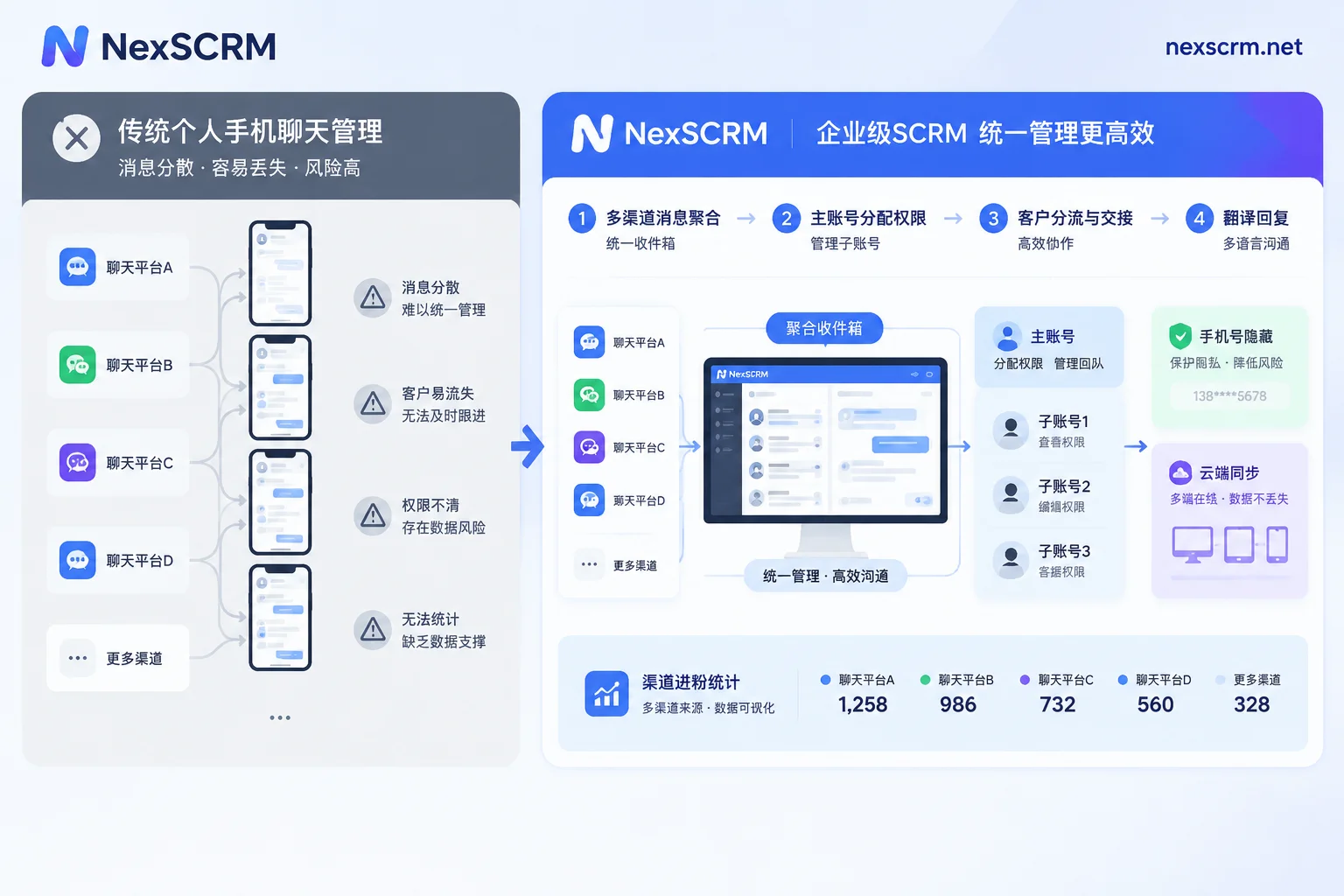
II. First Line of Defense: Take Back Account Control, Isolate Primary and Sub-accounts by Permission
The first step in preventing order grabbing is to prevent salespeople from directly accessing the underlying login permissions of social accounts.
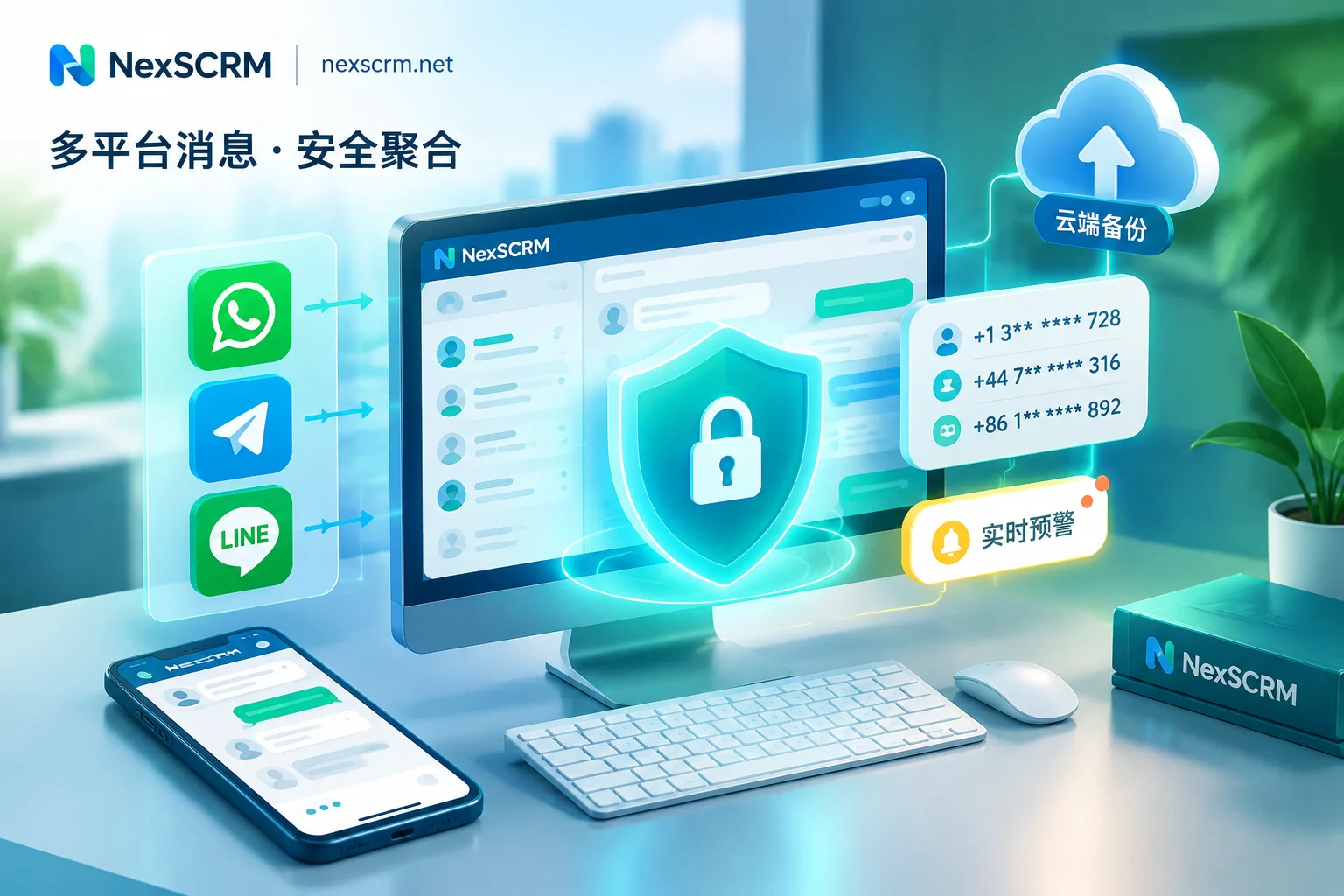
In NexSCRM's multi-account aggregation workbench, enterprises can centrally host all team accounts on WhatsApp (including regular and Business accounts), Telegram, LINE, Zalo, Instagram, etc. Management uses the primary account, and frontline salespeople use sub-accounts, cutting off the possibility of accounts being privately transferred from the source:
- Take over without scanning QR codes, eliminate employees changing passwords privately: Administrators first log in to social accounts in the background and bind independent fingerprint environments and session-level proxy IPs; login status is automatically saved. Salespeople only need to log in to the client with their sub-account password to chat directly every day. They do not need to scan QR codes with a phone, nor can they obtain the verification codes and rebinding permissions of the social accounts themselves.
- Divide visibility by role: The primary account can flexibly allocate ports and permissions (for the configuration logic of ports and seats, see "What does port mean? How many ports does a customer service rep occupy, calculated by the number of accounts online simultaneously"). Group A salespeople can only see the accounts assigned to them or the sessions routed to them, and cannot see Group B's customer resources, preventing internal poaching.
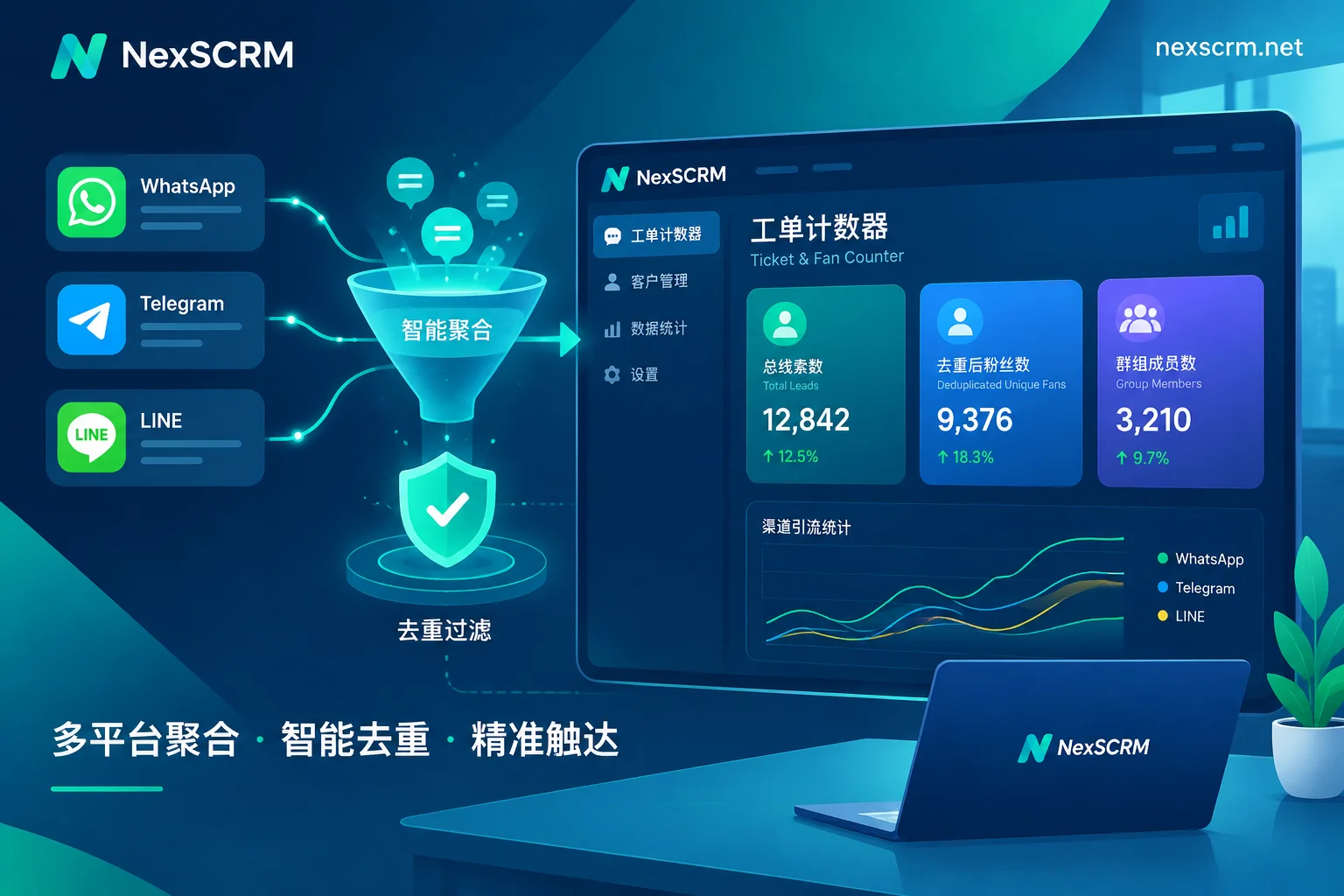
- Lock down lead acquisition and deduplication at the source: New customers from ads or social media are routed into the system via distribution links, and the lead counter automatically counts leads and performs system deduplication. Salespeople can neither hide the real number of incoming leads nor "eat" high-intent inquiries without reporting them.
III. Second Line of Defense: Enable Data Masking, Make Customers "Chattable but Not Takeable"
Once public accounts are managed, how do you prevent salespeople from secretly copying customer WhatsApp numbers or Telegram usernames with private phones?
This requires the data masking mechanism in the employee internal control feature. After enabling number and account masking, the customer phone numbers and social account IDs that frontline sales and customer service see in the workbench interface will automatically have some characters hidden (e.g., displayed as asterisk masks).
- Normal communication unaffected: Salespeople can still send messages, product images, voice messages, tags, and follow-up notes to customers in the workbench; daily conversion actions are completely unobstructed.
- Cut off private connection paths: Because they cannot see the full phone number and original ID, salespeople cannot export customers into a spreadsheet, nor can they take out a private phone to search and add them, physically blocking the path of "public domain leads to private WeChat/private WhatsApp."
IV. Third Line of Defense: Sensitive Behavior and Payment Control, Stop Order Grabbing Before It Happens
Many foreign trade order grabs are discovered only after the customer has paid a deposit to an external account specified by the salesperson, or goods have been shipped from another factory. Post-hoc accountability is often time-consuming and labor-intensive; truly effective risk control must achieve pre-interception and in-process alerts.
In a previous article "Can sensitive behavior monitoring detect private contact addition and private payments? Three types of actions it can catch and four blind spots", we detailed the boundaries of monitoring rules. In daily foreign trade management, three rules are key:
- Real-time alerts for sensitive words and sensitive behaviors: Set up a risk word library in the background (e.g., "personal account," "private number," "WestUnion," "let's chat on another number," "cheaper if you transfer privately," etc., in various languages) and sensitive action monitoring (e.g., sending business cards, sending unregistered links or QR codes). Once triggered, the system immediately generates custom alerts and records them in the operation log audit, allowing supervisors to intervene immediately.
- Payment control: The last mile of a foreign trade deal is sending the PI and payment account. Through the payment control function, enterprises can lock standard payment information or monitor payment-related phrases and image sending, strictly preventing salespeople from substituting the company's USD account with their own personal PayPal, third-party payment accounts, or external affiliated company accounts in the chat window.
- Original and translated text on the same screen, breaking the blind spot of minor language supervision: With the built-in multilingual real-time translation, regardless of whether the salesperson and customer use English, Spanish, Arabic, or Russian, the system automatically translates bidirectionally and retains both the original and translated text. When supervisors inspect chat records in the background, they do not need to understand the minor language; they can directly read the Chinese translation to quickly judge whether the salesperson has quoted low prices randomly, over-promised, or guided private orders.
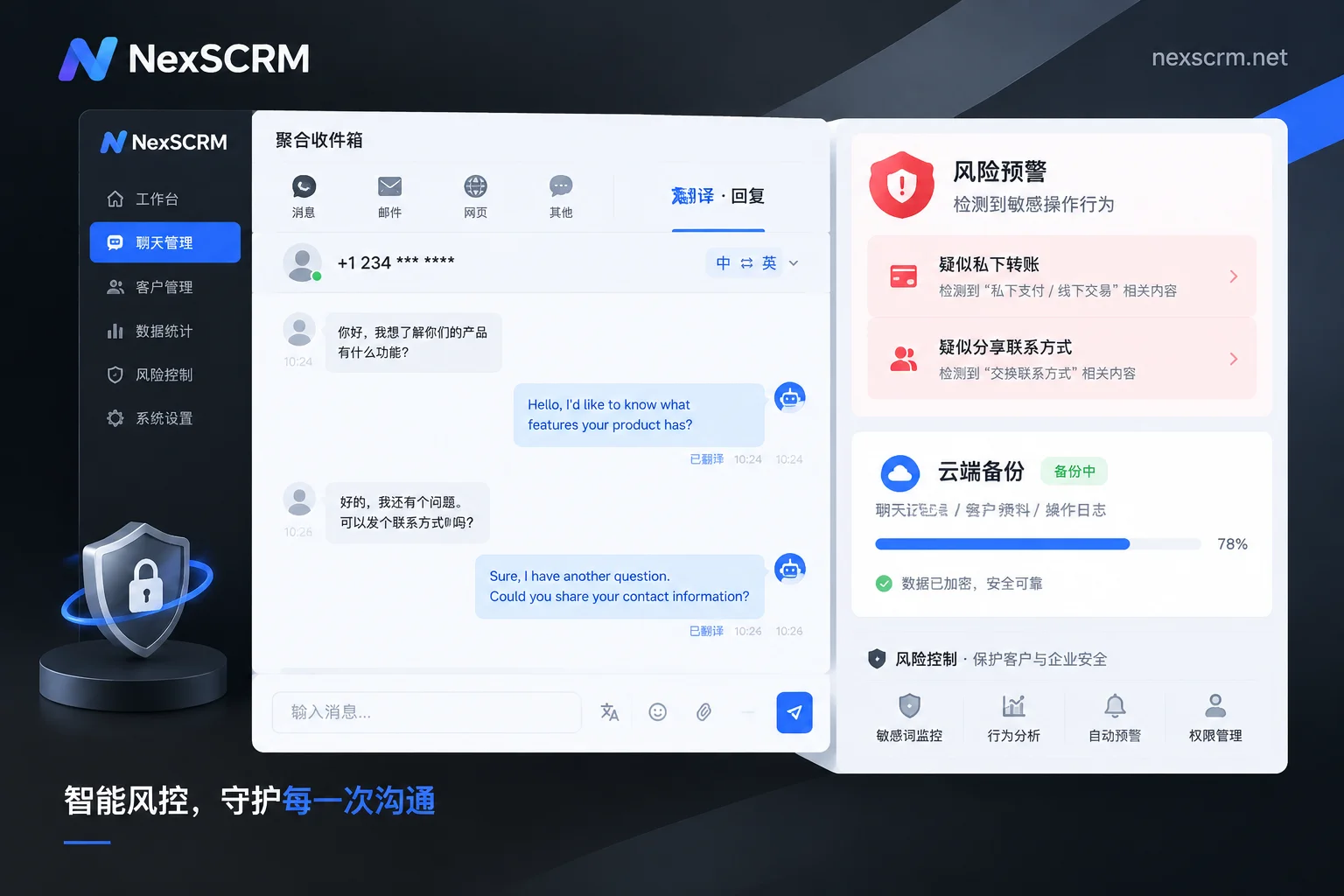
V. Fourth Line of Defense: Cloud Retention of Chat Records, People Leave but Customers Stay
Staff turnover in foreign trade is normal. The bottom line of order grabbing prevention is: the camp remains while soldiers change; salespeople can leave, but customer assets must remain intact in the company.
If you wait until an employee resigns to start handover, it is often too late (for handover standards across the private domain process, see "How to write a cross-border B2B overseas private domain operation SOP: Five-stage process from lead reception to handover internal control"). Under NexSCRM's data backup and customer operation system, handover is actually completed automatically in daily communication:
- Automatic cloud backup of chat records, anti-deletion and anti-tampering: All text, quotation images, voice messages, and media files exchanged between salespeople and customers are synchronized in real time to the enterprise cloud backup. Even if a salesperson tries to clear conversations locally on the client, administrators can still fully retrieve all historical conversations in the background by time, contact, or keyword.
- Customer profiles deposited on the enterprise side: Customer source channels, classification tags, historical notes, follow-up stages, and interaction activity are all stored in the enterprise-side database, not on employees' personal devices.
- One-click permission revocation, seamless replacement: When an employee leaves or changes positions, the administrator only needs to disable or revoke the employee's sub-account permissions in the background, then assign the corresponding social account port to the new salesperson taking over. As soon as the new salesperson logs in, not only are all historical chat records (including translation comparisons) there, but the customer profile and follow-up records in the right sidebar are also clear at a glance, allowing them to immediately continue following up based on the previous quotation and progress, leaving no time gap for the departing employee to "sneak in."
Conclusion: Order Grabbing Prevention Is Not About Guarding Against Employees, but Using the System to Protect Team Interests
Many foreign trade owners worry that implementing a risk control system will make salespeople feel "distrusted." But in fact, salespeople who truly want to build performance need handy translation tools, a stable multi-instance environment, and efficient quick phrases; only those trying to exploit loopholes fear transparent processes.
Use NexSCRM as the unified social media communication workbench for foreign trade teams. Externally, use multilingual real-time translation and AI phrases to help salespeople respond faster and win more orders; internally, use permission isolation, data masking, sensitive behavior monitoring, and cloud backup to protect customer assets. Once the rules run through the system, owners do not need to constantly suspect and check up on staff, and core customers can truly be deposited as the enterprise's own digital assets.


Comments(0)