 NexScrm官方博客
If you answer "where to get the most stable traffic" in one sentence: attract traffic from customer touchpoints you already have and pages you control, and let customers click a link to start the conversation themselves. Official websites, order emails, packaging cards, your own social media profiles, and Telegram official ads all fall into this category. Conversely, searching people by username to send private messages, posting links in others' groups, and bulk-adding people to groups are the most problematic practices.
Below we expand in four steps: why this judgment, where to attract from, which link to use for each entry point, and how to handle customers after they arrive.
First Understand How Telegram Judges Spam
Telegram's anti-spam mechanism mainly relies on user reports. The official Spam FAQ states directly: username search is not a tool for meeting strangers. If you send unwanted ads, private messages, or invite links to someone who hasn't saved your number, and they click "Report spam," your account may be restricted. Once restricted, the account cannot proactively message non-mutual contacts or add them to groups.
There is another key sentence in the same document: even if an account is restricted, it can still reply to people who message it first.
Therefore, "stability" can be defined by two criteria:
- The conversation is initiated by the customer; you only reply;
- The people who come are already interested in you and are unlikely to report you.
Only channels that satisfy both criteria are worth long-term investment.
Four Types of Entry Points, Ranked by Stability
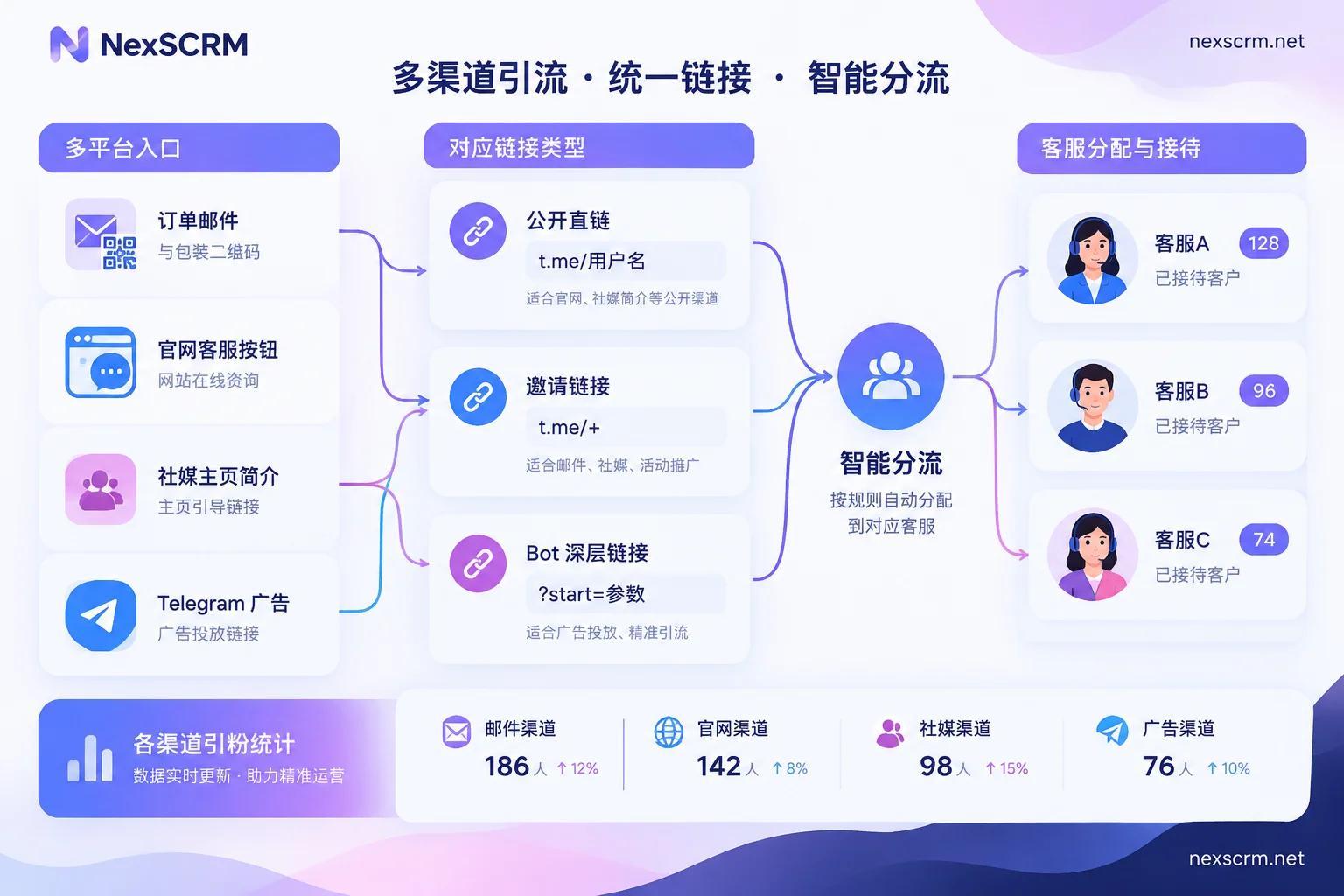
1. Existing Transaction Touchpoints: Highest Intent, Lowest Risk
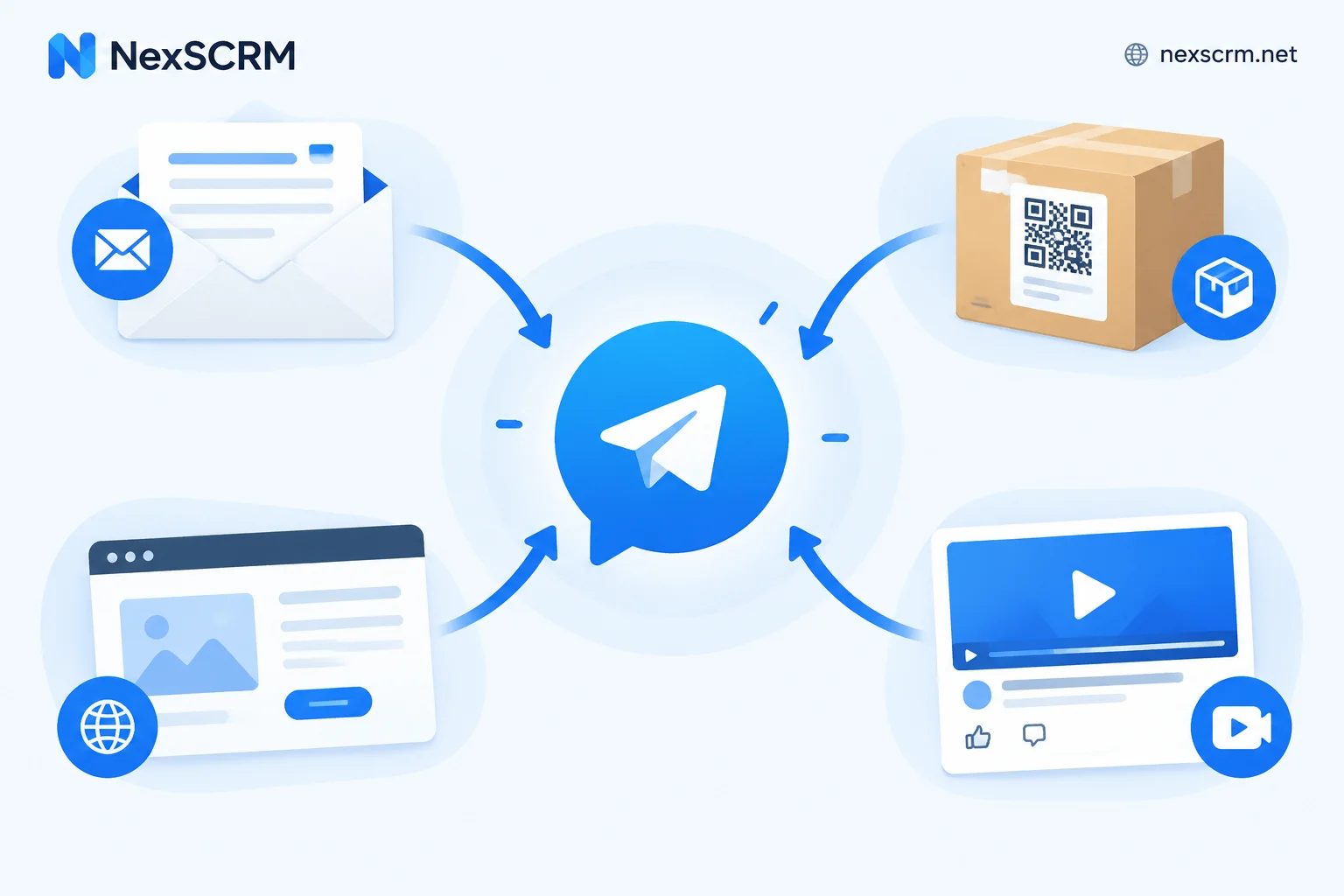
These people have already had transactions or inquiries with you. Put the Telegram entry point where they will naturally see it:
- Signatures in development letters and daily correspondence emails;
- Order confirmation and shipping notification emails;
- QR codes on packing slips or after-sales warranty cards in packages.
This type suits teams that already have stable shipments and want to move after-sales and repeat purchases to Telegram. Write clearly next to the QR code what scanning can do, such as checking logistics, applying for after-sales, or getting restock quotes. This makes people more likely to click than just placing a code.
2. Official Website and Landing Pages: Capture Proactive Inquiries
Place a Telegram customer service button or floating window on your independent site's product pages or contact page. When customers click, they are in a chat with you. These customers come with specific questions, and their first message is often an inquiry.
Note: if you only put a single fixed account on the page, one person can't handle the volume once traffic picks up. Routing methods are discussed later.
3. Owned Social Media Profiles: Convert Public Followers
Place Telegram links in YouTube video descriptions or pinned comments, TikTok and Instagram bios, and X pinned posts. The premise is that you already have continuously updated content on these platforms; the link just gives already-interested people a place to go. Different platforms have different rules about external links in bios and comments; follow the platform's current rules.
4. Telegram Official Ads and Channel Collaborations: Can Scale, But First to Channel or Bot
Telegram Ads only allows redirecting to public channels or Bots within Telegram (format: t.me/link or @username), and cannot directly link to an independent site. So the typical campaign path is: ad → your channel or Bot → then guide to one-on-one customer service. Mutual promotion and paid recommendations with vertical channel owners follow the same path.
This type suits teams that already have channel content and want to scale subscribers. It brings "subscriptions" rather than "private chats," and afterwards you need to use pinned posts or a Bot to transfer interested people to sales.
Not Recommended
- Searching by username or using lists of unknown origin to send private messages one by one;
- Posting invite links or ads in others' groups without the group owner's consent;
- Bulk-adding strangers to groups.
What these practices have in common is forcing others to receive passively, with the highest probability of being reported.
Which Link to Use for Each Entry Point
Telegram officially provides several link forms, each with different uses:
| Link Form | Format | Suitable Scenario |
|---|---|---|
| Public direct link | t.me/username | Website customer service button, email signature, social media bio |
| Invite link | t.me/+string | Private member groups, old customer groups, limited-time event groups |
| Bot deep link | t.me/botname?start=parameter | Multi-channel simultaneous campaigns, need to distinguish sources |
Public direct link is the simplest. Once a personal account, channel, or public group sets a username, anyone can find you through this link. It's enough for website buttons and email signatures.
Invite links are used for private groups or channels and can set expiration, member limits, or require admin approval to join. Use them for old customer groups or limited-time event groups; even if the link is forwarded, unrelated people won't flood in.
Bot deep links carry a start parameter at the end, e.g., start=yt for YouTube, start=box for packaging cards. After customers click, you can know which channel they came from, and the Bot can send a corresponding welcome message based on the parameter before transferring to human support. When running multiple channels simultaneously, this is the easiest way to distinguish sources.
After They Arrive: Successful Traffic Generation Means Being Able to Handle It
The faster you reply to a customer's first proactive message, the less likely they are to churn. The following things need to be arranged in advance.
Don't point all entry points to the same account. Telegram does not publicly disclose a daily limit on how many stranger private chats an account can receive; the judgment is based on whether behavior is abnormal, with no fixed threshold. Pointing all website, email, and social media entry points to one personal account means: first, one person can't handle it; second, if that account has a problem, all channels are interrupted simultaneously. A more reliable approach is to use routing links to distribute customers to several customer service accounts, then assign by language or shift.
Track fan arrivals by channel. Use independent routing links or Bot parameters for each channel to see which entry point brings more people and which entry point's customers are willing to keep chatting. Click data is viewed in GA4 or short link backend; the number of people entering Telegram is viewed on the receiving end. The two metrics have different definitions; don't mix them. For specific setup, refer to How to Set Up Data Statistics Tools for Independent Sites and Overseas Social Media Traffic to Private Domain.
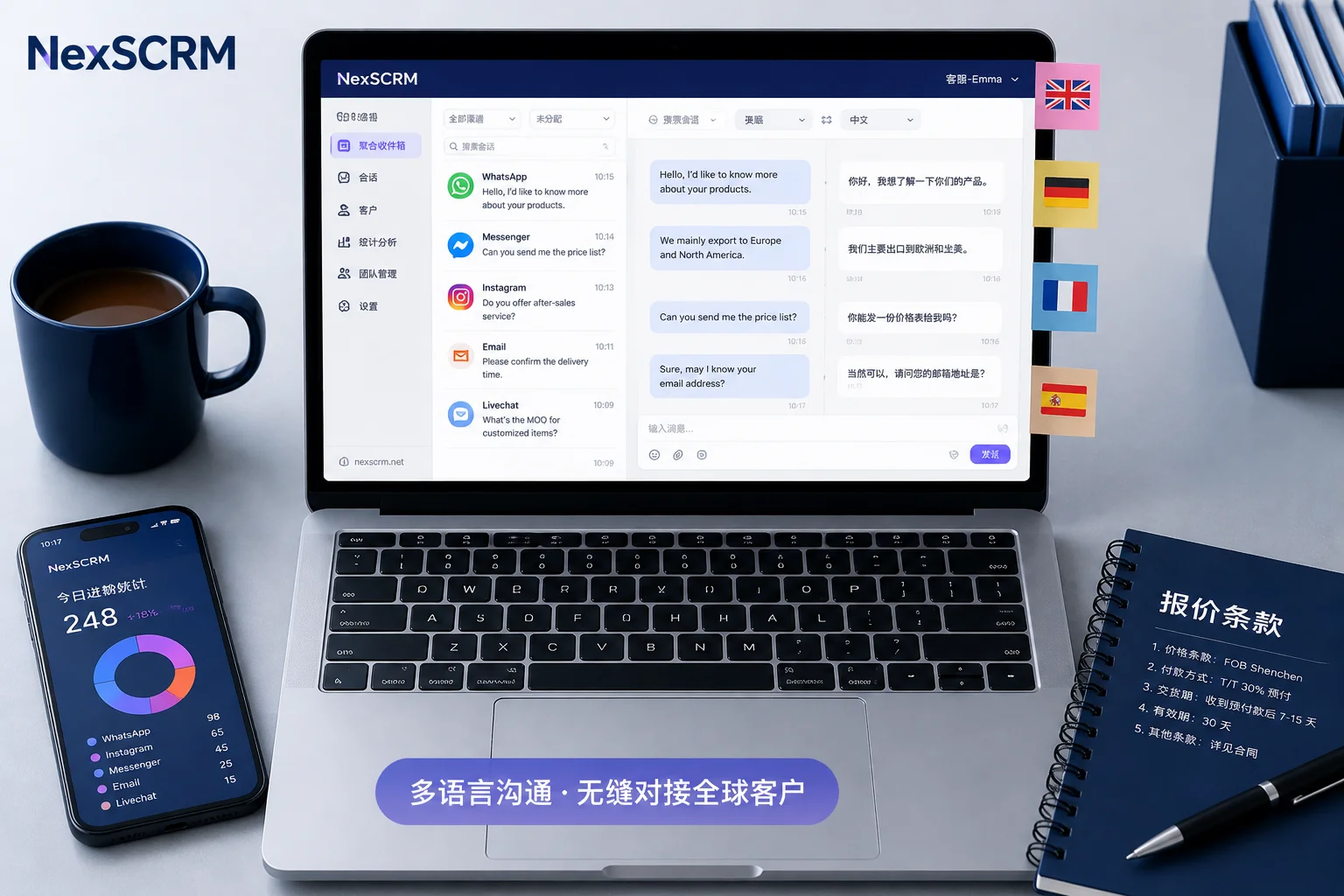
Foreign-language inquiries must be understood at first response. Customers come from different countries; your first reply must understand their question and answer in their language. You can't wait for a translator.
When using NexSCRM for this step, multiple Telegram accounts are centralized in one workspace for sending and receiving messages. Each account has an independent fingerprint environment and can bind session-level proxies separately. Several customer service agents can be online simultaneously without switching devices. Routing links distribute customers from each channel to different customer service accounts, and the fan counter records fan arrivals per account. Received text, images, and voice can be translated in real time, with both original and translation retained, and replies can be automatically translated into the customer's language. For multi-account access, see Multi-Account Aggregation; for routing links and fan statistics, see Counter and Backup.
If you plan to build channels, groups, and customer service accounts into a complete receiving structure, continue reading How to Build a Cross-Border Telegram Private Domain Traffic Pool: Three-Layer Reception with Channels, Groups, and Customer Service Accounts.


Comments(0)