 NexScrm官方博客
Many persons in charge of foreign trade enterprises, when reviewing digitalization investments, encounter a headache-inducing phenomenon: the company has spent a considerable budget to purchase a well-known brand's foreign trade customer management system (CRM), but half a year after launch, apart from the initially batch-imported historical lists and sporadic email exchanges, there is almost no fresh customer follow-up activity visible in the system.
Why does a foreign trade customer management system intended to improve efficiency often end up as an "electronic spreadsheet" that salespeople fill out perfunctorily? The core reason is that the communication habits of overseas buyers have changed, while many enterprises' management tools remain in the "email + static forms" era.
1. Why Do Traditional Foreign Trade Customer Management Systems Easily Become "Useless" in the High-Frequency Social Era?
In the past, foreign trade B2B relied on exhibition business cards and B2B platform inquiries, advancing large orders through long-cycle email exchanges. Traditional CRMs designed around "lead entry—email archiving—opportunity stages" fit this process very well. But in recent years, global trade has shown clear trends of order fragmentation, younger buyers, and instant communication. Whether it's small-B buyers in emerging markets like Southeast Asia and Latin America, or buyers for European and American brands, they are more accustomed to directly inquiring about prices, requesting samples, and confirming details via WhatsApp, Telegram, LINE, Zalo, or Instagram private messages.
When the main battlefield shifts to instant social media platforms, three major blind spots of traditional foreign trade customer management systems are exposed:
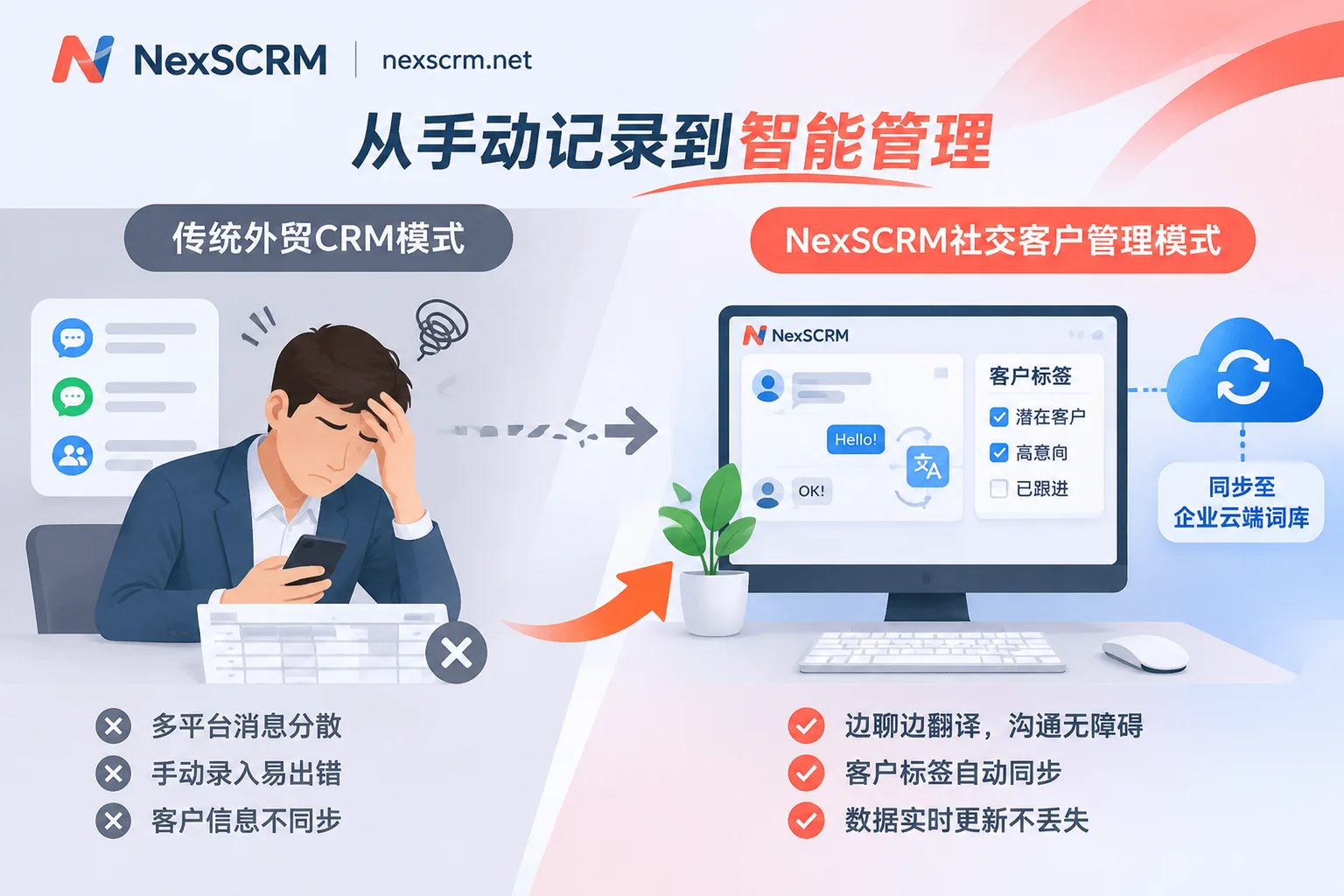
- Communication and records are separated; entry relies entirely on manual self-discipline: If a salesperson has exchanged dozens of voice messages and images with a customer on WhatsApp via mobile or web, and then has to switch to another independent CRM system to manually type out "follow-up records," it is not only time-consuming and laborious but also severely distorts information.
- Delayed response to multiple languages and channels: When facing inquiries from minor language markets, traditional CRMs only "store data" and do not solve "how to chat." Salespeople copy and paste translations back and forth, or switch between a dozen social media windows, easily missing replies and the golden closing period.
- Social assets drift outside the system: Although customers are added to salespeople's personal social accounts, the company backend only has a cold phone number. Once an account is banned or personnel turnover occurs, the real chat context and customer relationships are instantly disconnected.
2. Foreign Trade CRM vs Social SCRM: Which One Does Your Team Really Need?
When selecting a foreign trade customer management system, enterprises first need to clarify a concept: Do you need to manage the back-end "documents and static records" (traditional CRM), or the front-end "high-frequency interaction and private domain conversion" (social SCRM)?
We can see the boundary between the two through a comparison table:
| Evaluation Dimension | Traditional Foreign Trade CRM (Static Record Type) | Cross-Language Social SCRM (High-Frequency Interaction Type) |
|---|---|---|
| Core Management Center | Centered on emails, public pools, and static customer forms | Centered on real-time conversations on WhatsApp, Telegram, LINE, Zalo, etc. |
| Data Collection Method | Relies on salespeople manually filling follow-up logs and uploading attachments afterward | Tag while chatting; chat records and media files automatically backed up to the cloud |
| Multilingual Communication Capability | Usually only supports system interface multilingual, no built-in real-time conversation translation | Built-in real-time two-way translation, supporting automatic recognition and translation of text, images, and voice |
| Team Collaboration and Risk Control | Manages static list ownership; difficult to monitor private chat behavior on social software | Independent fingerprint environment multi-open, number desensitization, sensitive word and private payment monitoring |
If 90% of your team's customer development and maintenance already takes place on overseas social platforms, then a cross-language social SCRM represented by NexSCRM is the foreign trade customer management system that truly fits the frontline sales workflow.
3. Four Selection Criteria for the New Generation of Social Foreign Trade Customer Management Systems
To make the management system truly a "closing assistant" rather than a "form-filling burden" for salespeople, when evaluating a social foreign trade customer management system, it is recommended to focus on the following four core modules:
1. Aggregated Communication and Customer Profile on One Screen: Accumulate While Chatting, Say Goodbye to Manual Form Filling
A usable system must conform to human work habits. When overseas customers are led into the private domain from Facebook or TikTok, or directly send WhatsApp messages, salespeople should not have to jump back and forth between multiple software programs.
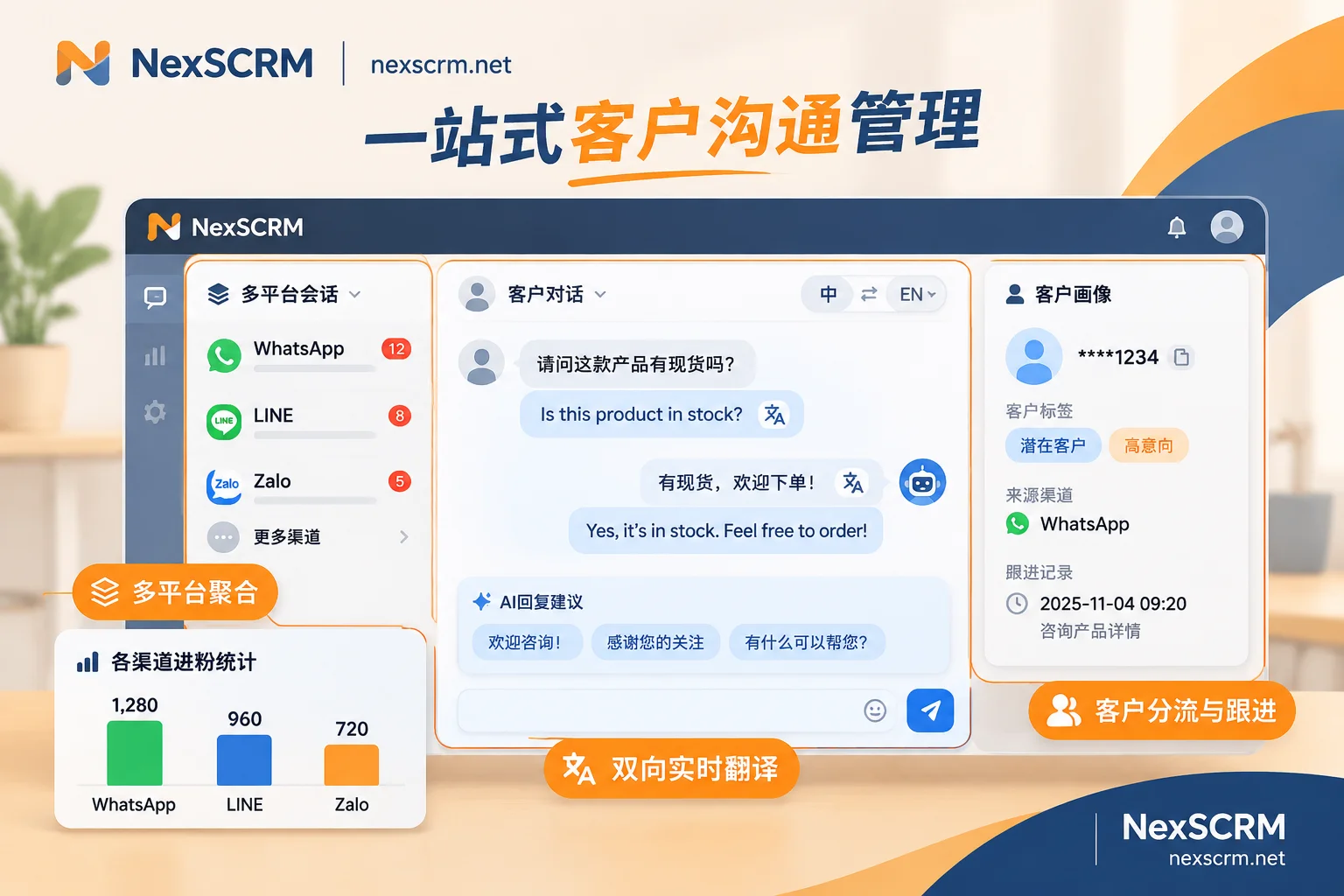
Through NexSCRM's multi-account aggregation workbench, the team can send and receive messages from multiple accounts on over ten platforms including WhatsApp (supporting regular and Business accounts), Telegram, LINE, Zalo, Messenger, Instagram, etc., all within one desktop client. Unread messages are uniformly alerted, and each account runs in an independent fingerprint environment with support for binding session-level proxy IPs. For how to standardize the management of a large number of accounts in the team, you can refer to our previous article "How to Manage Multiple Customer Service Accounts Without Losing Control? A Practical Guide for Cross-Border Teams to Achieve Human-Account Decoupling, Prevent Order Collisions, and Close the Performance Loop".
More importantly, NexSCRM's customer operation and profile features are directly embedded in the sidebar of the chat window:
- Routing and deduplication: Automatically assign customer service reps by source, tags, and historical records through routing links; the system automatically deduplicates contacts to prevent multiple salespeople from following up on the same buyer and causing order collisions.
- Panoramic customer profile: While replying to messages, salespeople can casually check customer tags, fill in notes, record source channels and follow-up activities, and view historical interactions and customer activity at any time.
2. Cross-Language Barrier-Free Response: Built-in Two-Way Translation and AI Script Collaboration
When expanding into non-English markets such as Latin America, the Middle East, Southeast Asia, Japan, and South Korea, language barriers directly affect inquiry conversion rates. If a foreign trade customer management system can only store customer phone numbers but cannot help salespeople understand a customer's Spanish voice message or Vietnamese image, follow-up efficiency remains low.
In terms of communication empowerment, NexSCRM provides two core levers:
- Multilingual real-time translation: No need to install browser plugins that easily fail; the client has multiple translation routes built in, including Google, Microsoft, DeepL, and AI large models. Messages are automatically translated in both directions, with original text and translation retained simultaneously. It can automatically recognize the other party's language, set target languages individually per contact, and support translation of image and voice messages (available by version).
- AI scripts and auto-replies: For high-frequency inquiries, the system supports automatically sending welcome messages when new customers first come online and keyword auto-replies; during deep follow-up, AI can generate reply suggestions based on customer questions and historical conversations, which are sent with one click after sales confirmation. Excellent opening remarks and quotation scripts can also be stored in a public script library, combined with quick reply templates supporting variable substitution and follow-up reminders, ensuring every cross-time-zone follow-up is professional and timely. For more details on human-machine collaboration, you can read "How Can Cross-Border Teams Make Good Use of AI Customer Service Assistants? Avoid the 'Fully Automatic Illusion' Trap and Build a High-Conversion Human-Machine Collaboration Loop".
3. Full-Chain Data Quantification: From Fan Counting to Team Performance Dashboards
Traditional foreign trade customer management systems find it difficult to count "how many real effective fans were actually added through social media ads today." Many teams rely on salespeople manually reporting numbers at the end of each day, which is prone to duplicate counting and difficult to verify actual conversions.
Through NexSCRM's fan counter and data dashboard, managers can say goodbye to muddled accounts:
- Accurate fan statistics: Supports main account fan counting, group fan counting, deduplication of work orders for individual or all sub-accounts, system duplicate checking, and fan supplementary entry. Routing link statistics are clear at a glance and can be exported.
- Multi-dimensional performance dashboard: The system automatically summarizes conversation volume, fan count, response time, and customer service performance across all ports. Which channel brings high-quality leads and which salesperson responds most actively—all are backed by real interaction data.
4. Enterprise-Level Asset Security and Internal Control: Customers Stay When People Leave, Eliminating Order Leakage and Lost Contact
Customer acquisition costs in the foreign trade industry are high, and the biggest fear is that salespeople clear chat records when they leave, or guide customers to private accounts to close deals in private chats. This is also the most fundamental security requirement for enterprises to deploy a foreign trade customer management system.
In terms of asset protection, NexSCRM's employee internal control and cloud backup system builds a tight defense line for enterprises (for detailed practical strategies, please refer to "How to Prevent Order Leakage in Foreign Trade? Manage the Four Defense Lines: Account Ownership, Number Desensitization, and Resignation Handover"):
- Permission isolation and data desensitization: The main account uniformly allocates ports and permissions, and sub-accounts are divided by role with visible ranges; after enabling data desensitization, frontline customer service cannot directly see full customer contact information.
- Real-time warning of sensitive behavior: The system supports sensitive word monitoring, payment control, and sensitive behavior monitoring (such as privately requesting contact information or privately sending payment QR codes), combined with operation log auditing and custom alerts, nipping order leakage in the bud.
- Automatic cloud backup: All chat records, media files, customer profiles, and follow-up records are automatically saved to the enterprise's cloud, supporting quick retrieval by time, contact, or keyword. Even if an employee resigns or a social account is unexpectedly abnormal, the complete historical context of old customers remains intact within the team, and new employees can seamlessly continue follow-up by taking over the sub-account.
4. Conclusion: Let Customer Management Return to "Efficient Communication and Closing" Itself
Choosing a foreign trade customer management system is essentially choosing a way for team collaboration and customer follow-up. When your overseas customers are active daily on instant messaging tools like WhatsApp, Telegram, and LINE, only a social SCRM that integrates multi-platform conversation aggregation, real-time multilingual translation, customer profile accumulation, and internal control backup can truly open up the management loop from "the first hello" to "long-term repurchase maintenance."
NexSCRM adopts a flexible subscription model billed by port (the number of accounts that can be online simultaneously), supports upgrade or downgrade at any time, and provides stackable unlimited-time translation character packs (specific version and pricing plans are subject to the official website). You can now visit the NexSCRM download page to get the Windows client. No credit card required to start a limited-time free trial, helping you turn overseas inquiries scattered across various social software into core assets truly deposited in the enterprise's hands.