 NexScrm官方博客
Recently, many operations leads at going-global brands have been doing the same math: click costs on overseas social media and search ads keep climbing, they've managed to funnel customers into WhatsApp, Telegram, LINE, or Instagram DMs, and they've even purchased a dedicated cross-border SCRM tool. So why is the final inquiry conversion rate still not showing any clear improvement?
Industry surveys show that more than 60% of companies fall short of expectations when rolling out private-domain and marketing tools. The main reason is usually not a lack of tools, but data silos and broken front-to-back collaboration—the ad team only cares about bringing people in, the customer service team scrambles across a dozen accounts and translation apps, and sales can't see the earlier conversation context when they follow up. If you've already read about the difference between traditional CRM and cross-border social media SCRM, you'll understand that the core of overseas social media communication is "instant interaction." For cross-border SCRM to actually help a team produce results, it must tightly connect the three most easily disconnected processes: lead routing, chat handling, and follow-up.
Gap 1: Ad spend and intake are disconnected—leads are routed incorrectly and can't be counted accurately
In many cross-border teams, marketing ad spend and DM reception run on parallel tracks. An ad post or independent site landing page lists a fixed number, and all customers flood in through it, easily creating three types of chaos:
- Hot and cold leads mixed together, allocation left to chance: A customer speaking a minority language is assigned to an English-only agent, or an existing customer inquiring through a different channel is treated as a brand-new lead and has to start over.
- Too many people flooding a single account, triggering risk controls: A large number of new customers adding the same account in a short period easily triggers restrictions on social platforms.
- Duplicates in lead counts can't be reconciled: The same customer clicks two ads and adds two customer service accounts; the ad operator counts two leads, while sales discovers it's the same person.
How can cross-border SCRM close this gap?
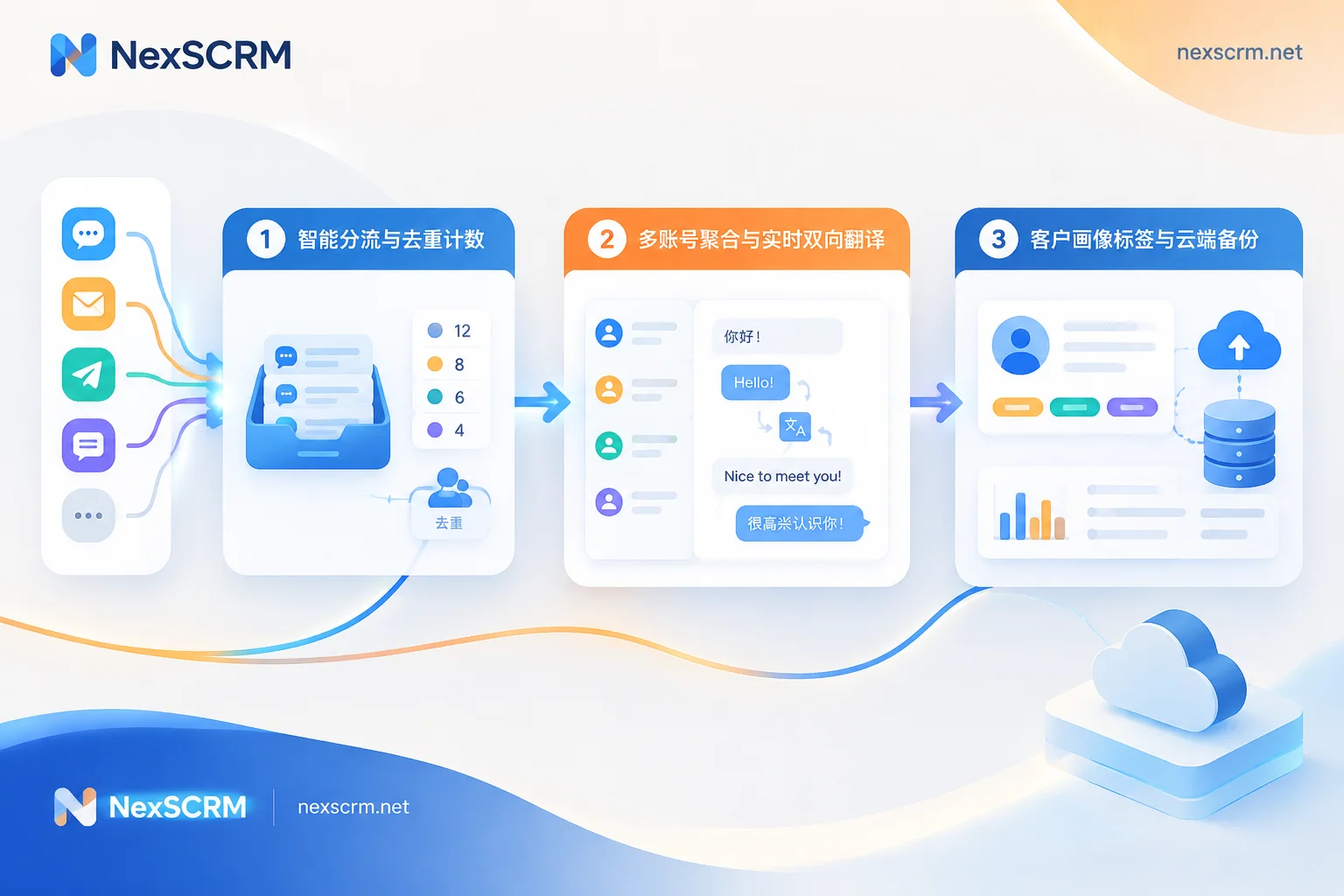
At the intake entry point, first replace fixed accounts with the system's routing links. Through NexSCRM's customer operations features, teams can automatically assign receiving agents based on channel source, customer tags, and history—for example, routing traffic from a Spanish-language TikTok video to the Spanish-speaking team, while existing customers are prioritized back to their original follow-up owner.
At the same time, replace manual spreadsheets with the built-in lead counter and statistics dashboard. The system can count followers on the main account and group followers, and also supports ticket deduplication and system duplicate checks across individual or all sub-accounts. If records are genuinely missing, you can correct them through follower supplements and export the statistics with one click (for troubleshooting details, see how to use the ticket counter accurately). This way, how many real, non-duplicate customers each routing link brought in can be reconciled by ad ops and sales looking at the same table.
Gap 2: Multi-platform and multilingual fragmentation—slow first response and inconsistent messaging
The first five minutes after a customer reaches out are the golden window for building trust. But in reality, cross-border customer service agents often juggle multiple platforms at once: WhatsApp, Telegram, LINE, Zalo, and even Facebook and Instagram. Switching back and forth between a dozen browser tabs or emulators makes it easy to miss unread messages. And when a customer writes in Arabic, Thai, Vietnamese, or another minority language, agents have to copy the text into a translation app, wait for it to be translated, and then paste it back—by which time the customer may have already left the chat.
A more hidden risk: new agents reply with stiff machine-translated sentences, or use the wrong pricing and delivery terms, turning a high-intent inquiry into a dead conversation.
How can response speed and reply quality improve at the same time?
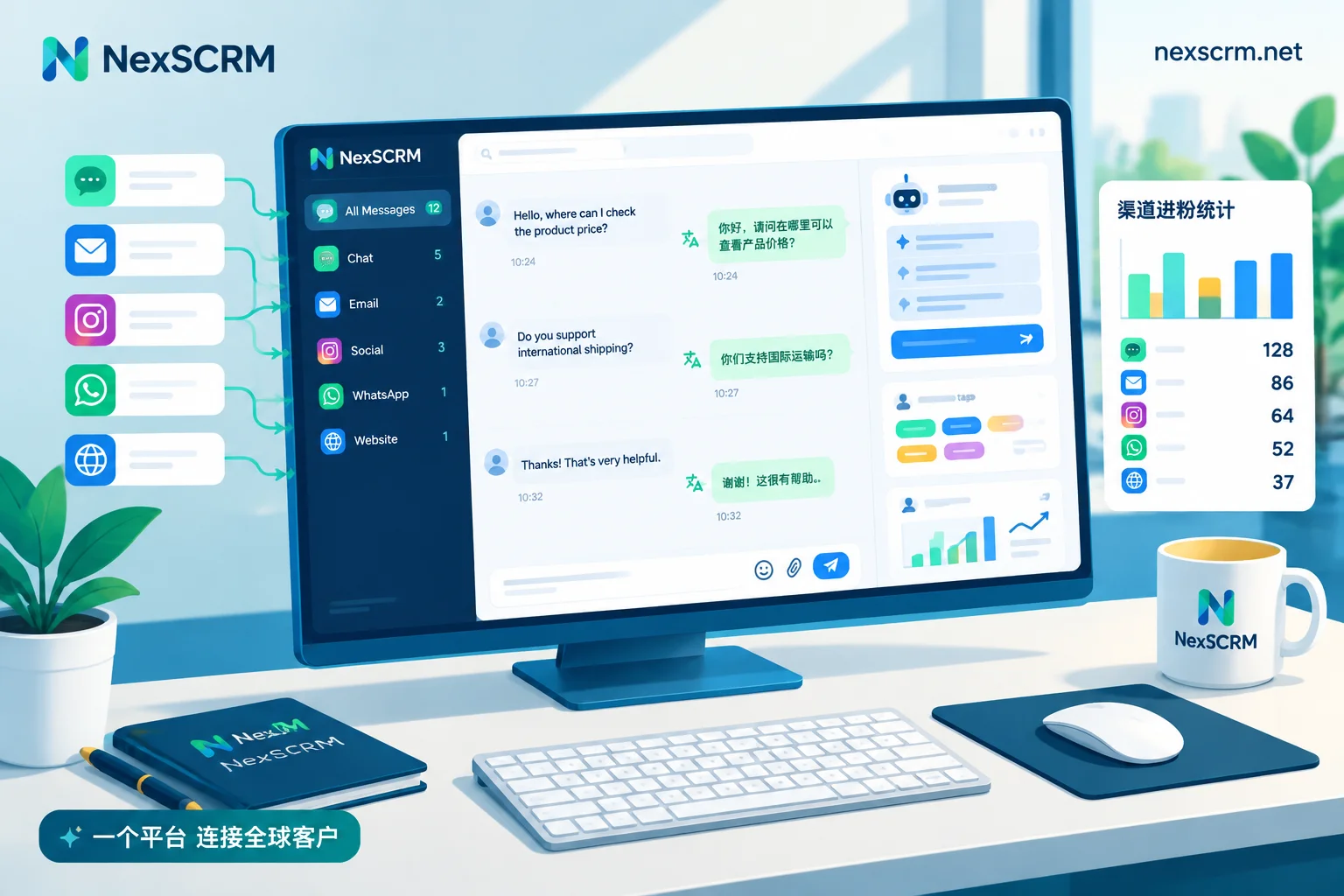
- Consolidate the workspace and anti-association environment: Connect social accounts scattered across platforms into the NexSCRM multi-account aggregation workspace. Unread messages from all platforms are alerted in one place; chat windows can be split, merged, or hidden according to preference; login states are saved automatically so you don't have to scan QR codes again after restarting the app. To keep accounts secure, each account runs in an independent fingerprint environment and supports binding session-level proxy IPs.
- Embed two-way translation directly in the chat box: Turn on the client's built-in multilingual real-time translation—no browser plugin required. The system automatically detects the other party's language and translates messages in both directions in real time, keeping both the original and the translation on screen for easy verification. In addition to text, image and voice message translation are supported (depending on version). You can set the target language separately for different contacts and switch freely among multiple translation engines, including Google, Microsoft, DeepL, and AI large models.
- Use AI assistance and standard scripts as a safety net: For first-time inbound customers, configure automatic welcome messages or AI-powered greetings in AI scripts and auto-replies to cut first-response time. During actual business conversations, AI generates reply suggestions based on the customer's question and conversation history, and agents send them after confirming. Teams can also save polished AI opening lines to a shared script library, and with variable substitution, keyword-triggered quick-reply templates, and a media asset library, every agent sends product materials and terms in a consistently professional way.
Gap 3: Follow-up records stay in individuals' hands—conversations with customers fizzle out
Many going-global teams turn private-domain operations into a "one-time transaction": a customer asks about pricing on day one but doesn't order, and three days later the agent is already buried under new unread messages and forgets to follow up. Or a key salesperson suddenly resigns or changes roles, their account's chat history is wiped, and the colleague taking over has no idea which customers are discussing samples or which are stuck on payment terms.
For overseas private-domain operations to generate repeat purchases and long-tail conversions, customer data must move from "stored in the salesperson's head" to "retained in the company's system."
How can cross-border SCRM truly retain customer assets?
- Build customer profiles while chatting: During daily conversations, agents can complete customer profiles directly in the chat sidebar—adding intent-level tags, writing notes, and recording source channels and each follow-up. Combined with conversation grouping, customer activity statistics, and automatic follow-up reminders, you can see at a glance from the workspace which customers are due for a check-in and which highly active customers deserve priority attention.
- Cloud backup and performance dashboards: After enabling chat history backup and data dashboards, text chats and sent/received media files are automatically backed up to the cloud, and managers can search and review them anytime by time, contact, or keyword. Dashboards also clearly show team conversation volume, new lead counts, response times, and agent performance, helping supervisors spot intake bottlenecks in time.
- Enterprise-side retention and internal control safeguards: For permission management, the main account can define visibility scopes by role and assign ports and permissions, while sub-accounts support multi-device login. At the same time, through data masking, sensitive-word monitoring, sensitive-behavior monitoring (such as privately adding contact info or privately collecting payments), payment controls, and operation log audits, the team maintains a baseline of business compliance (for more details, see how to prevent order poaching in foreign trade). More importantly, all chat records, customer profiles, and follow-up histories are stored on the enterprise side—even if an employee leaves, the customer relationship stays intact with the team.
Conclusion: Get one core workflow running first
Cross-border SCRM isn't an ornament for piling up complex concepts. Its core value is helping teams run the daily workflow smoothly: "lead intake—cross-language communication—continuous follow-up—asset retention." When your ad operators can see real, deduplicated lead counts, your agents can reply instantly in multiple languages from a single window, and your supervisors can review complete follow-up profiles at any time, every lead bought with high acquisition costs is truly secured.
NexSCRM offers flexible pricing by port (the number of accounts that can be online simultaneously), supports upgrades or downgrades at any time, and allows stacking non-expiring translation character packs. If you're organizing your team's multi-platform customer service workflow, go to the NexSCRM download page to get the Windows client and start a limited-time free trial (no credit card required), or check the pricing and versions page for a configuration that fits your current team size.