 NexScrm官方博客
In recent going-global industry research, a notable trend is that more and more cross-border e-commerce and foreign trade enterprises are treating private domains as a core growth engine, moving from early "single-market trials" to "synchronous multi-country and multi-region expansion." However, when the business map simultaneously covers Europe and America, Latin America, Southeast Asia, and Japan and South Korea, the underlying logic of overseas private domain operations is completely different from the domestic single WeChat ecosystem.
Overseas, customers in different countries are scattered across vastly different instant messaging and social media apps: customers in Europe, America, and Latin America are accustomed to using WhatsApp, the Japanese and Taiwan markets cannot do without LINE, Vietnamese customers frequently use Zalo, while emerging markets and community-heavy users gather on Telegram. In addition, front-end traffic generation also involves public domain direct messages on TikTok, Instagram, and Facebook Messenger.
If the team still manages things by "one platform with one set of tools, one country as one silo," they will soon fall into the quagmire of frequent software switching, constant switching between small languages, and fragmented customer data. To truly revitalize multi-country, multi-channel overseas private domains, the team needs to integrate the three steps of cross-channel reception, language adaptation, and segmented profiles at the workstation level.
Why Does a Multi-Country Layout Quickly Cause Overseas Private Domain Operations to Spin Out of Control?
When the private domain pool expands from a single WhatsApp to three or four mainstream overseas platforms, operations teams typically hit three walls:
- Desktop software proliferation, missed reply rates soar: Customer service computers simultaneously run clients for three or four platforms and a dozen browser tabs. Different software has different pop-up logic, making it very easy to miss high-intent inquiries during peak times.
- Mixed languages, translation settings tossed back and forth: The same foreign trade salesperson might be checking parameters with a Mexican customer in Spanish in the morning, replying to a Hanoi buyer about delivery time in Vietnamese in the afternoon, and then a Japanese customer sends a picture asking for details. Relying on external translation plugins or a single global language setting easily leads to the embarrassment of "sending the wrong language."
- Inconsistent customer standards, handovers become a mess: Remarks and tags on different platforms are not interconnected, and management cannot see globally which are high-activity buyers and which channels bring high-quality fans; once employees turnover, communication records scattered across personal accounts on various platforms are even harder to retain completely.
(Further reading: If you are at the stage of building a standard process for a single B2B team, you can first refer to "How to Write a Cross-Border B2B Overseas Private Domain Operations SOP: Five-Stage Process from Fan Reception to Handover Internal Control" )
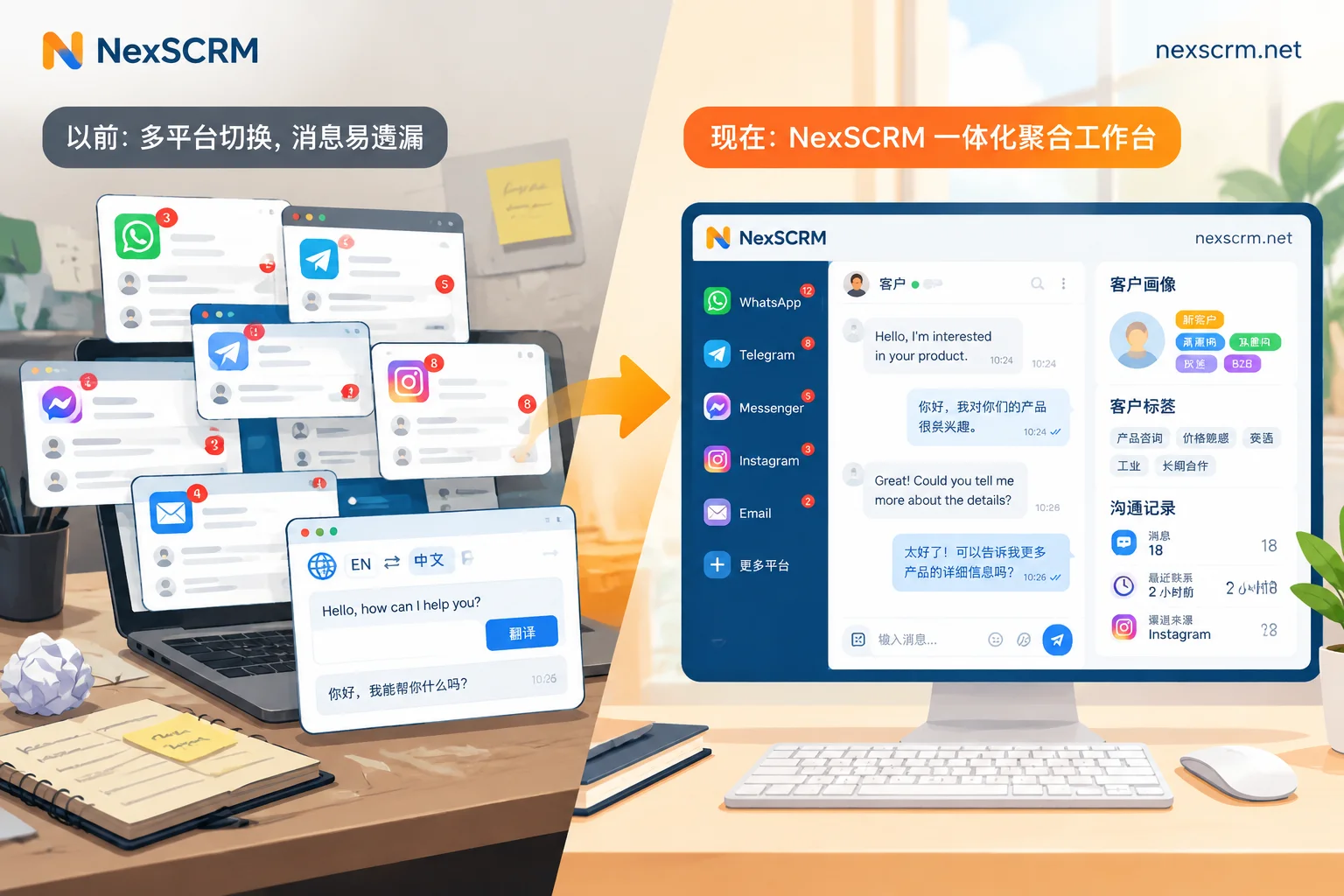
Step 1: Gather the Fragmented Overseas Social Matrix into the Same Workstation
The first priority of multi-platform overseas private domain operations is to "reduce the burden" for frontline staff and eliminate the physical switching cost between platforms.
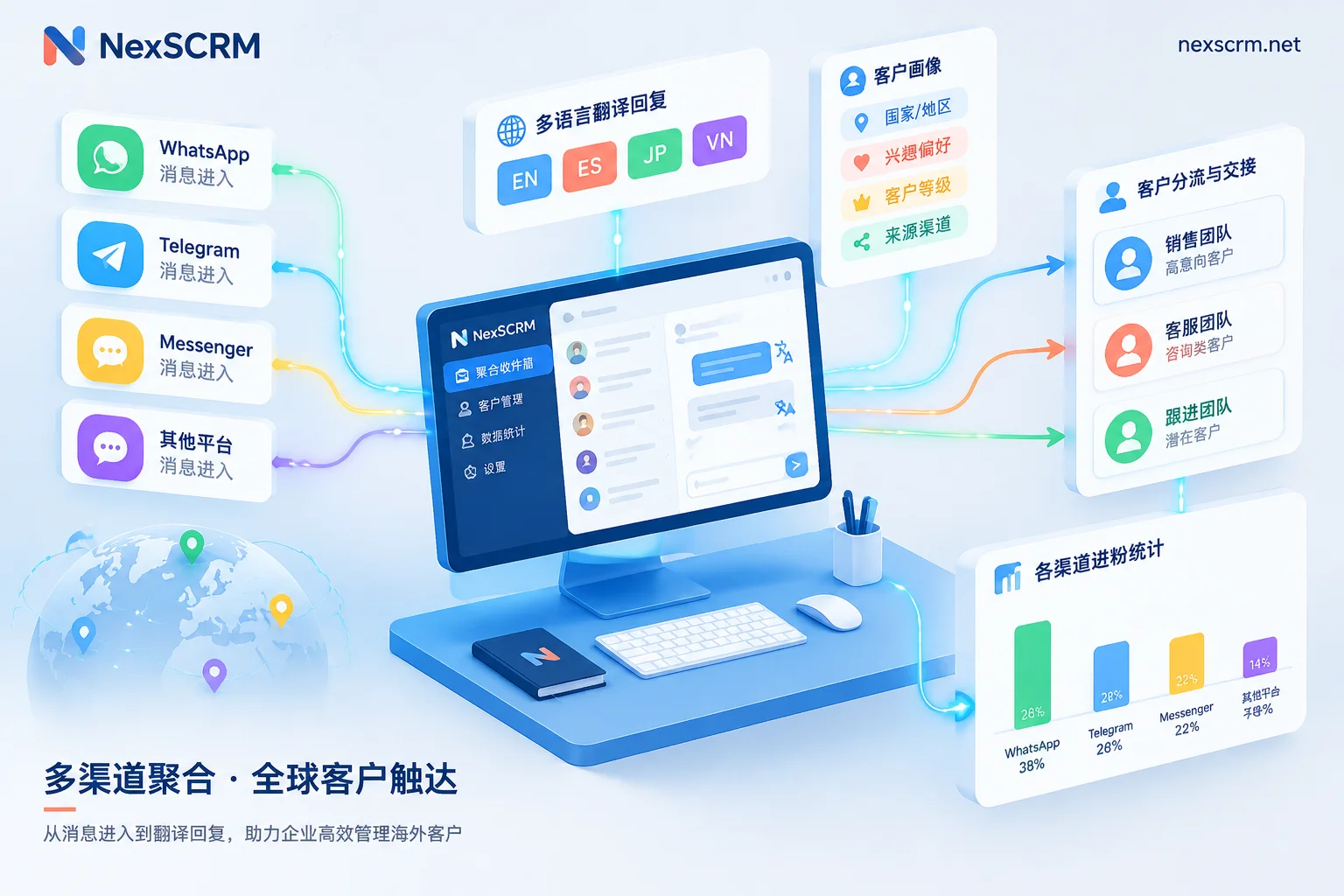
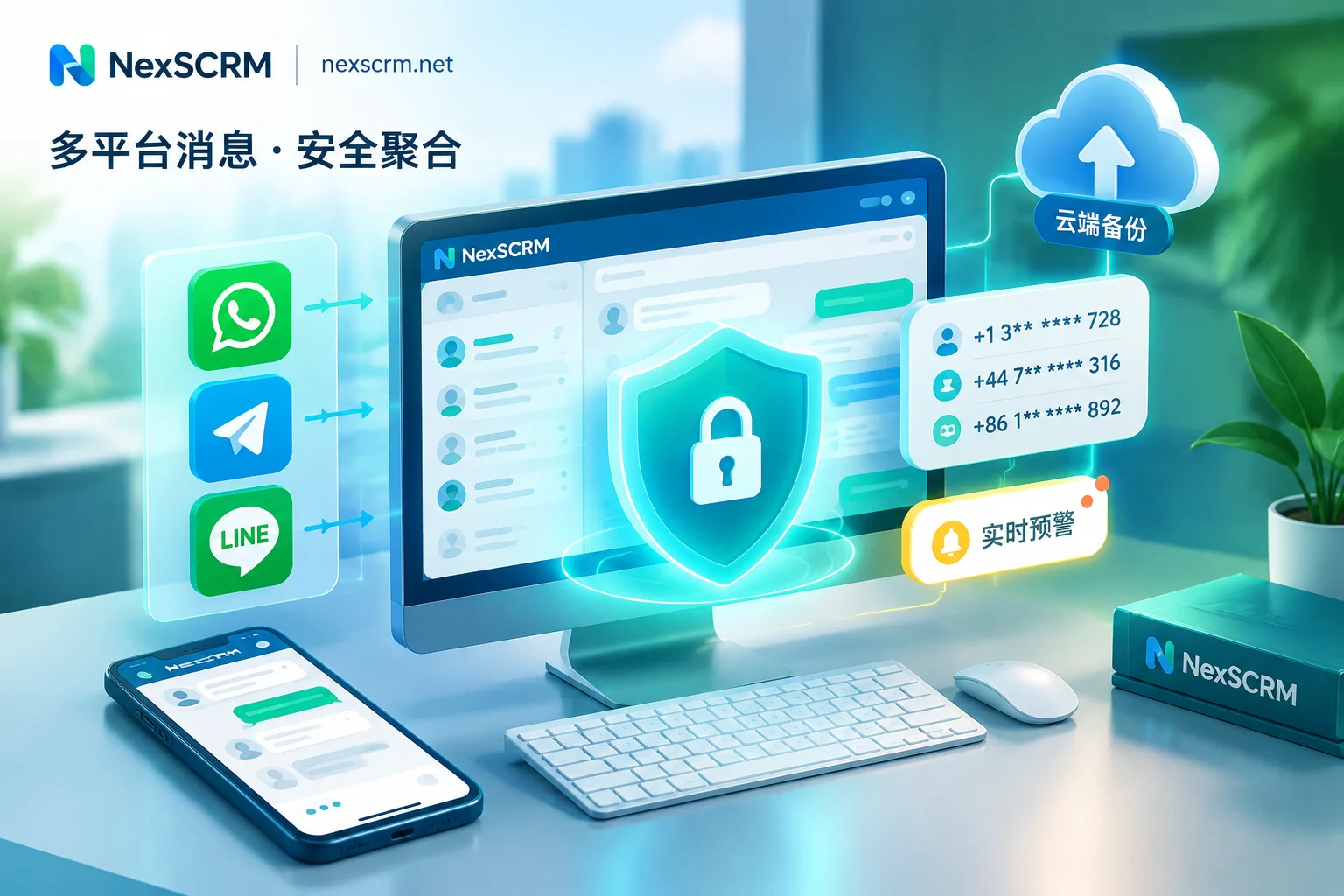
With NexSCRM's multi-account aggregation feature, teams can centralize multiple accounts from mainstream overseas platforms such as WhatsApp (including regular and Business accounts), Telegram, LINE, Zalo, Facebook, Messenger, Instagram, TikTok, X (Twitter), Discord, and Signal into a single desktop workstation for sending and receiving messages.
In the specific practice of cross-channel reception, three details directly determine daily efficiency and account security:
- Unified unread reminders and flexible window scheduling: Whether a customer comes in via TikTok direct message or adds a LINE friend, all unread messages will be uniformly reminded in the workstation. Customer service can freely split, merge, or hide chat windows according to their operating habits, no longer needing to search the screen for flashing icons.
- Independent environment and scan-free reconnection: The biggest fear of running multiple platforms and accounts simultaneously is environment cross-talk and frequent disconnections. In NexSCRM, each account runs in an independent fingerprint environment and supports binding an independent proxy IP per session; at the same time, the software automatically saves login status, so there is no need to take out the phone and scan codes one by one every day when restarting the client.
- Distribution links and fan deduplication statistics: When running multi-channel ad campaigns or social media traffic generation on the front end, distribution links can automatically assign customers to the corresponding customer service based on source, tags, and historical records. With the built-in fan counter, fan additions to the main account, group additions, and cross-sub-account ticket deduplication can all be automated, avoiding the same overseas buyer being counted repeatedly in fan acquisition costs across different platforms or different customer service accounts. (For details on counting and deduplication, please refer to "How to Use Ticket Counters Accurately? Manage the Four Gates of Deduplication, Group Statistics, and Fan Supplement" )
Step 2: Use "Contact-Level" Real-Time Translation and AI Scripts to Bridge Cross-Border Time and Language Gaps
After bringing multi-country customers into the private domain, whether you can handle them and chat deeply depends on the fluency of cross-language communication and first-response speed.
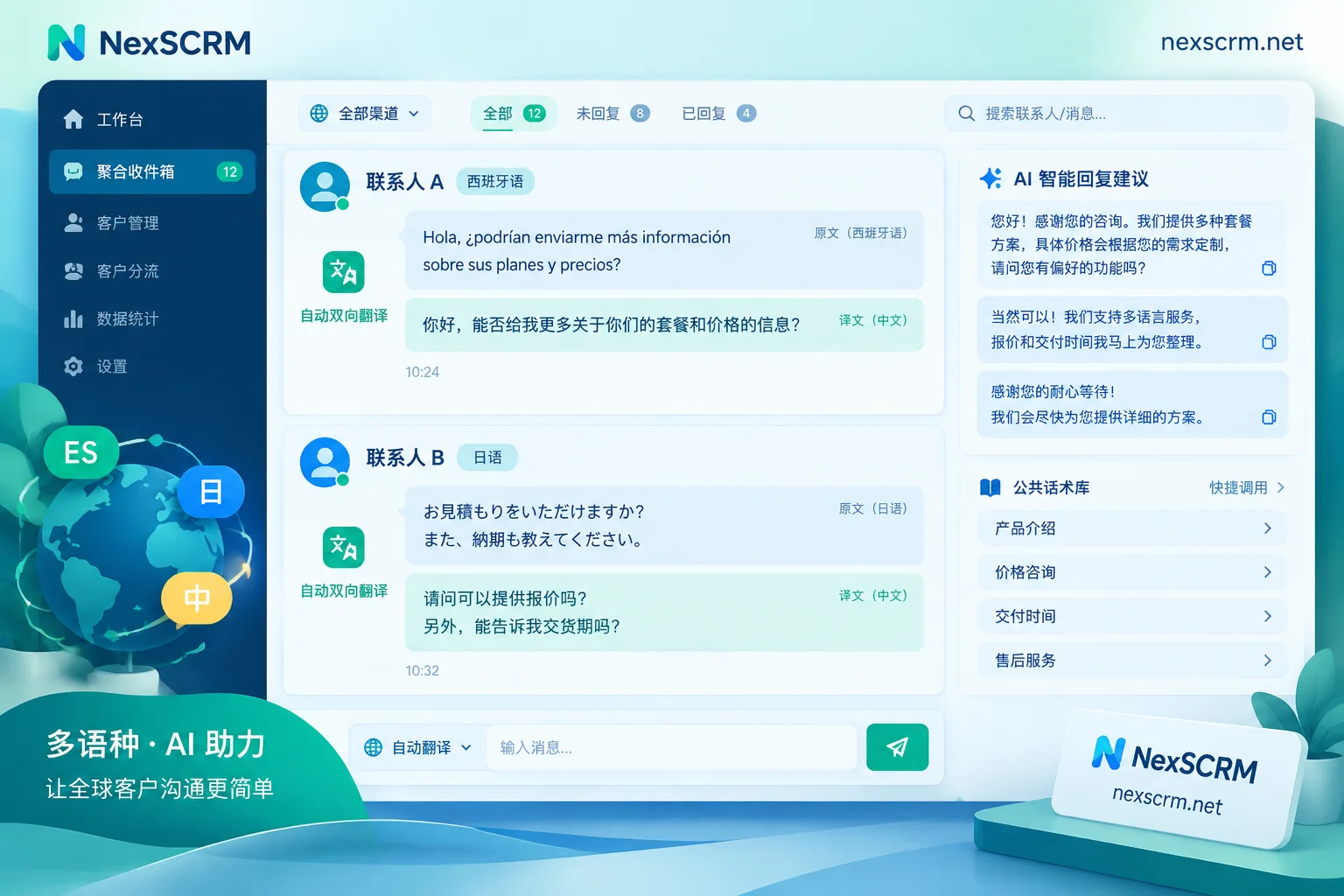
Traditional translation tools often can only set a single "global target language," but in multi-country private domain operations, customer service faces concurrent conversations in multiple languages. Through NexSCRM's built-in multilingual real-time translation, teams can achieve more refined language adaptation:
- Automatic recognition and independent language settings per contact: The system can automatically recognize the language sent by the other party and supports setting translation language independently per contact. For example, fix customer A to Portuguese translation, fix customer B to Thai translation; when switching chat windows, translation rules automatically follow, achieving two-way real-time translation of sent and received messages, while the chat interface retains both the original text and translation for verification.
- Multi-modal and multi-engine free switching: Overseas customers very much like to send voice messages or directly take product photos and brochures in private domain communication. The workstation not only supports text translation but also image and voice message translation (available by version), and integrates multiple translation engines including Google, Microsoft, DeepL, and AI large models, allowing switching and comparison at any time when encountering professional foreign trade terms or local slang.
- AI collaborative reception for nighttime and high-frequency inquiries: Cross-border private domains naturally have time zone issues. When a new customer comes in via direct message for the first time, you can configure automatic welcome messages or have AI automatically greet; set keyword auto-replies for common logistics and specification questions. In the deep follow-up stage, AI scripts and auto-reply features can generate reply suggestions based on the customer's current question and historical conversation; customer service can confirm or fine-tune and send with one click, and can save high-quality opening lines into the team's public script library.
Step 3: Accumulate Unified Customer Profiles and a Secure Asset Library Across Platforms
Many going-global enterprises mistakenly treat "adding a customer as a friend" as the endpoint of private domain operations. In reality, a friend list without segmentation and follow-up records is just a bunch of dormant numbers. The real value of private domains for repeat purchases and conversion comes from refined back-end operations and data accumulation.
Regardless of whether customers are on WhatsApp or LINE, teams should use unified customer operations and management specifications to transform them into structured assets:
1. Build Cross-Platform Customer Profiles and Activity Segmentation
During daily chats, customer service can at any time add unified business tags, fill in remarks, mark source channels, and record each follow-up in the sidebar of the workstation. The system will fully retain interaction history and assist in calculating customer activity. When it's time for old customer reactivation or new product recommendations, operations staff can quickly filter out high-activity or specific-tag customer groups, and combine quick reply templates with variable replacement and a public media material library to achieve personalized precise reach, rather than blind mass messaging that leads to blocking.
2. Follow-Up Reminder Closed Loop to Prevent Long-Cycle Lead Gaps
Overseas B2B inquiries or high-ticket consumer goods often have long decision cycles. After the first round of quotations, customer service can directly set a follow-up reminder on the conversation. When the agreed time arrives, the system automatically prompts for a return visit, ensuring that every high-value private domain lead has a proper beginning and end.
3. Cloud Backup and Team Internal Control to Keep Private Domain Assets in the Company
What multi-platform operations fear most is "out of sight, out of mind." Through chat record backup and data dashboards, chat records and media files from all platforms are automatically synchronized to cloud backup; supervisors can search by time, contact, or keyword at any time, and intuitively view each account's conversation volume, fan additions, response time, and customer service performance on the dashboard.
At the same time, with customer number data desensitization, sensitive word and sensitive behavior monitoring (such as preventing private contact information addition and payment control), and operation log auditing, all customer profiles, historical records, and follow-up tracks are firmly kept on the enterprise side. Even if customer service positions change or employees leave, the new colleagues can smoothly access the previous context, truly making private domain assets belong to the enterprise.
Conclusion
As overseas private domain operations enter a new stage of multi-country, multi-channel parallel operations, the competition is no longer about who opens more accounts, but who can maintain ultimate response efficiency and a unified customer experience in a complex matrix of platforms and languages.
If you also want to integrate your team's private domain traffic scattered across WhatsApp, LINE, Telegram, Zalo, and other platforms, you may visit the NexSCRM official website download center to get the client. Currently, registration allows you to start a limited-time free trial (no credit card required), with flexible subscription based on the actual number of simultaneous online ports, helping your going-global team easily manage global private domain customers in one workstation.


Comments(0)