 NexScrm官方博客
After moving inquiries from email to WhatsApp, Telegram, LINE, and Zalo, many teams find that despite writing plenty of scripts, conversion still depends on individual sales reps. The problem is usually not the scripts but the lack of a broken-down process: where customers come from, who responds first, what to ask, which stage they are at, and who takes over after a handover are all unclear.
An executable overseas private domain SOP can be written in five stages: intake, first response, intent qualification, stage-based follow-up, and handover & internal control. For each stage, specify three things: who is responsible, within what time frame, and what records to keep. Below is a stage-by-stage explanation.
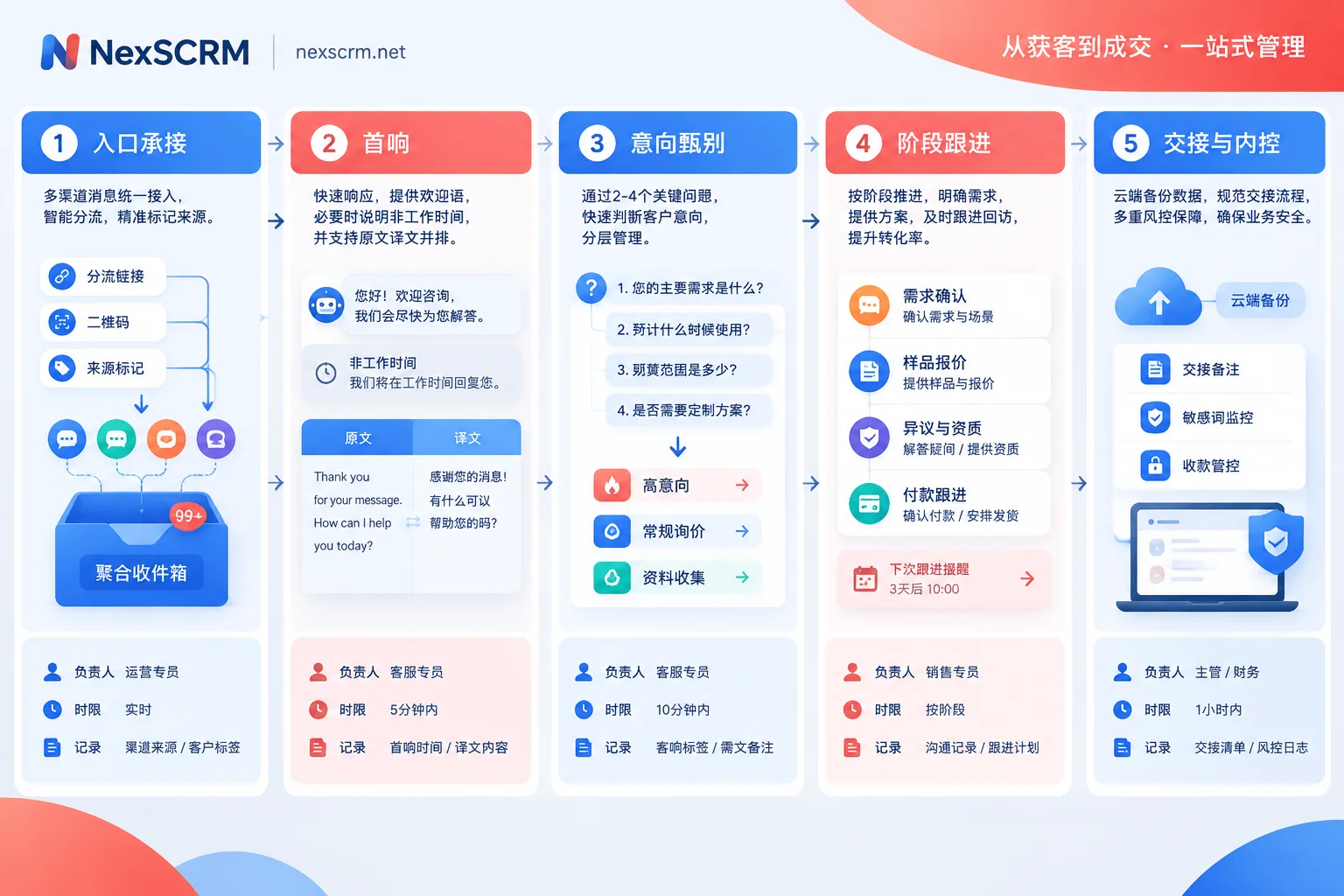
Stage 1: Tag Each Entry Point Separately and Only Engage Buyers Who Come to You
Assign a dedicated direct-to-IM link or QR code for each entry point: website chat widget, social media page, exhibition brochure, business card. Do not use the same link for all entry points; otherwise, you cannot distinguish the source after customers arrive, making it impossible to judge which entry point is worth further investment.
In the SOP, record the following for this stage:
- Entry point list: which receiving account corresponds to each entry point and who monitors it.
- Link naming convention: e.g., “channel-campaign-date” so everyone on the team can understand at a glance.
- Welcome message: tell buyers what this account is for, such as product inquiries, quotes, or sample arrangements.
The premise of a private domain is that buyers initiate the conversation or explicitly agree to receive communications. Without permission, mass unsolicited outreach can trigger platform spam restrictions and may lead to account bans—this should be a red line in the SOP.
Be clear about measurement: the number of new contacts from an entry point only indicates how many people it brought in; it cannot be directly treated as the deals from that entry point. For how to set up tracking for clicks and new contacts separately, see How to Set Up Tracking Tools for Website and Overseas Social Media Traffic.
Stage 2: First Response to Catch the Customer, Then Ensure Accuracy
Buyers expect much faster replies on IM than via email; many guidelines suggest a few minutes. The SOP does not need to copy a specific number, but you should set a measurable first-response time based on team capacity and prepare two fallbacks:
- Welcome message or auto-greeting: confirm receipt and ask a simple question, e.g., “Which model are you interested in?”
- Off-hours notice: tell buyers when someone will reply and ask them to leave their requirements.
Trigger mechanisms vary by platform; for setup details, see How to Set Up Keyword Auto-Replies and Welcome Messages.
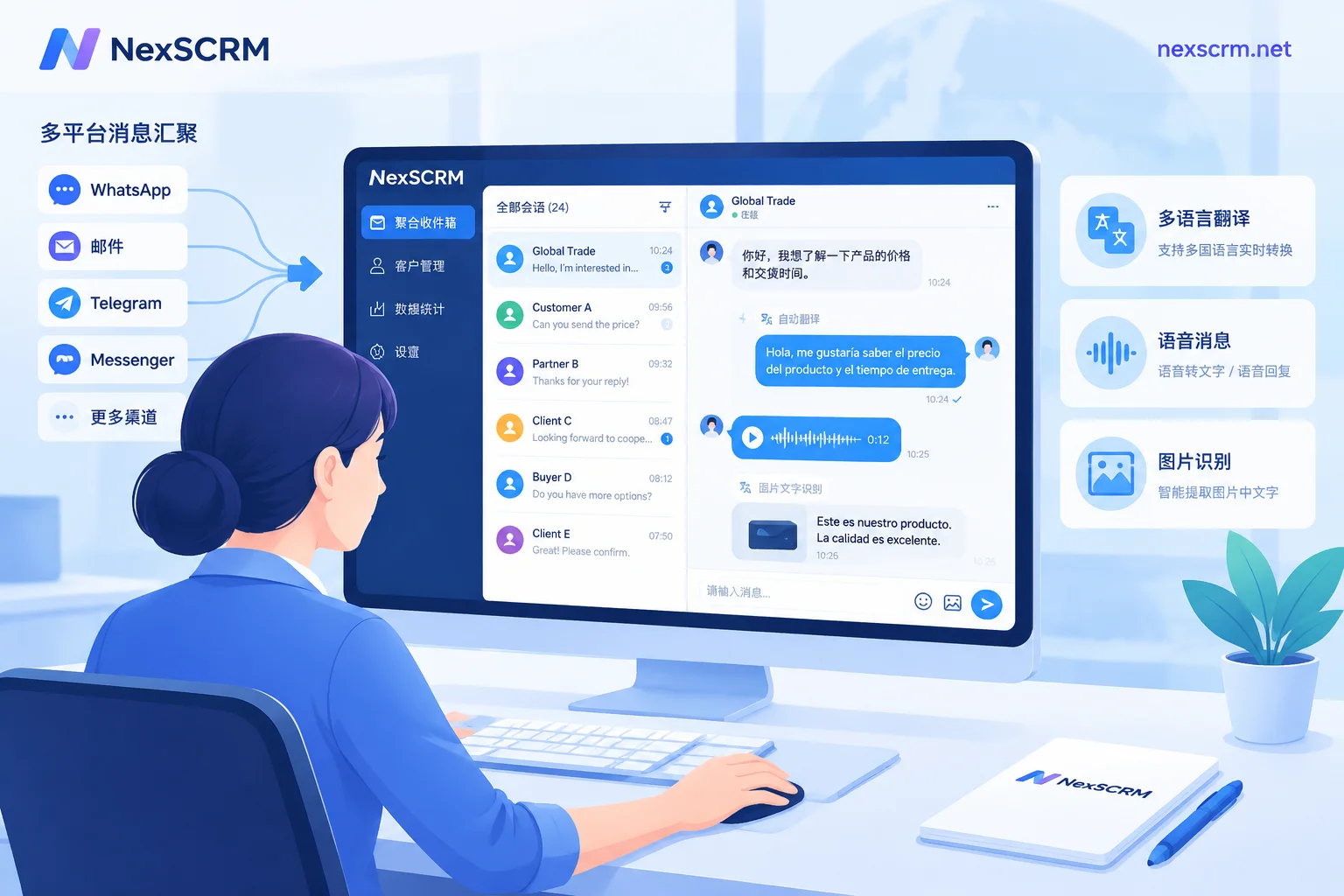
For inquiries in less common languages, translation must meet two conditions: translate text, images, and voice; and retain both original and translated text. In industrial products, specifications, dimensional tolerances, and trade terms can lead to wrong orders if mistranslated, so sales must verify numbers and terms against the original. It is advisable to specify in the SOP: when customers start quoting numbers or discussing terms, switch to a translation route better suited for accuracy. For how to embed translation into first response and term verification, see How a Real-Time Multilingual Translation Customer Service System Helps Foreign Trade Inquiries Move Forward.
Stage 3: Use Two to Four Questions to Qualify Inquiries, Don’t Send a Form Immediately
B2B purchasing chains are long, but dropping a long form in the chat window will likely deter buyers. A better approach is to design two to four progressive questions, asking one at a time and following up based on the answer:
- Which specification or model do you need, and roughly what quantity?
- When do you expect delivery?
- What certifications does your target market require?
- Are you the decision-maker for this purchase, or are you gathering information for your team?
Based on answers, classify customers into three tiers, each with a different follow-up priority:
- High intent: model, quantity, and delivery time are clear; advance to proposal and quote the same day.
- Standard inquiry: needs are clear but not urgent; follow up at a normal pace.
- Information gathering: send specifications first and schedule a next contact time.
Record the qualification result on the spot; don’t leave it only in the sales rep’s mind. The same buyer might scan a QR code at an exhibition and later come through the website, ending up with two sales reps, so deduplicate before tagging. In NexSCRM, contact deduplication, customer profile tags, and follow-up reminders are all done in one workspace; for details, see Profile, Deduplication, and Script Features.
Stage 4: Prepare Scripts and Materials by Sales Stage
Closing deals requires step-by-step progress. Organize script templates and resource libraries by stage so that different sales reps maintain consistent messaging:
| Stage | Entry Condition | Standard Action | Common Materials |
|---|---|---|---|
| Needs confirmation | Qualification completed | Restate needs and ask buyer to confirm | Product catalog, specification PDF |
| Sample & quote | Buyer confirms needs | Provide sample plan; quote with validity and trade terms | Quotation template, sample policy |
| Objection handling & qualification | Buyer compares prices or requests factory audit | Respond with standard wording and provide proof | Factory walkthrough video, third-party test reports, certificates |
| Payment follow-up | Buyer confirms order | Send formal payment information and confirm receipt time | Company payment details (send only via fixed template) |
Two rules to include in the SOP:
- Set the next follow-up time before ending each conversation. Disconnection in IM often happens because no one remembers to follow up.
- Distinguish which parts of the script can be changed and which cannot. Greetings can be personalized, but price terms, payment information, and certification statements must use unified templates. For how to draw this line, see How Public Script Templates Keep the Whole Team Consistent.
Stage 5: Customer Assets Under the Company, Handover and Internal Control Follow the Process
Foreign trade teams often have multiple accounts across platforms. If chat records exist only on individual sales reps’ phones, customers are often lost when someone leaves or rotates. This SOP stage has three requirements.
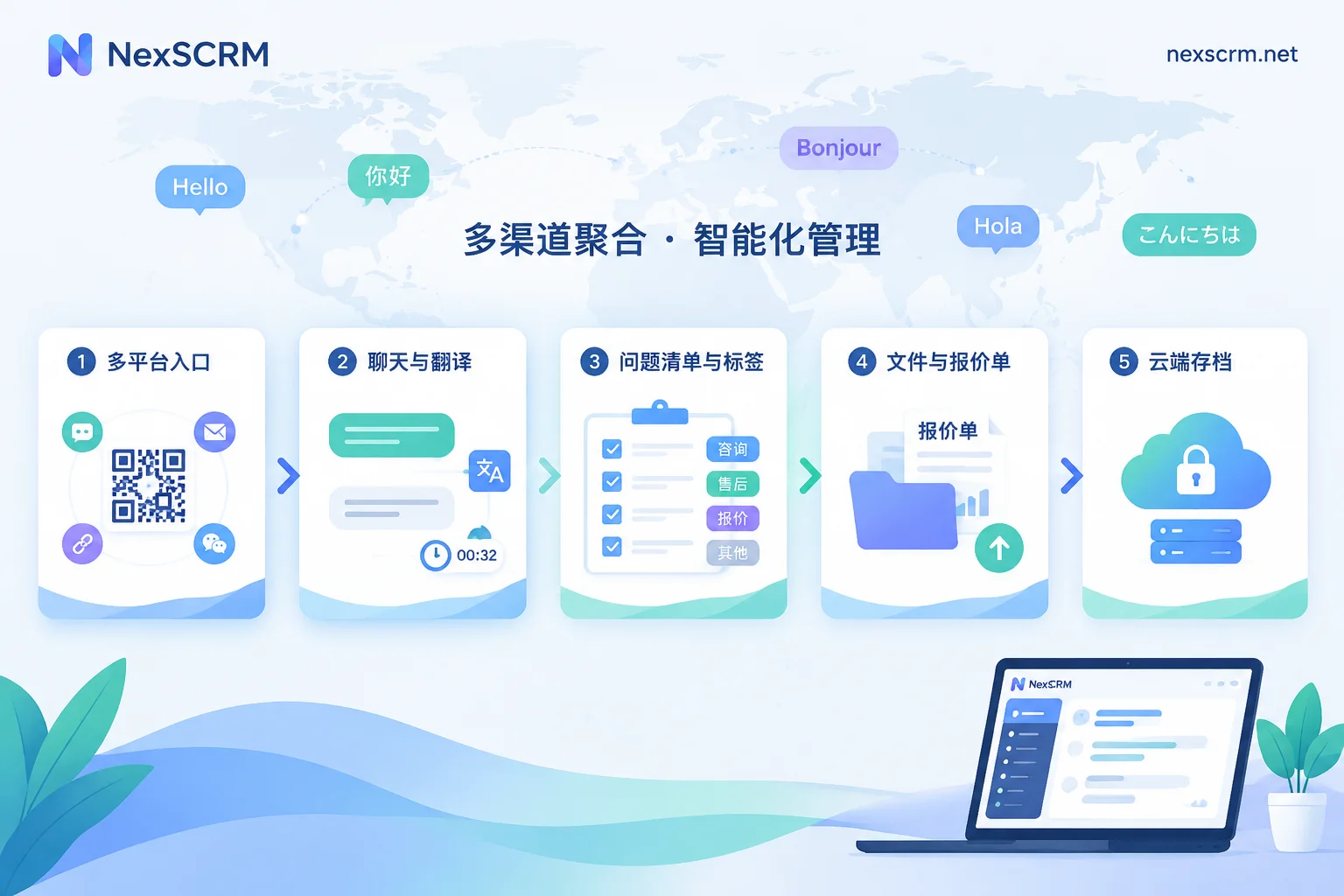
Centralize and back up all conversations to the cloud. Send and receive messages from multiple platforms and accounts in one workspace, back up chat records to the cloud for retrieval anytime. NexSCRM supports aggregated sending and receiving across multiple platforms and accounts, with each account using an independent fingerprint environment and optional session-level proxies to reduce the risk of account association. See Multi-Account Aggregation. Pricing is per port, where the number of ports equals the number of accounts that can be online simultaneously. For specific versions and prices, refer to the official website; teams can first run through the process with a free trial before deciding.
Write a standardized handover note. The person taking over should review the history before contacting the customer, so the buyer doesn’t have to repeat their needs. The note should include at least:
- Current stage
- Quoted price version and validity
- Unresolved issues
- Next follow-up time and agreed actions
Turn internal controls into switches, not self-discipline. Enable sensitive word monitoring, mask customers’ core contact details, and send payment information only through controlled channels. Whether payment information is replaced relates to fund security; any changes should go through approval. For what monitoring can cover and its blind spots, see Can Sensitive Behavior Monitoring Detect Private Contact Sharing and Off-Platform Payments?.
Implementation Order
You don’t need to launch all five stages at once. Start with the entry point and account that generate the most inquiries: first set the entry tag and first-response time limit, then add qualification questions and tags. Once running smoothly, complete the stage-based script library and handover template, and finally connect all team accounts into one workspace and enable internal controls uniformly. After each stage, check whether records are complete—e.g., does every customer have a source, qualification, and next follow-up time? This check is more indicative of whether the SOP is actually being executed than evaluating how well the scripts are written.


Comments(0)