 NexScrm官方博客
After foreign trade teams switch multilingual communication tools, the most common pitfall is: translation stays on the screen, and the customer's original words and translations are never together in the system. Months later, reviewing chat history reveals only a jumble of garbled text or half-copied phrases. When choosing a multilingual SCRM system, the first real question isn't how many languages it supports, but where translation fits in the messaging flow—is it just an aid for your understanding, or is it an official action embedded into conversations and customer profiles? Take systems like NexSCRM that support real-time two-way translation on WhatsApp, Telegram, LINE, Zalo, and aggregate and archive conversations; it's the latter. But the judgment shouldn't stop at the product name; you need to go through the four layers below. If any layer isn't answered clearly, all other features are meaningless.
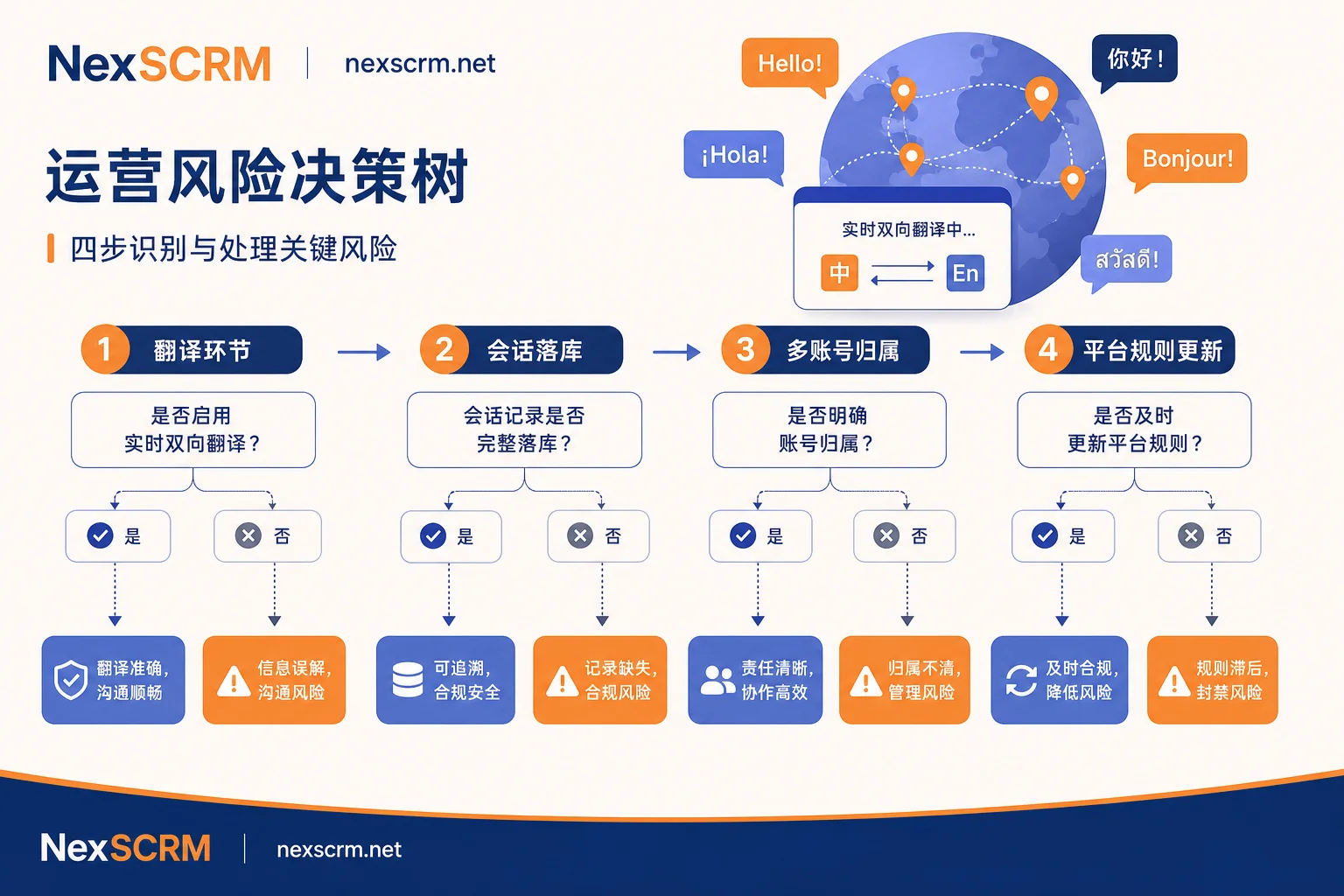
Decision Tree for Choosing a Multilingual SCRM: Ask Where Translation Occurs
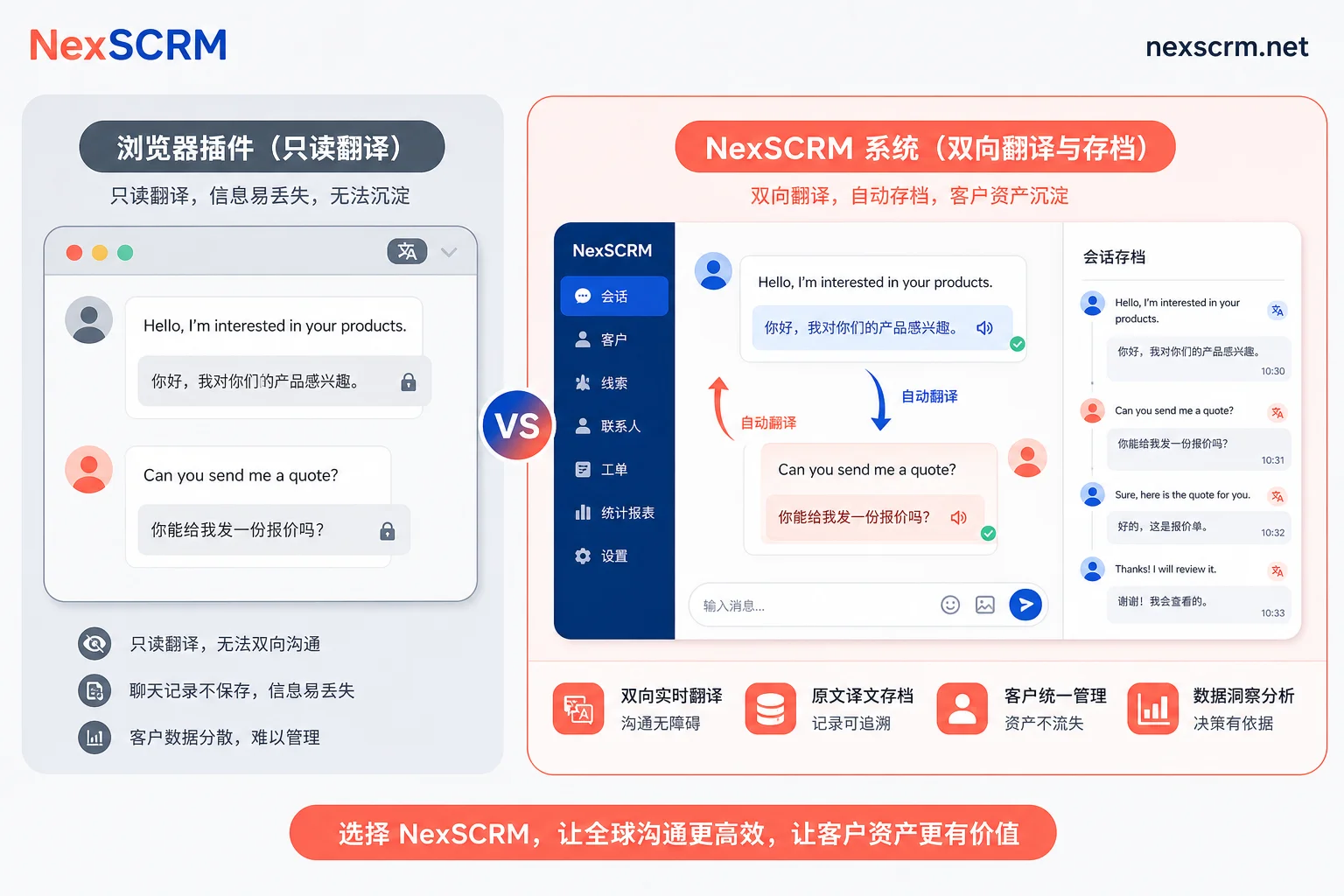
Break down your selection into a decision tree, with the first branch being where translation intervenes. General web page translation (like browser extensions) occurs at the "rendering layer," only converting incoming messages to Chinese on your screen to aid understanding, but you still need other means to reply. Copy-paste tools operate at the "clipboard": you paste the customer's message, translate it, then paste the translation back into the chat box. You can send replies, but both paths break outside the system—neither the original nor the translation enters your chat history or customer profiles. A true multilingual SCRM system embeds translation directly into the messaging flow: incoming minority language messages are automatically translated to Chinese, your Chinese replies are automatically translated to the customer's language and sent, with both original and translation attached to the same message. A simple way to test where your tool stops: have a colleague view the same conversation on another account simultaneously. If they can't see your translated content, translation isn't actually in the system.
Practical Differences: Read-Only Rendering, Copy-Paste, and Two-Way Translation for Sending and Receiving
Three intervention methods correspond to three team situations. Read-only rendering suits a phase when one person handles one language with low volume, but its failure point is that you can't directly send translated content, nor multi-agent collaboration. Copy-paste solves sending but breaks at the clipboard—who pasted what, when, and to which customer leaves no trace. Two-way translation makes translations part of the conversation, visible to everyone, and replies are translated. For teams with sporadic inquiries and customers who accept slow replies, free tools with manual review are often sufficient; but when inquiries arrive in bursts and customers expect quick quotes, if translation stays beyond the "copy, paste, reply" steps, response speed won't keep up.
One visible difference is the conversation interface: read-only tools usually exist as floating windows or sidebars, copy-paste tools require toggling windows back and forth, while two-way translation tools vertically display original and translated text within speech bubbles, marking the sender and translation time. During selection, ask the provider for a remote demo: "When a customer sends a message in Thai, agent A replies in Chinese, what does agent B see on the same interface?" This step filters out most products that only translate without leaving traces post-conversation.
Should Originals and Translations Be Archived Together: Conversation Data Storage Is a Key Selection Criterion
The second branch is more critical: besides appearing on the screen, does the translation get stored with the conversation? Many teams think all chat records are saved, but actually only one-way originals or translations are stored. In foreign trade orders, price, address, and delivery date changes happen in chats. In case of disputes, being able to restore the correspondence between the customer's original words and your translated reply constitutes evidence. Storage must include at least five elements: original text, translation, language, sender, and timestamp. Exporting plain text (txt) doesn't count because it loses the link between messages and conversation ownership.
To verify reliable storage, spot-check three things: Can you filter historical conversations by language? For a specific customer's original message, who gave the translation and when? Can conversations belonging to a departed agent be fully transferred to the next person? If answers are vague, the system's "archiving" might just be stacking message text on the server without establishing searchable correspondences.
Multi-Account, Multi-Agent Conversation Ownership, Duplicate Leads, and Departure Handover
The third branch appears in multi-person collaboration: after aggregating multiple platforms and accounts, the system must determine who sees what, who replies, and who owns the customer—not left to verbal agreements within the group. English, Spanish, and Arabic inquiries often land with different agents. If the system doesn't track conversation occupation status, two agents might reply to the same lead simultaneously, causing inconsistent pricing and immediately damaging the customer experience. Multi-account conversation assignment logic must answer: On message arrival, is it idle or occupied? Does the system recognize that the same customer on WhatsApp and Telegram with different IDs is the same person? When an agent leaves, who inherits all unfinished conversations across all languages?
Traditional CRM obviously fails at this level—it assumes workflows are email and static forms, and conversations often require manual entry or forwarding, increasing duplicate lead probability. This is also the most substantial difference in "multilingual SCRM vs. traditional CRM": the former treats instant conversations as the primary subject, while the latter treats them as attachments. For conversation ownership, NexSCRM's article on Overseas Social Media Team Multi-Account Permission Division and Customer Service Collaboration Solutions provides more detail; when selecting, compare if your team's current permission granularity is sufficient.
Does the System Keep Up with Platform Rules: Group Message Editing and Service Message Billing
The fourth branch examines the system's adaptability—when platform rules change, can it respond timely, not just translate? In August 2026, LINE officially launched the group chat message edited event (messageEdited Webhook). When customers edit messages in groups, the system can track the historical update. Subsequently, LINE announced adjustments to additional push message fees for official accounts in Japan starting October 1, 2026, and in September 2026, multi-official account friend guidance opened in verified MINI App. Another important change comes from Meta: starting October 1, 2026, each business number will have 1,000 free Service Messages per month. From the 1,001st message, even replies sent by human or third-party bots within the 24-hour customer service window will be billed at the Utility rate for the country/region.
What do these changes mean? If a customer edits an address in a group and the system doesn't recognize the messageEdited event, automated replies might still reference the old address, causing mix-ups. Once monthly message volume exceeds 1,000, automated replies directly increase channel costs. During selection, ask about the system's support for such events and billing updates—whether there's a clear changelog, and if costs can be estimated by conversation volume in the backend. Meta hasn't yet published a detailed country-by-country tier policy, and LINE's Japan new regulation only applies to Japan.
Quoted Numbers, Addresses, and Honorifics: Three High-Risk Scenarios for Machine Translation Output
After answering the above four branches, return to translation quality itself. Free tools are fine for most everyday pleasantries, but the following three sentence types carry the highest risk: First, amounts and units, like whether "50K" means 50,000 or 50 thousand, and whether exchange rates and tax rates are omitted; second, addresses and administrative divisions, as Southeast Asian and Middle Eastern addresses often have multi-level place names, and direct output can lose levels; third, honorifics and titles—Latin languages and Japanese use different terms based on the other person's status, and direct translation can come across as rude.
Therefore, quotes, negotiations, and critical order modifications must be manually confirmed. Do not promise prices in automated replies, and don't forward customer-modified numbers directly to the warehouse—first have a human review the correspondence between translation and original. No tool claims 100% accuracy. Setting the quality boundary at "sentence types requiring human backstop" is more practical than chasing inflated accuracy figures.
Additional Items to Verify for Southeast Asia, Latin America, and Middle East Markets
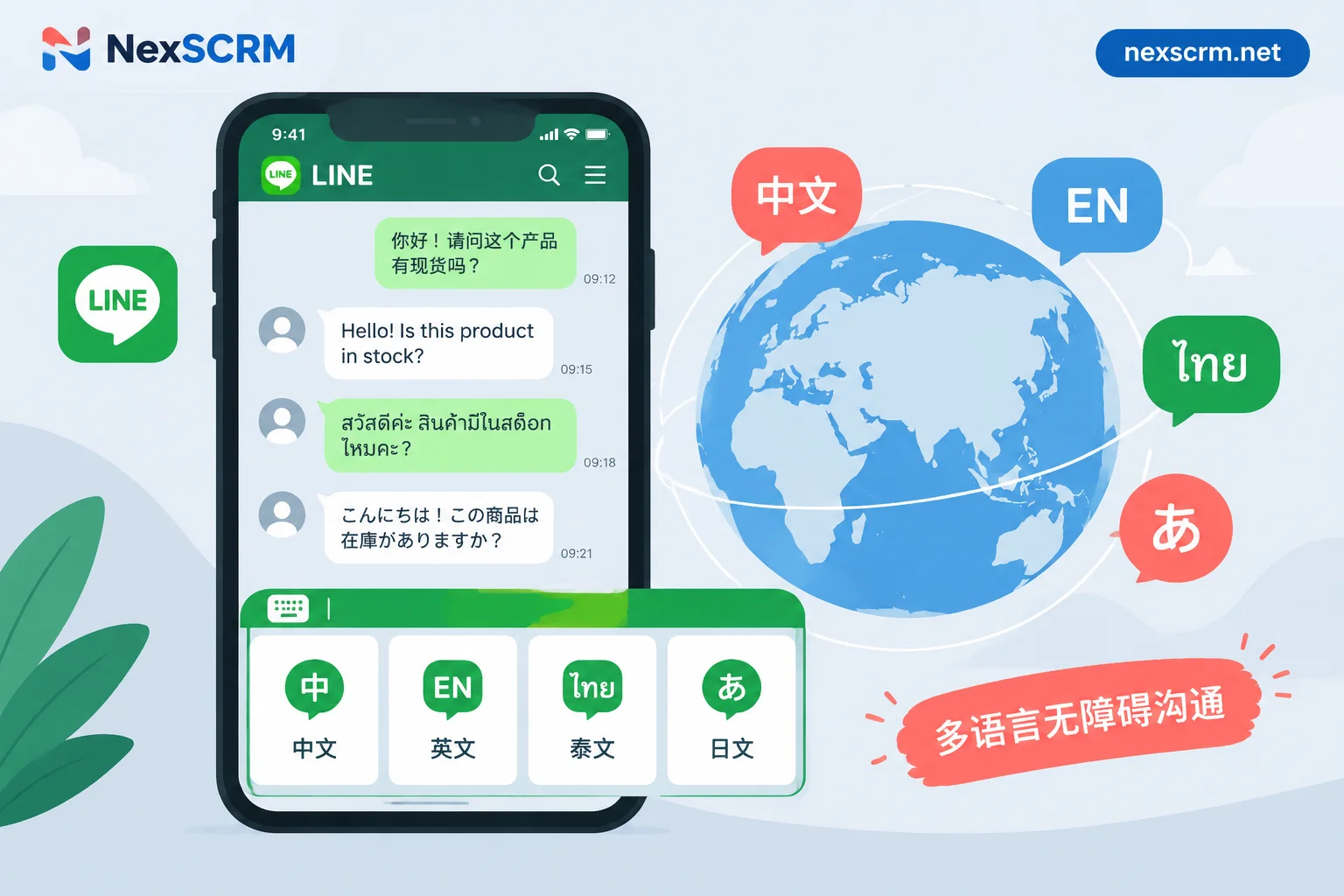
If your target markets are Southeast Asia, Latin America, or the Middle East, add several verification items: Does the channel mix cover high-frequency apps like WhatsApp, Telegram, LINE, Zalo? Does right-to-left writing (e.g., Arabic) display correctly in the interface, and are local titles and date formats adapted? Can scheduling and response times be aligned with the customer's local time? Does the system support the minority languages of your primary markets, and how is human review arranged? Take Zalo, for example; the official has not yet published complete English documentation for third-party translation APIs. This means teams wanting to directly integrate real-time two-way translation can only rely on general machine translation plus human review in the short term, without expecting ready-made official interfaces.
Recommendations for Teams of 3, 10, and 30+ People
Convert the decision tree into three tiers for teams to match by size.
| Team Size | Must-Prioritize Pain Points | Features That Can Wait | Suggested Budget Direction |
|---|---|---|---|
| 3-person group | Basic translation chain, conversation traceability | Complex duplicate lead detection, multilingual auto-routing | Two-way translation and basic storage |
| 10-person team | Conversation ownership, assignment and occupation status | In-depth BI and cross-channel customer journey | Conversation collaboration and permission management |
| 30+ people | Statistics reports, message backup, compliance audit | Real-time machine translation for edge languages | Data statistics and message backup |
For a 3-person group, budget should go to translation and storage; free tools + manual review might suffice. At 10 people, you must solve conversation ownership and assignment, or two agents will compete for the same lead. Above 30 people, without data statistics and offsite message backup, operations managers can't see response times and conversion funnels across languages. Refer to WhatsApp Chat Record Team Sharing and Customer Asset Accumulation for specific practices on meeting audit requirements for message backup fields. As for Telegram Multi-Account Aggregation Login Management Solutions and Zalo Chat Chinese-Vietnamese Two-Way Real-Time Translation Software Comparison, they address aggregation and translation issues for different channels; use according to your primary channels.
FAQ
What is the difference between a multilingual SCRM system and a traditional CRM?
Traditional CRMs are based on email and static entry; conversations often require manual transcription. Multilingual SCRM systems embed directly into instant messaging channels like WhatsApp, Telegram, LINE, and Zalo, with translation, archive, and multi-agent status all handled within the system. The difference isn't about having a customer table, but whether conversations are first-class citizens in the system.
Are free translation tools sufficient for foreign trade customer service?
When inquiry volume is low, customers don't mind waiting, and you ensure manual review of critical information, they are sufficient. However, free tools typically lack session-level archives, multi-agent collaboration, and message ownership, and cannot automatically store translations with originals. When inquiries peak or multiple people need to handle various languages simultaneously, free tools lead to slow responses, duplicate leads, and missing history.
Can SCRM handle both WhatsApp and Telegram simultaneously?
Yes, provided the system integrates with both platforms' official APIs or Business interfaces. WhatsApp has a 24-hour customer service window and a monthly limit of 1,000 free service messages; Telegram Business offers conversation tags and business hours configuration. During selection, confirm the system keeps up with changes in both mechanisms.
Should translations and originals be archived together?
Yes. Archives must contain original text, translation, language, sender, and timestamp to trace the correspondence between the customer's original words and the translation. Exporting plain text or only translations means not archiving. Recommend spot-checking once a week with real chat records to confirm the completeness and accuracy of stored fields.
Will machine translation make errors for minority languages?
Yes, especially in amounts, units, address levels, and honorifics. Quotes, negotiations, and critical order modifications must be manually confirmed. Additionally, platform rule changes (like message editing) can cause automated replies to cite outdated information.
Can the system recognize when a customer edits their message in a group?
If the system integrates LINE's messageEdited Webhook, it can recognize and track changes; otherwise, you only see the final version, not historical updates. Ask the vendor if it has adapted to this event, especially for teams managing order changes.
Take your team's real conversations from the past week and check them against the four questions: Where does translation occur? Is the translation stored? How are multi-account assignments determined? Does the platform follow rule updates? Going through your existing tools item by item before deciding to replace them is more prudent than looking at price quotes first. In most cases, the problem isn't insufficient tools, but whether translation and conversations truly live on the same chain.


Comments(0)