 NexScrm官方博客
Many cross-border customer service agents assume a generic "comfort + apology" script can handle all returns and exchanges, but the truly efficient approach is to break it down by request type and process stage, providing copy-paste templates for each. Customers want clear, actionable answers, not emotional support. The following cross-border e-commerce return and exchange customer service scripts and multi-language templates are structured around 5 key process stages, with advice for high-risk scenarios like group chat edits and rude machine translations.
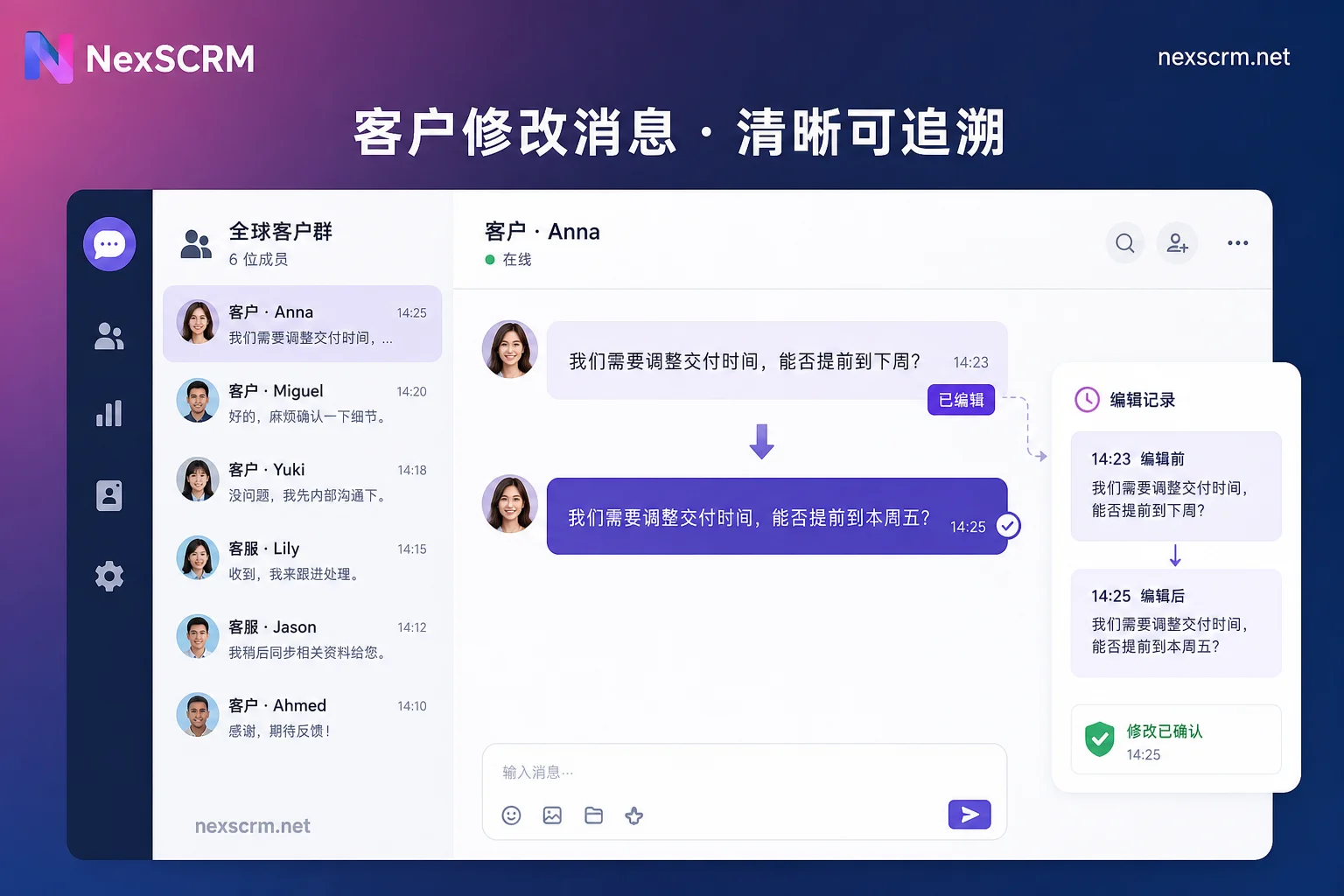
Timeliness context: On August 12, 2026, the LINE developers' official announcement stated that the Messaging API added a messageEdited Webhook event. When a user edits a sent text message in a group chat containing an official account, the system pushes the edit event with a separate replyToken (as described in the LINE developers' official announcement). This means if the customer changes the address or specs in the group chat and the customer service system does not adapt, it will continue to fulfill based on old data, easily leading to wrong item disputes.
First, distinguish three types of return/exchange requests
Return/exchange requests roughly fall into three categories: product issues, logistics issues, and buyer's remorse. These differ greatly in evidence, responsibility, and room for compromise. If you misjudge the type, all subsequent scripts will go off track.
| Request Type | Typical Scenario | Evidence Required | Responsibility | Room for Compromise |
|---|---|---|---|---|
| Product Issue | Wrong item, defect, missing parts | Customer provides outer box label, defect close-ups, unboxing video | Merchant bears | Can offer exchange, reshipment, partial compensation |
| Logistics Issue | Shipping damage, delay | Customer provides label and damage photos, merchant coordinates with logistics | Depends on logistics responsibility | Can assist with claims or reshipment |
| Buyer's Remorse | No longer wants, wrong spec ordered | Customer bears return shipping cost (if any) | Customer bears | Can negotiate partial refund or discount coupon |
3 quick questions to judge
- Has the customer exceeded the no-questions-asked return window? (Based on your platform's return window)
- Did the problem occur during shipping? (Check if the label is intact)
- Did the customer clearly state "I don't want it"? (Buyer's remorse type)
Once you've judged, proceed to Stage 1.
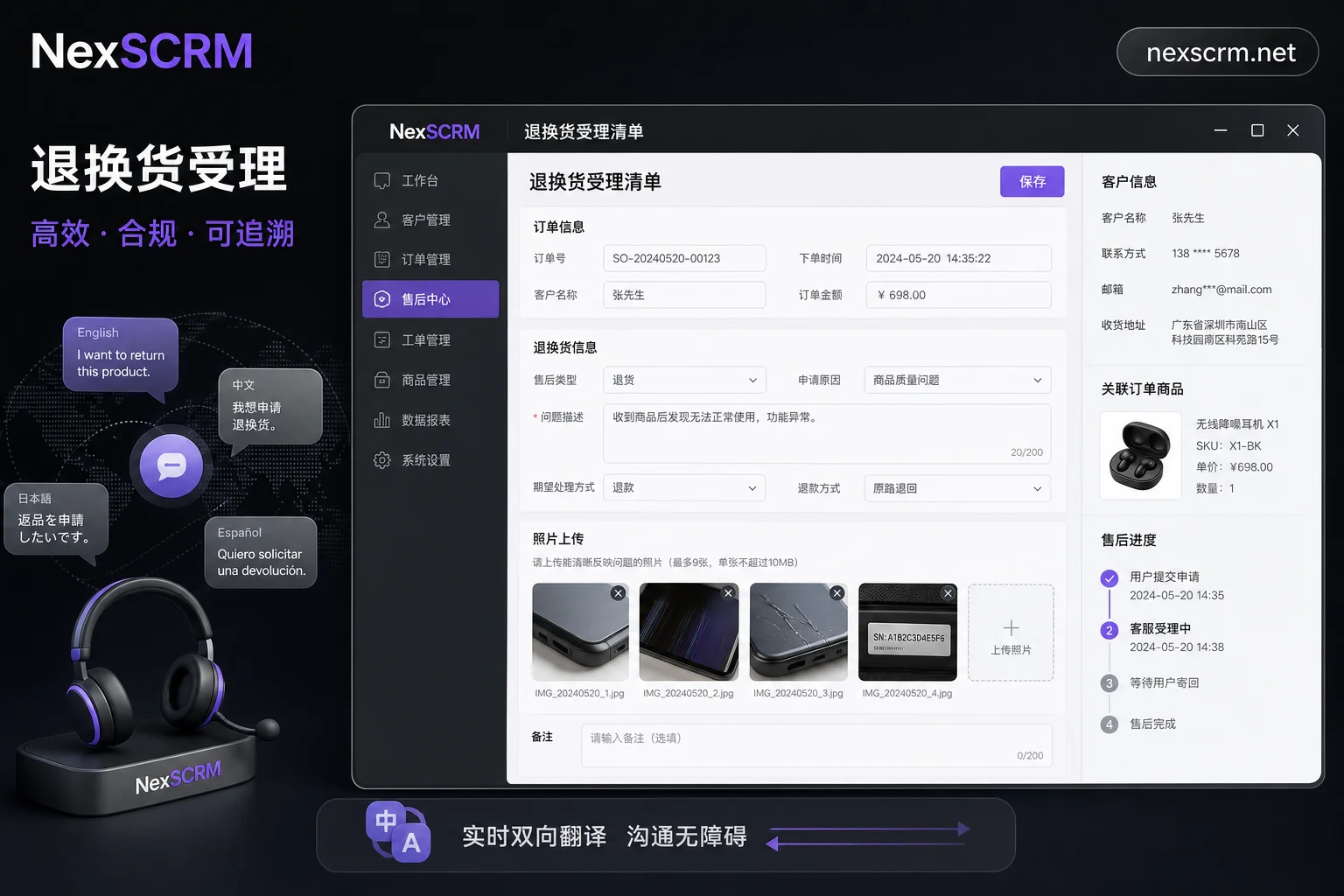
Stage 1: Acceptance & Information Collection: How to ask for order number, problem description, and evidence photos all at once
The worst thing in the acceptance stage is repeated questioning. Each follow-up question erodes the customer's patience and increases dispute likelihood. The right approach is: first, a short empathy statement, then list all required info at once, and finally give a timeline.
Chinese original:
很抱歉给您带来不便。为了尽快帮您处理,请一次性提供:①订单号或运单号;②问题描述(文字即可);③外箱和面单照片;④开箱视频(如有);⑤瑕疵特写照片(若涉及产品问题)。我们将在【时效】内答复下一步方案。
English key points:
We're sorry for the inconvenience. Please provide all of the following together: order/tracking number, description, photos of outer box & label, unboxing video (if any), and close-up of the defect. We'll reply within [time].
Japanese key points:
ご不便をおかけして申し訳ございません。以下の情報をまとめてご提供ください:ご注文番号、状況説明、外箱と伝票の写真、開封動画(あれば)、不良箇所のアップ写真。回答は【期日】以内にご連絡いたします。
Vietnamese key points: Keep the structure of "apology sentence + information list + timeline sentence"; use appropriate honorifics (anh/chị) based on the customer's age/gender, and avoid imperative verbs; e.g., use "Vui lòng cung cấp" instead of "Cung cấp". This is a structural note, not an official standard.
Sentence skeleton: Empathy sentence + list sentence + timeline sentence. Asking three times in pieces makes the agent look unprofessional and is often seen as evasion. Standardize the list as a template to reduce typos. Turning the intake checklist into a standard template is also the easiest win for customer service automation.
Stage 2: Responsibility Determination: Which info must the customer provide, and which should not be requested from them
The core of responsibility determination is distinguishing between "evidence the customer should provide" and "evidence the merchant should check." External evidence of wrong items, missing parts, or damage (label, unboxing video, defect close-ups) should come from the customer; internal info like warehouse outbound records, weighing, and shipping batch, the merchant should check themselves—don't make the customer chase the courier.
Here's a comparison of bad vs. good sentences:
| Scenario | Bad Sentence | Good Sentence | Reason |
|---|---|---|---|
| Wrong item | Please verify the weight with the courier company | We will check the shipping batch and weighing records; you only need to provide a photo of the label | Keep internal checks with the merchant, reduce customer burden |
| Missing parts | Are you sure you didn't take it out? | Did you record a video when unboxing? If you have already unpacked, could you provide a photo of the outer box to confirm if it was resealed? | Use questions instead of accusations to avoid escalation |
| Damage | The courier won't pay; we can't do anything | We have filed a claim with the courier and will arrange a reshipment for you; please provide a photo of the damage for our records | Offer action instead of deflection |
Avoid making the customer re-provide evidence after they've already provided it once; only ask for other dimensions subsequently. Be mindful of tone in other languages to avoid sounding blunt.
Stage 3: Offering Solutions: Order of presentation for refund, exchange, or partial compensation
Present solutions in the order "fact confirmation → solution options → deadline." Don't reveal all your concessions at once to prevent the customer from pushing further.
Template structure:
We have confirmed [fact]. We can offer you the following options: A [Option 1]; B [Option 2]; C [Option 3]. Please let us know your choice before [deadline]; if we do not receive a response, we will proceed with [default option] on your behalf.
Multi-language note: Solution terms must be field-based; list amounts, timelines, and responsible parties separately, not as a full sentence translation to avoid ambiguity. For example:
| Field | Example |
|---|---|
| Solution name | Exchange/Refund/Partial compensation |
| Amount | Full/50% |
| Timeline | 3-5 business days |
| Bearer | Merchant/Customer |
This way customers can understand at a glance, and it's easier to translate.
Stage 4: Refusal or Partial Responsibility: Sentence structure to say "can't do" clearly without escalating
When you need to refuse the customer (e.g., beyond return period or non-quality issue not willing to take full responsibility), use a four-part structure: buffer apology → basis statement → clear boundary → alternative solution. The difficulty in cross-border e-commerce is never "saying no," but ensuring the customer is still willing to communicate after you say it—this is where the four-part structure helps.
Four-part template:
We fully understand how you feel (buffer). According to our after-sales policy [basis], this case does not support a full refund (boundary). However, we can offer you [alternative].
Japanese buffer phrases (クッション言葉): Start with "恐れ入りますが" or "申し訳ございませんが" instead of saying "できません" directly. Indirect refusals like "難しいですが" are more polite than a direct "できません". For tone control with customers in Japan and Taiwan, refer to LINE private domain customer service multilingual communication tips for Japan and Taiwan. Note: Japanese buffer phrases are for refusals or requests; if it's clearly your own fault, apologize directly without a buffer.
| Language | Direct hard refusal | Rewrite suggestion |
|---|---|---|
| Japanese | できません | 難しいですが、代わりに... |
| English | No, we can't | We're unable to... however, we can... |
| Vietnamese | Không thể | Xin lỗi, anh/chị có thể... |
Note: Do not cite any platform-specific policy terms or compensation ratios; only say "our after-sales policy". In Vietnamese, direct imperative sentences can seem harsh; add politeness particles and honorifics. Buffer phrases are for refusals or requests; if clearly our fault, apologize directly without buffer.
Stage 5: Execution & Closure: Shipping number, timeline commitment, and follow-up closing scripts
During execution, clearly confirm the final shipping address, provide the return tracking number, commit to a viable timeline (e.g., 3-5 business days, not "soon"), and agree on a follow-up time.
Closing script:
The above solution is confirmed. The final shipping address is [address]. The exchange tracking number will be provided within [timeline]. We will follow up again on [date]. Please keep an eye out.
Satisfaction confirmation before closing:
Is the outcome satisfactory? If you have any other issues, feel free to reach out.
Key: The script must repeat the final address and specs to avoid another error.
The five stages above form the complete skeleton of the cross-border e-commerce return/exchange customer service script and multi-language template. Missing any stage will push conflict to the next.
The Overlooked Aspect: If the customer changes the address in the group chat, how to confirm which version is authoritative
This scenario is often overlooked but carries high dispute risk. After the LINE update on August 12, 2026, users can edit sent messages in group chats. If the edit event is not captured, the customer service system may fulfill based on the old address. Industry technical analysis also indicates that customer service inboxes that do not adapt to edit events will continue to rely on stale data, so the system must store timestamps of message edit history.
Response script:
You mentioned earlier [quote the original]. For confirmation, please reply "confirm" to indicate the following address is the final shipping address: [address]. If not confirmed, we will use the original address in the order system.
Technical side recommendation: Adapt to the LINE messageEdited event (integration guide in LINE official account and SCRM system integration tutorial), store edit history timestamps, and confirm the final version with the customer in communication. If the system is not adapted, at least manually @ the customer in the group chat to confirm. If using tools with message backup capabilities like NexSCRM, you can directly trace the conversation record of that message.
Three High-Risk Sentence Types from Machine Translation: Refusal, Blame, Evidence Demand
Machine translation tends to ruin the tone of these three sentence types:
| Type | Chinese Original | Translation Risk | Rewrite Idea |
|---|---|---|---|
| Refusal | 我们无法退款 | Too blunt, especially offends Japanese customers | Add a buffer phrase and offer alternative |
| Blame | 您当时没拍视频吗? | Sounds like accusing the customer | Change to "Was it possible to record a video when unboxing? It would help us process faster" |
| Evidence demand | 请尽快上传照片 | Commanding tone | Change to "Could you please upload photos when you have a moment? We'll follow up promptly" |
Human backup: Sentences involving money, responsibility, and refusal must be reviewed by a human before sending; don't directly use translation tools.
How to Maintain Multi-language Templates: Field-based Splitting and Minimal Viable Version Set
The real maintenance cost of cross-border e-commerce return/exchange templates is not translation but version management. There is no standard answer to "how many languages to prepare"; determine your minimal language set based on your market share. Split templates into a fixed sentence skeleton plus variable fields (order number, amount, timeline, solution name). When changing one thing, only modify the skeleton, not the fields.
For example, the skeleton "We have arranged [solution] for you, which will arrive within [timeline]" can have fields substituted. Archive translations alongside the original for dispute review. Archiving manually is hard to sustain; tools like NexSCRM, which support real-time two-way translation, message backup, and aggregation across WhatsApp/LINE/Zalo, keep the original, translation, and conversation in one customer timeline, allowing review by conversation when disputes arise.
FAQ
How to ask for evidence photos for missing items without hurting the relationship?
Lead with empathy, then request: "We're very sorry for the inconvenience. Could you provide the unboxing video or a photo of the outer box? We'll quickly verify and reship." Use "to help us process faster" instead of "must provide," and explain the purpose.
How to reply to a Japanese customer complaining about a wrong item?
If it's clearly our fault, apologize directly and offer a reshipment plan, no buffer: "この度は誤配送により、大変ご迷惑をおかけし誠に申し訳ございません。すぐに正しい商品を再送いたします。" Buffer phrases are for refusals or requests; if clearly our fault, apologize directly.
When a customer changes the address in the group chat, how to confirm which version prevails?
Quote the original text before and the modified info after, ask the customer to reply "confirm" or leave a message specifying the final address, and save the conversation timestamp. If no system auto-capture, manually @ the customer to confirm.
How many languages should the return/exchange templates be in?
Based on your target market share. Usually cover English, Japanese, and add Vietnamese or Indonesian for Southeast Asian markets. Prepare at least one full set of return/exchange process templates per language, which can be shared via field-based splitting.
How to write a return/exchange email template in English?
Structure: Subject line contains the order number; opening apology (if at fault); body lists the problem, solution, timeline; closing with a contact email. Avoid blunt language; use "we are sorry" and "we will" to express action.


Comments(0)