 NexScrm官方博客
Cross-border e-commerce customer service scheduling should be based on the active hours of customers in their time zones, not local working hours. First, map the conversation coverage window using the last 30 days of session data, then decide on the shift model and staffing per shift, and finally incorporate handover rules and channel costs into the schedule. Message pile-ups in the morning, high first response times, and lost leads are all signs that the baseline is wrong.
This article clarifies three things: which multi-time-zone shift models suit which teams, how to calculate the minimum number of staff per shift, and whether night shifts are worth keeping after WhatsApp's per-message pricing for in-window replies returns from October 2026.
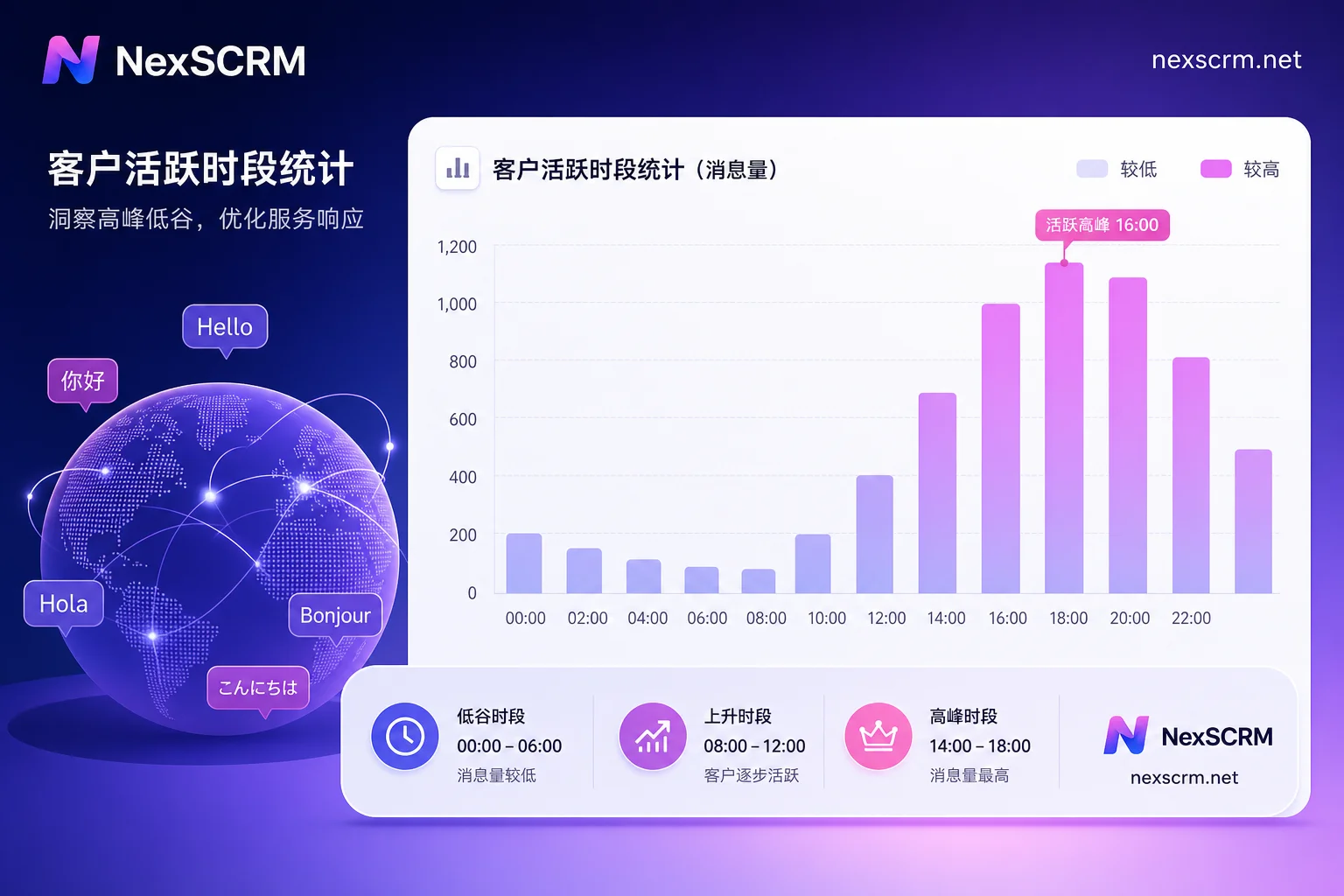
Step 1: Turn Customer Time Zones into a Coverage Table and Calculate the Actual Hours Requiring Human Attention
Don't rush to schedule shifts. First, pull the session initiation times across all channels for the last 30 days, and tally message volume by hour segment in the customer's time zone. Below is a format example (example); you need to fill in the proportions with your own session data:
| Time Slot (Customer Time Zone) | Message Volume (Example) | Human Needed? |
|---|---|---|
| 9:00-12:00 | 25% | Yes |
| 12:00-17:00 | 45% | Yes |
| 17:00-22:00 | 20% | Yes |
| 22:00-9:00 | 10% | Depending on cost |
If customers are spread across the Americas, Europe, Southeast Asia, and the Middle East, break it down further by language: separate Vietnamese, Japanese, Spanish, and Arabic messages, because you'll need this later for filling gaps with native speakers or translation fallback. This table is the sole basis for all subsequent decisions; without it, scheduling is just guesswork.
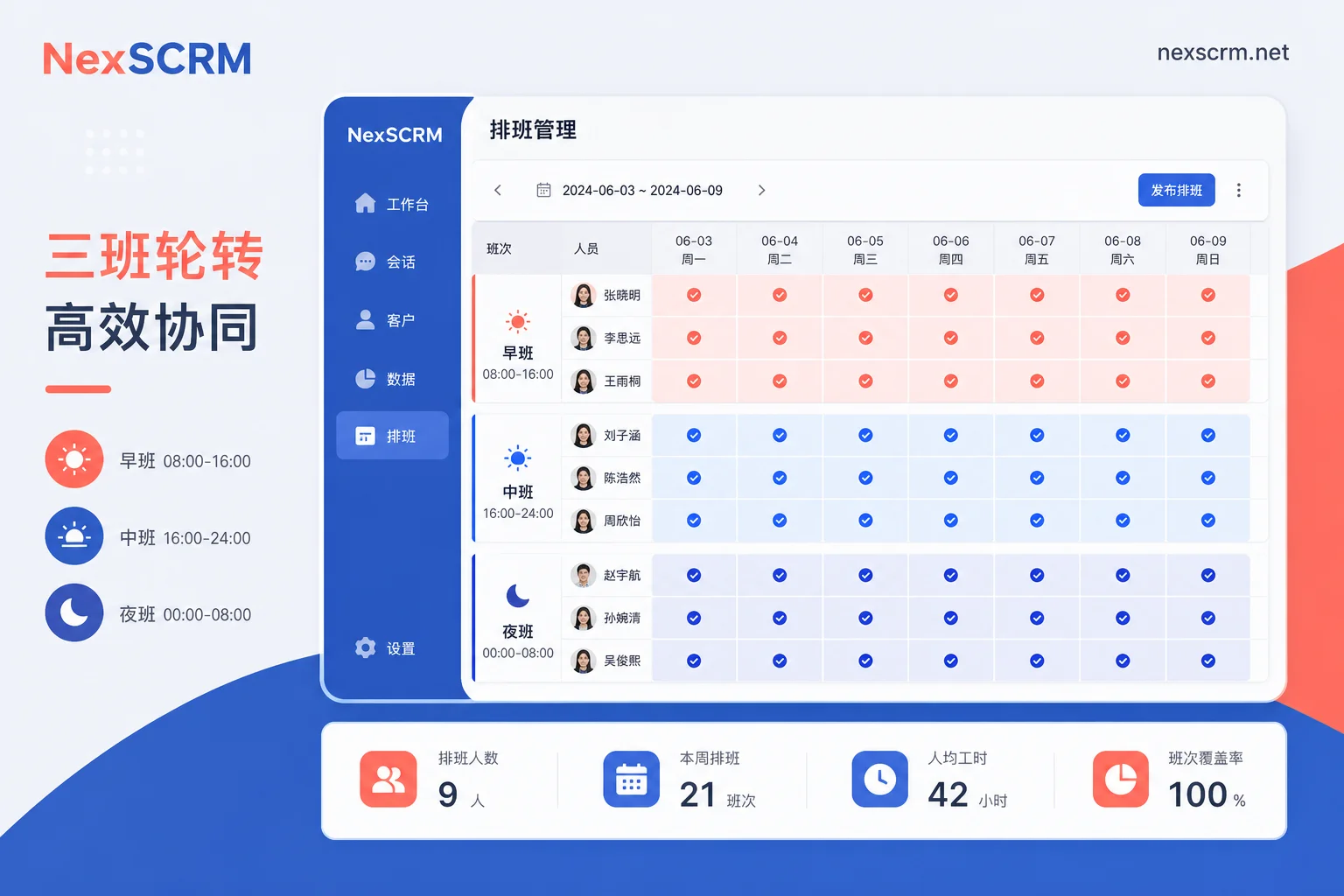
Shift Model 1: Three-Shift Rotation – How to Schedule 24-Hour Cross-Border Customer Service (Suitability, Minimum Staffing, Handover Points)
How to schedule 24-hour cross-border customer service depends on whether there is steady overnight inquiry volume. When customers span more than three time zones and there is steady overnight volume (e.g., North America and Europe online simultaneously), use three-shift rotation.
The minimum staffing per shift derives from two parameters: the acceptable waiting time (how long customers are willing to wait) and the average manual handling time per session (the actual time an agent spends on a session). The number of sessions one agent can handle simultaneously = Acceptable wait time ÷ manual handling time per session. For example, if the acceptable wait is 5 minutes and manual handling time is 2 minutes per session, one agent can handle about 2-3 sessions concurrently. These parameters must be taken from your own session logs; the example numbers here are for calculation only.
With a peak concurrency of 30 sessions and 2-3 sessions per agent, each shift needs at least 10-15 agents. Based on 3 sessions per agent, each shift would need 10 agents, so three shifts total 30, plus a supervisor and QA, about 32. However, the shift example for 20-30 person teams at the end is an 8/8/4 configuration, which reflects actual allocation based on message volume, not uniform full staffing per shift; please note this.
Shifts can be split as follows: Shift A 8:00-16:00, Shift B 16:00-24:00, Shift C 0:00-8:00 (all in headquarter time). The most failure-prone point is the late-night handover when customers are mid-conversation and context isn't passed clearly. So handovers must be logged as fields: customer time zone + language, session progress, committed items with deadlines, and assigned owner for incomplete actions.
Shift Model 2: Staggered Double Shifts – How to Split When Covering Two Main Time Zones, and How to Cover the Gap
If primary customers are concentrated in two time zones (e.g., Europe + Middle East), two shifts suffice. Time split: early shift covers Europe morning to afternoon, late shift covers Middle East afternoon to evening, with a 1-2 hour overlap between shifts for handover and peak support. Use the overlap for targeted payment follow-ups or high-value customer revisits. For the gap period (e.g., Europe late night, Middle East early morning), set an auto-reply telling customers, "We will reply within X hours." Note: From October 1, 2026, auto-replies during the gap will be billed as in-window Service messages per message, no longer free, so don't set them to high-frequency loops; only reply once after the customer's first message and provide a clear response timeframe.
Shift Model 3: Day Shift + Night On-Call – Which Types of Conversations Must Have Human Response at Night
If nighttime inquiry volume is low but you can't leave it completely unattended, use day shift + night on-call. At night, only four types of conversations require human response: high-value inquiries (e.g., large single orders, explicit requests for quotes), payment or logistics anomalies, existing customers already in the quotation process, and complaint escalations. All other conversations go into the next-day queue and are handled first by the day shift.
The on-call staff can be 1-2 people, and response time limits and escalation paths should be written into the schedule, e.g., "must respond within 15 minutes; if unresolved, escalate to the on-duty supervisor," with escalation paths specified to individuals to avoid being unreachable at night.
Don't Forget Night Shift Cost: How to Assess Worth Under Per-Message In-Window Reply Pricing
Whether a night shift is worth it now requires factoring in channel costs. According to Meta's official rate notice updated on August 25, 2026, from August 1, 2026, replies generated by Meta Business Agent are charged at $2.00 per million tokens; from October 1, 2026, free-form replies (Service messages) sent by human agents or third-party AI within the 24-hour customer service window, and Utility template messages, will revert to per-message billing and no longer be free. Direct and BSP connections must bind a valid payment method by September 30, 2026, or message services may be interrupted.
This change applies only to WhatsApp Business Platform (Cloud API/On-Premises API) WABA business accounts; native free Business App and web manual replies are unaffected. Official tiered rates are still being released, but we can set up the formula now:
Night cost = Night session volume × Estimated message rounds × Unit channel cost + Labor cost
Compare this against the value of orders facilitated or recovered at night. If night session volume is low, rounds are high, and channel costs are rising, the goal of on-call shifts should shift from "reply quickly" to "advance the conversation to the next step within the window," guiding customers to quotations or orders rather than idle chat.
Handover Rules: Session Context, Translation Original and Translated Text, and Incomplete Actions Must Be Transferred with Each Shift
Given the frequent mention of handovers, here is a ready-to-use template answering "How to hand over a customer chat mid-conversation at shift change." Handover content includes at least three items: session context, translated original and translated text, and incomplete actions with commitment deadlines. For example:
- Customer A: Dubai, Arabic, quoted $2,000, requested confirmation within 24 hours, translated chat history saved.
- Incomplete action: follow up on payment by 10:00 tomorrow.
Handovers should be recorded in system fields, not verbal or in group messages. Complete cross-shift context transfer relies on aggregated sessions and message backup across multiple platforms. See customer service automation for ideas on archiving session records and translations automatically, with one-click retrieval at handover.
Filling Small-Language Time Slots: The Boundary Between Translation Layer Coverage and Human Fallback
For slots with Vietnamese, Japanese, Spanish, or Arabic, native-speaking agents may be scarce. The boundary is clear: routine inquiries (order status, logistics tracking, product specifications) can be handled by non-native agents with real-time two-way translation; contract terms, price negotiation, complaints, and compliance issues must be handled by native or senior agents. Mark each agent's language proficiency in the schedule, e.g., "Japanese business level," "Spanish daily level + translation backup." Also, for Japanese and Traditional Chinese time slots, be aware of local communication habits; see LINE private-domain customer service multi-language tips for Japan and Taiwan markets.
Non-native agents need real-time two-way translation within the same session interface. NexSCRM offers real-time two-way translation for WhatsApp, Telegram, LINE, and Zalo, with translation results automatically archived to reduce switching costs. For using auto-replies in small-language gaps, see AI auto-reply bot configuration tutorial for cross-border customer service to decide trigger conditions.
Shift Schedule Examples for Three Team Sizes and KPIs for Review After Two Weeks
The three tiers below are the most common team size ranges for cross-border e-commerce customer service.
| Team Size | Shift Model | Shift Example | Language Configuration | Coverage Scope |
|---|---|---|---|---|
| 3-5 people | Day shift + night on-call | Main shift 9:00-18:00, night on-call 18:00-9:00 (1 person) | English + one small language | Only four high-priority conversation types |
| 8-12 people | Staggered double shifts | Early shift 8:00-16:00 (4 people), late shift 16:00-24:00 (4 people) | English + Spanish + Arabic | Cover two main time zones |
| 20-30 people | Three-shift rotation | A 8:00-16:00 (8 people), B 16:00-24:00 (8 people), C 0:00-8:00 (4 people) | Multi-language full coverage | All periods, dynamically adjusted by message volume |
Note: The 20-30 tier is an actual allocation based on message volume, not a full staffing of "capacity per agent × number of shifts."
After two weeks online, review these metrics: customer active hour coverage (actual coverage ratio of peak hours), first response time percentiles (P50, P90), post-handover conversation stagnation rate (share of sessions with no reply within 2 hours after handover), and night session progression rate (share of night sessions that progressed to quotation or order). Ensure the data scope aligns with shifts; otherwise, attribution is impossible. Message volume and response times within shifts need automatic statistics; use NexSCRM's messaging and marketing data statistics features.
Frequently Asked Questions
Should cross-border e-commerce customer service work night shifts?
Look at two numbers: night session volume and night session value. Decision criterion: Is "night session volume × estimated message rounds × unit channel cost + night labor cost" lower than the value of orders facilitated or recovered at night? Set a threshold based on your own average order value. If there are high-value inquiries or payment anomalies at night, someone must be on call. Additionally, as WhatsApp in-window replies revert to per-message billing from October 2026, include channel fees in night shift costs; use the formula to decide.
How many customer service agents are enough for foreign trade?
Calculate in two steps: First, minimum concurrent online staff = peak concurrent sessions ÷ sessions per agent. For example, peak concurrency of 20 sessions, acceptable wait of 5 minutes, manual handling time of 2 minutes, 2-3 sessions per agent, so 7-10 agents needed online. Second, total staff = concurrent staff × number of shifts (coverage hours ÷ shift duration) × redundancy factor. For example, covering 16 hours with 8-hour shifts requires 2 shifts; 7 × 2 = 14, with a 1.2-1.5 redundancy factor gives 17-21 people. If using staggered double shifts, an 8-12 person team can cover two main time zones.
When do overseas customers usually reply?
There's no universal timetable. Take the last 30 days of session initiation times, create an hourly distribution in the customer's time zone, and overlay local holidays and work patterns (e.g., some markets have Friday afternoon differences; verify with your own backend data, don't rely on assumptions). Base decisions on data, not feelings.
How to hand over a customer chat mid-conversation at shift change?
Use a handover template recording customer time zone, language, session progress, committed items, and incomplete actions, stored in system fields, not verbally. For example: "Customer in Dubai, Arabic, quoted, follow up payment at 10:00 tomorrow." Handover quality should be measurable; see WhatsApp customer service KPIs for foreign trade teams for metric definitions.
Can you reply after the WhatsApp window expires?
After the 24-hour window closes, free-form replies are restricted; you cannot send non-template messages. Only template messages can be sent, or you wait for the customer to initiate a new message to reopen the window. Template messages require pre-approval; if sending Utility templates (e.g., order updates), they will be billed per message from October 1, 2026, with specific tiered rates still being released; refer to Meta's official documentation.
Do small-language time slots require native-speaking agents?
Not necessarily. Routine inquiries (orders, logistics) can be handled by non-native agents with real-time two-way translation, but contract, price, complaint, and compliance issues require native or senior agents. If the translation tool ensures semantic accuracy and archiving, routine sessions are fully coverable.


Comments(0)