 NexScrm官方博客
You have a list of 200 old clients, all of whom placed orders last year, and this year they have collectively gone silent. The easiest thing to do is export the numbers, paste a template, and send it all at once — which is also the fastest way to send your account into a low quality rating.
B2B re-engagement can be done, but its form is closer to "finding a reason to reopen the conversation one by one" rather than a marketing campaign. Below is the actual execution order.
First confirm what you can send now: is the window open or closed
WhatsApp's rules are designed around whether the customer has actively spoken. When a customer sends you a message, it opens the 24-hour customer service window; within the window you can reply freely. After the window closes, if a business wants to reach out proactively again, it must rely on compliant permission (opt-in) and message formats that comply with platform rules. If messages sent outside the window contain too much marketing content unrelated to historical transactions, you will face stricter review and restrictions.
For a dormant list, the window is closed for the vast majority. So the first thing is not to write copy, but to confirm who on this list has given you usable permission.
There is a difference that must be clarified first: are you using a peer-to-peer chat client like WhatsApp Business App, or an official API-based solution? The two differ fundamentally in "what formats can be sent outside the window" — the API side has template messages and a review mechanism, while peer-to-peer chat does not have that template process, but is still bound by business messaging policies and quality rating. The judgment logic in this article applies to both; for specific message formats, check the official documentation for the one you actually use, and do not apply one side's rules to the other.
opt-in is not "he contacted me before"
One often overlooked point in Meta's opt-in specification: a customer initiating an inquiry does not equal consent to receive your marketing broadcasts long term. Compliant permission must do three things — clearly state who you are, tell the other party by message category what they will receive (order notifications? restock reminders? promotions?), and provide a clear way to opt out or refuse.
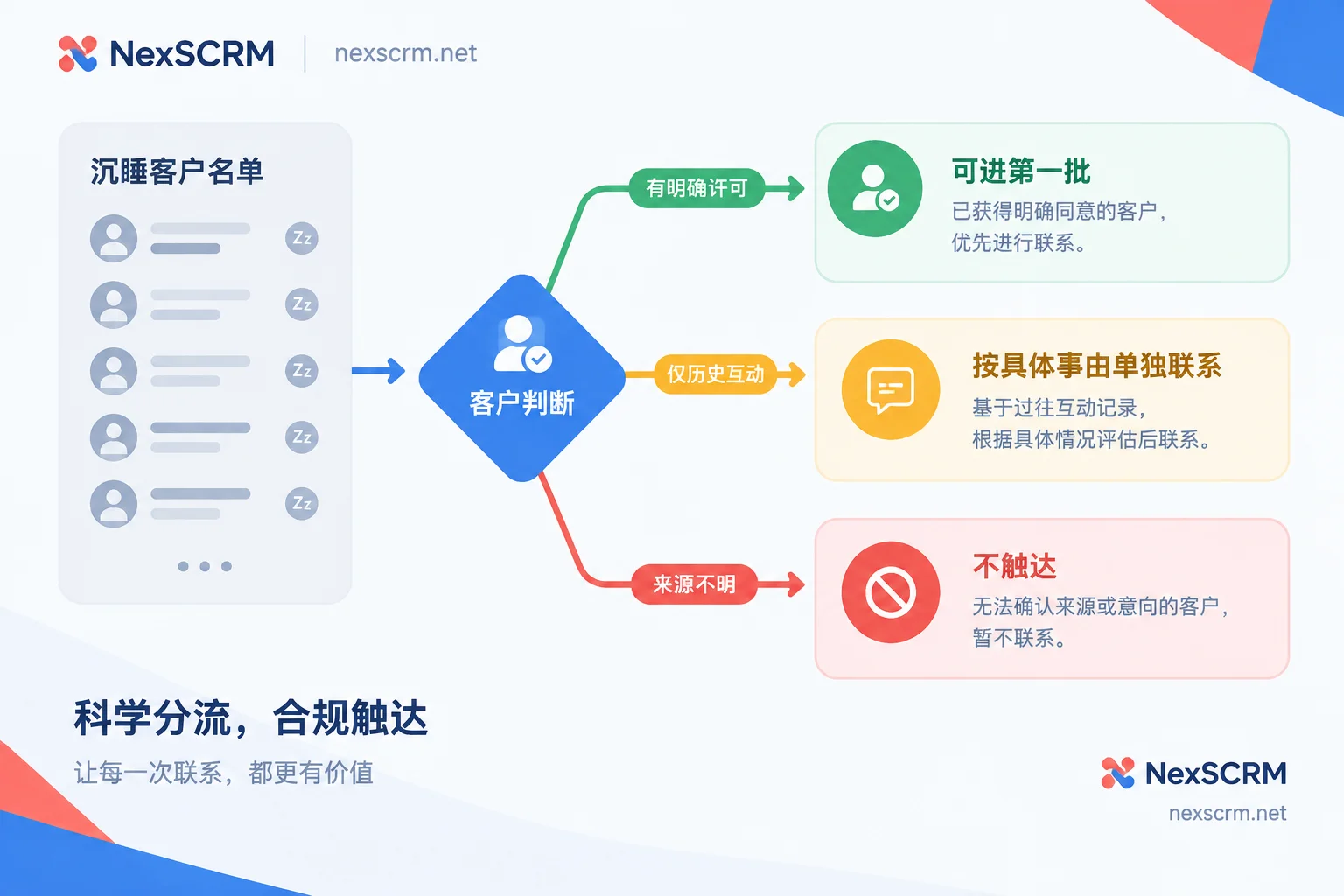
So before touching the list, divide these people into three tiers:
- Has explicit permission, and the permission category covers what you want to send: can go into the first batch.
- Only chatted, inquired about prices, or placed orders historically, but no separate receiving permission: do not treat as a broadcast target; treat as a target to contact individually only when there is a specific business reason. In B2B, this tier is usually the largest and also the most valuable.
- Unknown source, purchased list, never interacted: do not touch; these are most easily reported directly as spam.
Why you cannot mass send: quality rating will decide for you
WhatsApp enforces quality ratings (High / Medium / Low) and daily reach limits on business accounts. The rating looks not at how much you send, but at how recipients react — blocking and reporting are the heaviest negative signals. When a batch of irrelevant messages goes out, even if only a small percentage of people report it, the rating can drop a tier, the daily reachable number is pushed down accordingly, and in severe cases the account is restricted.
The direct implication of this mechanism for re-engagement is: the less relevant the send, the fewer people you can send to later. So the order should be reversed — first send to the small batch most likely to respond, preserve the rating and reply rate, then scale down.
How to rank the list: use chat history, not "last order date"
The trigger for B2B re-engagement is hidden in historical conversations, not in a date field in the customer table. There are four practical ranking bases:
Purchase cycle. Was the last order for consumables or equipment? For consumables, estimate the repurchase point by usage — if you ordered six months' worth last March, around September is a reasonable time to open. For equipment, look at the rhythm of parts, spare parts, and production line expansion. The specific cycle depends on your own category; industrial consumables, bulk FMCG, and custom equipment are not on the same scale at all.
The specific blocker from last time that prevented the deal. Quote over budget, MOQ unsuitable, certification not passed, missing a certain specification — once these blockers change (price adjustment, new specification, certification obtained), they become natural reasons to reopen the conversation, and reasons the other party truly cares about.
Categories inquired about but not purchased. The other party expressed interest, but budget was not allocated at the time.
Region and trade shows. If there is a trade show in the client's market, arranging a meeting is the least sales-like way to reach out.
To find this information, you must go back to the original chat records to search, not rely on sales memory. Once the team scale grows, the cost of this step directly determines whether re-engagement is feasible. In NexSCRM, this corresponds to cloud backup and retrieval of chat records; search historical conversations by keyword (for the difference between searching individual chats, global search, and searching all accounts, see How to search historical messages by keyword in chat records), then turn conclusions into client profile tags and follow-up reminders: tag contacts with labels like "September restock," "waiting for certification," "needs 1200mm spec," so when the condition is met you know who to contact.
What to write: one message handles one thing
The most common failure of a re-engagement message is writing it as a product pitch. The person on the other side is procurement or engineering; the first thing they judge is "does this message relate to the work in front of me."
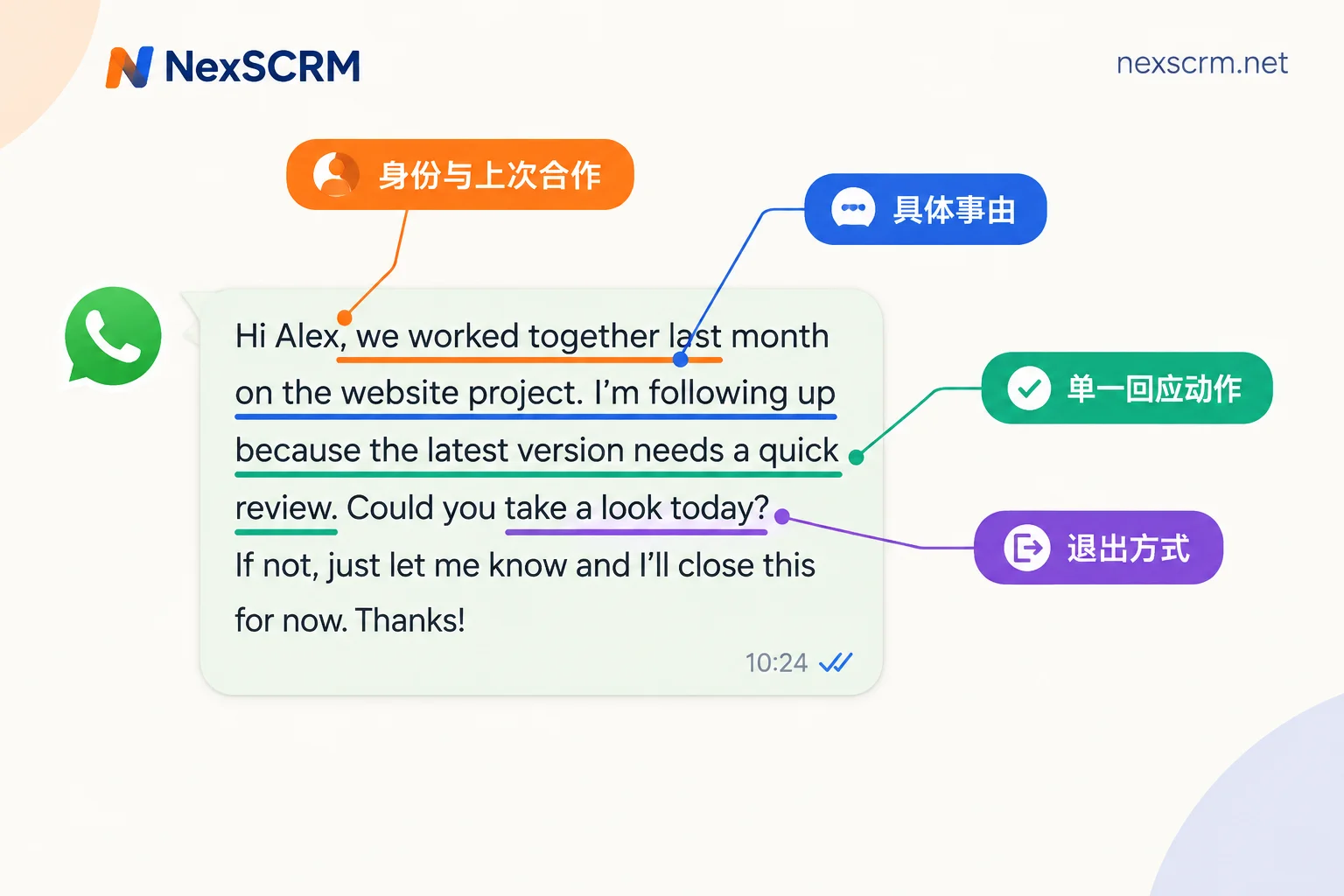
A usable re-engagement message usually contains four parts: identity and the last collaboration, one specific reason, one low-cost response action, and an opt-out method.
Hi David, this is Lily from XX Machinery. Last April we shipped you the 800mm laser cutter for your Jakarta line. There is now a 1.5mm nozzle for that model, which lasts longer on stainless than the 1.2mm one you were using. Want me to send the spec sheet? If you would rather not get these updates, just reply STOP.
What it does right: names the specific model and time, the reason is directly related to the other party's existing equipment, asks only one yes/no question, and includes an opt-out method.
Conversely, these ways of writing basically get no reply and easily earn reports:
- Opening by dumping a product catalog or a full price list.
- An opener with no direction like "Dear customer, we have new products."
- Throwing out three questions at once.
- No contact for half a year, and the first message urges an order.
When the list is large and multiple people execute, making these messages into templates with variables to unify wording is correct, but every variable must have a value — if any field like client name, model, or last order month is empty, the whole message immediately exposes itself as a mass send. For the pitfalls of these two parts, see How to use variables in quick reply templates to automatically fill in client names and How to make the whole team's answers consistent with public script templates.
Pace: small batches, watch reactions, then decide whether to scale
- Control the first batch to a few dozen people, all from the tier with the clearest permission and the most specific reason.
- After sending, stop first, observe changes in blocks, reports, and quality rating, then decide on the second batch.
- Keep proactive outreach outside the window low frequency. If the same matter gets no response, do not repeatedly send a different version within a few days — repeated pushing is the most direct source of rating decline.
- No response usually means the reason does not hold; go back and change the reason rather than increasing intensity.
After the client replies: the window is open, do not waste it
Once the client replies, the 24-hour customer service window opens. This period is the only stage where you can communicate freely; finish what needs to be done: confirm needs, send specifications, provide a quote, and agree on the next time point.
Two places where things easily go wrong:
First, the other party replies in their native language, and back-and-forth translation delays things; a day passes quickly. For which translation route to use for daily reception and when to switch when entering quote negotiations, see Which translation route to use for daily reception and quote negotiations.
Second, after a batch send, replies flood in concentrated, multiple customer service agents are following up at the same time, and it is easy for two people to take the same client, or for the person following up to not be the same as the original owner. Before sending, define client ownership (see How to prevent two customer service agents from following the same client with ticket deduplication), and first perform duplicate contact merging on the list — two numbers from the same company each receiving an identical re-engagement message is one of the most awkward failures.
Handover: the biggest fear in re-engagement is context breaking
B2B decision chains are long; clients assume you remember where you left off last time, what you quoted, and why it did not go through. If a salesperson leaves, the account changes hands, or equipment is replaced, and historical records exist only on a certain phone or in a certain salesperson's personal account, then so-called re-engagement becomes starting over, and the client's patience usually does not last until you finish your homework.
So the real preparation to do in advance is archiving: centralized retention of chat records, searchable, not tied to personnel or devices. This must be completed before re-engagement; it cannot be made up afterward.
Do not send in these situations
- The list source cannot be explained clearly.
- You search all records and cannot find a specific reason; you can only write "long time no see."
- The account quality rating has already dropped to Medium or Low; first restore the rating before anything else.
- The client has explicitly said not to contact again.
- You just want to clear inventory, and the other party has never bought this category.
After going through this round, you will find that 80% of re-engagement success or failure is before sending the message — permission tiering, list ranking, reason, and client ownership are all set, and the message itself is actually the simplest step.


Comments(0)