 NexScrm官方博客
When comparing real-time bilingual translation software for Zalo chat, the real differences boil down to three points: the stage at which translation occurs, whether translations are archived with the conversation, and whether there is fallback handling for the most error-prone aspects of Vietnamese-Chinese translation—honorifics, amounts, and addresses. In August 2026, a Vietnamese legal magazine reported that Vietnam is accelerating personal data compliance and electronic identity authentication, making enterprise-level conversation archiving increasingly the norm, and copy-paste translation approaches can no longer support audit requirements. Before jumping to install a plugin, open your Zalo settings and check which layer your current solution actually translates.
Conclusion First: What Problems Do the Three Types of Zalo Translation Solutions Solve?
Common Zalo translation solutions fall into three tiers: native client built-in translation, browser plugins, and SCRM system-level bidirectional translation. Their differences are not in "whether they can translate," but in "which layer they translate and whether the translation is retained."
| Solution | Translation Stage | Archived? | Fallback for Common Errors | Suitable For |
|---|---|---|---|---|
| Native client | Reader-side optional action, mostly manual or partial auto | Largely not archived | No business rule fallback | Individuals using occasional messaging |
| Browser plugin | Text overlay on visible area, read-only rendering | Only in browser memory/cache, not structured | None | Single-account, low-frequency ad-hoc communication |
| SCRM system-level bidirectional translation | Intercepts both incoming customer messages and outgoing agent replies | Original, translation, account, agent, timestamp all structured and archived | Configurable terminology base and business rules | Multi-account, multi-agent daily customer service operations |
If your team has more than two Zalo accounts or has shift changes and offboarding needs, the third tier becomes almost a hard requirement. The first and second tiers are sufficient for simple price inquiries but lack fallback mechanisms for honorific mismatches, digit errors in amounts, and address ordering errors common in Vietnamese-Chinese translation.
Difference 1: Where Translation Occurs: The Real Difference Between Read-Only Rendering and Bidirectional Interception
Returning to the first difference in the comparison of real-time bilingual translation software for Zalo chat: the stage at which translation occurs. Browser plugins are "readers," not "transceivers"—when you reply, they don't help translate your Chinese input into proper Vietnamese before sending. True bidirectional translation must work in both directions: auto-translate incoming customer messages and auto-translate outgoing agent messages with allowances for human correction. This interception is critical because a January 2025 public evaluation of bidirectional Chinese-Vietnamese and Vietnamese-Lao machine translation (ViBidirectionMT-Eval) pointed out that Chinese-Vietnamese machine translation, without human post-processing, tends to err on honorifics, amounts, and addresses. Read-only translation leaves all language risk on the sending side—if your outgoing Vietnamese is wrong, the customer receives the error.
So, to answer "Is Zalo's built-in translation accurate?" and "Can Zalo desktop auto-translate?": Based on public information, the Zalo client does not offer robust enterprise-grade bidirectional automatic translation; cross-border teams currently rely on plugins or system-level tools to fill the gap. The accuracy of native client translation depends on context completeness; without context, it drifts.
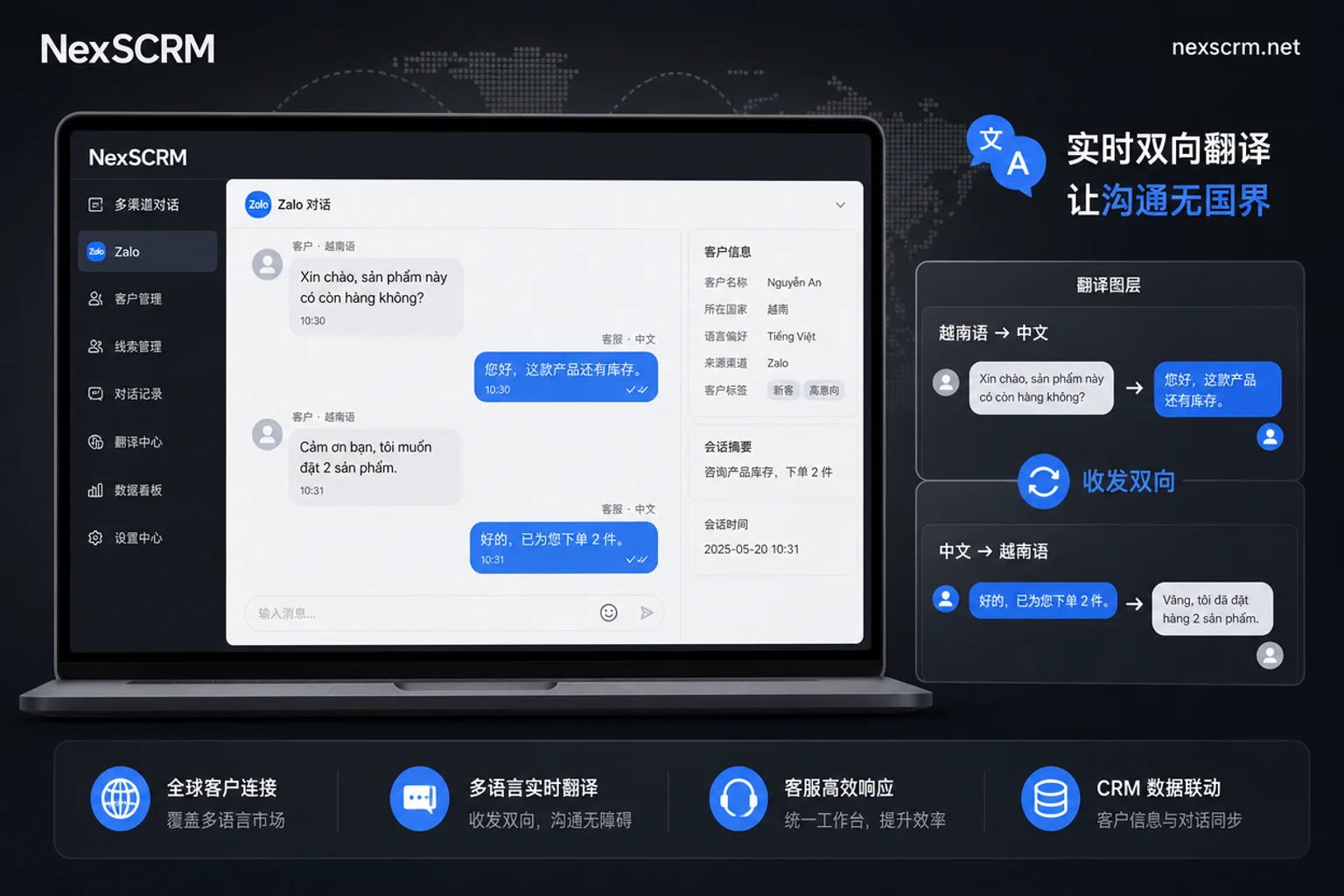
Difference 2: Multi-Account and Multi-Agent: Can Translations Be Archived and Handed Over with the Conversation?
With single-machine plugins, translations exist only in the current browser's rendering layer; when an agent switches computers, previous translations are lost. Worse, information such as the customer's original words, the translation you sent, the timestamp, and the handling agent cannot be structured and retained. SCRM system-level solutions write the original text, translation, account, agent, and timestamp into the conversation database, binding translation results with the conversation record. Taking aggregator systems like NexSCRM as an example, multiple Zalo accounts are managed in a single backend, translations are archived with conversations, and shift changes can hand off conversations with complete translation history.
This is no longer a nice-to-have in 2026. As Vietnam advances data compliance, the issue of preserving enterprise customer interaction records is being brought to the forefront earlier. This is the most core answer to "What is the difference between Zalo translation plugins and SCRM translation?": one only translates, while the other also helps you retain the asset after translation.
If you need to quickly switch between multiple accounts while preserving translation context, you can look at tools like social media aggregation customer service for handling conversation dimensions, or refer to how Southeast Asian cross-border e-commerce uses Zalo for precise customer retention for ideas on integrating translation into the broader customer operations process.
Difference 3: Three Types of High-Frequency Distortion Points in Vietnamese-Chinese Translation: Honorifics, Number Units and Amounts, and Addresses and Administrative Divisions
The most commonly mistranslated content in Vietnamese-Chinese translation is not long sentences but these three deceptively simple categories.
First, honorifics. In Vietnamese, pronouns like Anh (brother), Chị (sister), Em (younger sibling) are directly tied to relationship, age, and intimacy. Machine translation often chooses incorrectly without context. The solution is to establish fixed mappings: agents uniformly use "Anh/Chị + surname" to address customers and lock the translation in the terminology base.
Second, number units and amounts. In the Vietnamese dong counting system, thousand separators and large units like "triệu" (million) and "tỷ" (billion) are particularly prone to misreading. When a customer sends "1.500.000 đ", is it 1.5 million or 15,000? Check action: for any sentence involving amounts, always re-read the original Arabic numerals. Amounts entered into the terminology table must retain a bidirectional format. So, how prone are Vietnamese number units to errors? The errors lie in the trailing zeros.
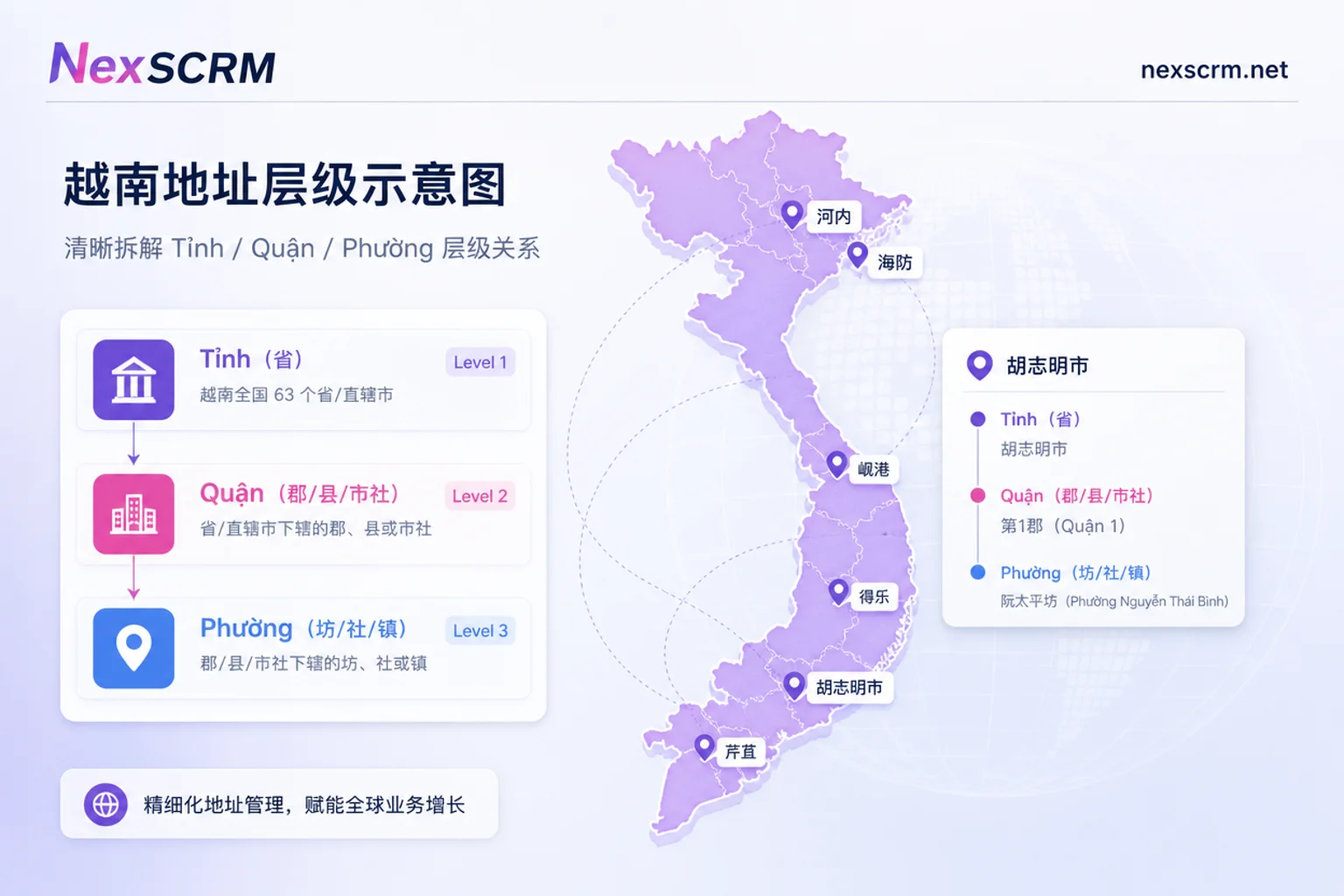
Third, addresses and administrative divisions. Vietnam's full address follows the order "house number, street, Phường (ward), Quận (district), Thành phố (city) or Tỉnh (province)", which is the reverse of Chinese. Direct translation often results in reversed order. The safest approach is to refill by hierarchy and confirm with the customer in the conversation. The answer to "What to do if a Vietnamese customer's address is translated incorrectly?" is, first, don't rush to correct it—split the original address by level, then confirm with the customer.
If your system supports a terminology base, pre-recording fixed mappings for three-level administrative divisions can save a lot of manual verification.
After Compliance Tightens, New Constraints on Translation Solutions from Conversation Archiving and Access Control
Once compliance tightens, the evaluation dimensions of the Zalo chat bilingual translation software comparison must also evolve. Vietnam's push for data compliance and electronic identity authentication brings the issue of preserving enterprise customer interaction records to the forefront earlier. Archiving and audit habits are extending to local platform communication scenarios—this is a trend observation, not an explicit requirement. To be clear: current public regulations do not impose qualification thresholds or filing requirements on translation tools themselves.
In this context, the criteria for evaluating translation solutions should expand from "whether the translation is fluent" to three layers: whether complete conversation records are retained, whether historical translations can be queried by account and agent, and whether permissions are sufficiently granular. Local plugins only cover immediate translation for the current session and break off when switching devices; system-level solutions can archive conversations and translations together. If you need to manage multiple Zalo accounts in the same backend while retaining searchable translation records, you can learn how tools like NexSCRM integrate translation with conversation management in their bidirectional real-time translation and multilingual customer service system, but note that translation accuracy is not their selling point—you need to test it with real conversations yourself.
Zalo Translation Configurations for Three Team Sizes and Pre-Launch Spot-Check Method
Based on team size, configuration recommendations are as follows:
| Team Size | Recommended Configuration | Terminology Base Ownership | Archive Responsibility | Handover Process |
|---|---|---|---|---|
| 1-2 people | Native client + browser plugin, manual review when necessary | Personal maintenance, Excel sheet suffice | Self | No fixed handover, but manually back up chat records for important quotes and addresses |
| 3-8 people | SCRM system-level bidirectional translation, enable both-direction interception | Operations lead maintains, categorized by product/logistics | Customer service team leader exports archives weekly | During shift changes, transfer conversations within the system with complete translation history |
| 9-20 people | System-level + terminology base + manual spot checks | Dedicated person maintains, versioned updates | Customer service manager audits monthly | Transfer conversation ownership in the system upon departure to ensure historical accessibility |
Regardless of the tier, it is recommended to conduct a spot-check of 20 historical conversations before launch. Method: randomly select 20 conversations from real chat records, check the bidirectional translations for honorifics, amounts/units, and three-level addresses, and record error types rather than vague impressions. If honorific errors exceed half, prioritize supplementing the terminology base; if amount/unit errors are frequent, create a bidirectional template for number formats; if address order errors are common, integrate the administrative division mapping table directly into the system. The results determine whether you need an additional manual review step.
This method is more effective than any feature list in helping you complete a comparison of real-time bilingual translation software for Zalo chat—first identify your team's actual error types, then decide whether to migrate translation from the plugin layer to the system layer.
FAQ
Is Zalo's built-in translation accurate when chatting in Vietnamese?
Zalo's built-in translation can handle simple greetings, but it is noticeably inaccurate with honorifics, amounts, and addresses. It is acceptable for casual communication, but always manually verify quotations and shipping information.
What is the most reliable way to translate between Chinese and Vietnamese in Zalo?
The most stable approach is bidirectional interception with a terminology base: incoming Vietnamese is automatically translated to Chinese, and when you reply, your Chinese is translated to Vietnamese, with a manual check of key numbers and addresses before sending.
Can Zalo desktop be set to auto-translate?
Based on public information, the Zalo client does not offer robust enterprise-grade bidirectional automatic translation; cross-border teams currently rely on plugins or system-level tools. Plugins only cover page display and cannot intercept input box content.
What is the most effective way to remedy an incorrectly translated Vietnamese customer address?
Don't rush to correct the translation. Break down the original address according to "house number, street, Phường, Quận, Thành phố/Tỉnh", compare with Chinese administrative divisions, refill level by level, and then confirm with the customer.
Are Vietnamese number units prone to translation errors, and how to prevent them?
Yes. Machine translation tends to drop or misread large units. Prevention: for all monetary messages, force a re-read of the original Arabic numerals, and include both Vietnamese units and Chinese numerals on quotations.
What is the practical difference between plugin and SCRM translation on Zalo?
Plugins only provide reader-side translation, and the translation stays in the current browser, lost when switching devices; SCRM system-level translation intercepts translations in both directions and archives original text, translation, account, and agent together. Multi-account, multi-agent teams must use system-level solutions.



Comments(0)