 NexScrm官方博客
Many people think configuring a cross-border customer service AI auto-reply bot is just connecting ChatGPT to WhatsApp and starting to chat automatically, but after launch they discover cost overruns, chaotic human handoffs, and nonsensical replies in minor languages. In reality, a complete tutorial for configuring a cross-border customer service AI auto-reply bot should follow seven steps in sequence: channel preparation, cost estimation, trigger boundaries, rules and scripts, human handoff thresholds, multilingual and multi-channel implementation, and pre-launch spot checks. Each step has clear criteria and acceptance standards.
Three Decisions Before Configuration: Which Platforms, Which Conversations AI Handles, and Monthly Budget Cap
This tutorial on configuring a cross-border customer service AI auto-reply bot has three preliminary decisions. If these are not set, writing scripts will inevitably lead to rework:
- Which platforms: Only WhatsApp, or also Telegram, LINE, Zalo? The API permissions, messaging windows, and billing rules differ significantly across platforms.
- Which conversations AI handles: Will AI handle all conversations first, or only common FAQs and logistics inquiries? This determines trigger boundaries.
- Monthly budget cap: According to Meta's 2026 new billing model, AI replies are billed by Token, while human messages are charged per message. Set a number first, then derive the AI intervention rate.
Step 1: Channel and Account Preparation: How to Set Up WhatsApp AI Auto-Reply Bot and Clarifying the "AI Ban" Rumors
First, let's clarify a widely circulated claim: Has WhatsApp completely banned AI bots? According to Meta's official developer documentation, the rumor that 'WhatsApp has completely banned AI bots' is inaccurate. Meta has not banned businesses from using AI through the official Cloud API. Instead, on July 1, 2026, Meta launched the Meta Business Agent platform, designed specifically for enterprise customer service agents, and introduced a Token-based billing system. The restrictions only target generic personal chat accounts in some markets. Enterprise use of official APIs and third-party CRM integrations (such as AI Customer Service Assistant) is open and supported.
Account Preparation Checklist:
- Register a WhatsApp Business account and apply for Cloud API access (requires business verification).
- Create an app in the Meta Developer dashboard and obtain API keys.
- If using an aggregator platform, such as Cross-border Customer Service Software, follow its instructions to bind your account.
- Record your BSUID (Business User ID). In August 2026, Meta added the
user_changed_user_idWebhook, which sends notifications when a user's BSUID changes, ensuring conversation indexing is not interrupted.
Criteria: Business verification passes, and you can receive Meta's test Webhook push.
Acceptance Standard: You can successfully send and receive a test message and receive the user_changed_user_id push notification.
Step 2: Cost Estimation: How to Convert Token and Per-Message Billing into Monthly Expense
Starting July 1, 2026, Meta split non-template replies into regular Service messages and Meta Business Agent messages, the latter billed by Token. Starting October 1, 2026, regular Service messages within the 24-hour window will also resume per-message charges. This means your AI bot will incur Token costs and message costs for every reply.
Estimation Framework:
月度成本 ≈ 会话量 × AI介入率 × 平均轮次 ×(每轮Token费用 + 每轮消息费用)
- Conversation volume: Estimate total monthly customer service conversations.
- AI intervention rate: The proportion of conversations you plan to have AI handle first.
- Average turns: The average number of back-and-forth interactions between AI and user per conversation.
- Unit price: Token costs are billed by Meta based on usage, with specific prices on the official pricing page; per-message charges have fixed rates.
Stress Testing Method: Simulate peak traffic in a sandbox environment, calculate the average Token consumption per conversation, then multiply by conversation volume to estimate monthly expense. Note that Token and message fees are double-stacked; don't forget to include both.
Criteria: Sandbox stress test covers at least 100 real conversations and calculates average Token consumption per conversation.
Acceptance Standard: Monthly cost estimate is within ±20% accuracy and includes post-October 1 per-message fees.
The above splitting rules and effective dates are based on Meta's official WhatsApp Business Platform pricing document (updated 2026-07-01). Unit prices should refer to real-time values on that page.
Step 3: Trigger Boundaries: Which Conversations Let AI Handle First, Which Must Go Directly to Human
Based on business value and risk, categorize conversations into three types:
| Conversation Type | Example | Handling |
|---|---|---|
| Common FAQs | Product specs, usage | AI first |
| Logistics inquiries | Order status, tracking | AI first, but requires order system integration |
| Negotiation/Complaints | Discount requests, refunds, complaints | Direct to human |
Cost models also constrain trigger scope: high-Token-cost conversations (like long complaint texts) should reduce AI intervention and be transferred to human for cost-effectiveness.
Step 4: Rules and Scripts: Intent Classification, Variable Fields, and Writing Multilingual Scripts
Intent classification granularity: at least distinguish six categories: "greeting", "product inquiry", "order inquiry", "complaint", "negotiation", "other". Variable fields should include order number, language, and channel source for script template calls.
Multilingual scripts: Should you write a separate version per language or use a Chinese master template with real-time translation? It depends on the number of languages. If only English and Chinese, write separate versions for better quality control; if covering more than five minor languages, use a Chinese master template with real-time translation, but be sure to manually verify translation accuracy during testing.
Example script template (don't copy directly; adjust to your product):
- "Hello, I am your intelligent customer service. How can I help you?"
- "Your order has been shipped. The tracking number is XXX."
- "If you are not satisfied with the product, we support 7-day no-reason returns. Please click here."
Criteria: Six intent categories have at least 90% agreement with manual annotation on 100 historical conversations.
Acceptance Standard: Randomly sample 10 real conversations; variable fields (order number, language, channel source) are correctly filled by the script template without null values.
Step 5: Human Handoff Thresholds: When Is It Better to Transfer from AI Customer Service to Human?
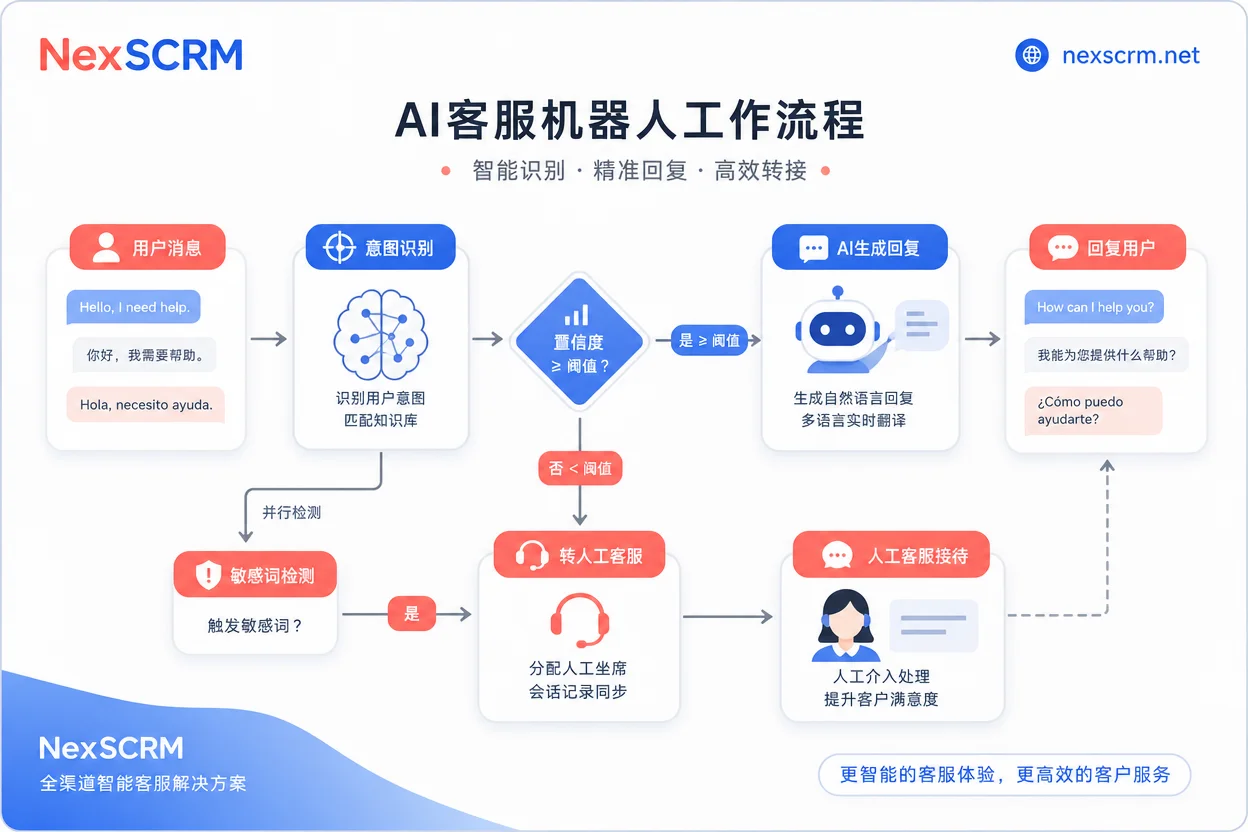
AI cannot keep chatting indefinitely; when to transfer to human is key. Standardized mechanisms include three hard boundaries:
- Confidence below threshold for 2-3 consecutive times (e.g., below 50% or triggering Fallback)
- Sensitive keyword detection (refund, complaint, legal action, etc.)
- Sentiment analysis identifies high anger
When any condition is triggered, immediately transfer to human and pass full historical context (chat logs, order info, attempted solutions) to the agent.
Criteria: AI fails to understand user intent two consecutive times, or sensitive words are detected, or sentiment analysis indicates high anger.
Acceptance Standard: After transfer, human agents can immediately take over using chat logs without the user repeating themselves.
Step 6: Multilingual and Multi-Platform Implementation: How to Configure Translation Rendering, Conversation Archiving, and Agent Assignment
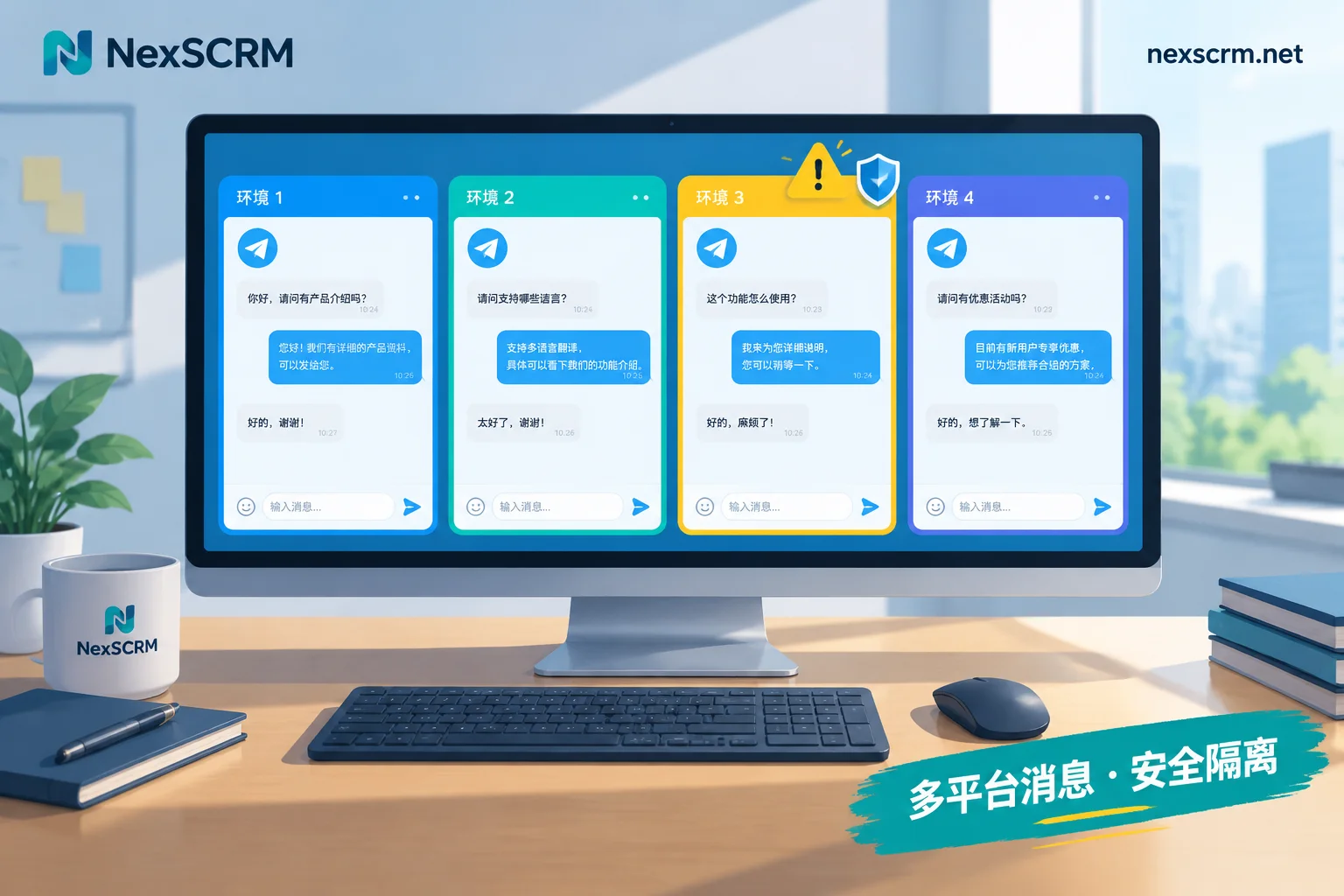
When using WhatsApp, Telegram, LINE, and Zalo in parallel, it's recommended to use a unified backend to handle conversations. For example, NexSCRM, an aggregator backend, supports multi-account aggregation and real-time bidirectional translation for WhatsApp, Telegram, LINE, and Zalo, storing both translated and original texts. Key points:
- Dual-track storage of translation and original: Keep original text; translations are for display only to avoid information loss due to translation errors.
- Conversation archiving: Archive by customer identity (e.g., email or BSUID) so conversations across channels for the same customer can be linked.
- Agent assignment: Group by language and channel, e.g., French team handles French Telegram conversations, English team handles English WhatsApp conversations.
Also, since Meta added the user_changed_user_id Webhook, when a user's BSUID changes, the backend must catch this push and update the conversation index; otherwise, historical conversations will break.
Criteria: Successfully configure multi-account aggregation, and both translated and original texts can be stored simultaneously.
Acceptance Standard: When the same customer initiates conversations on two channels, the backend can merge them into the same customer profile, and historical conversations do not break after BSUID changes.
Step 7: Pre-Launch Spot Checks and Gray Release: Which Scenarios to Test and Which Metrics to Pass
Before launch, conduct multiple rounds of minor language spot checks, covering at least the following scenarios:
- First question: Can AI correctly identify intent on the user's first question?
- Follow-up: After user adds information, can AI continue answering with context?
- Negative expression: User says "I don't want this"; does AI understand refusal intent?
- Vague request: User says "I'm just browsing"; does AI guide to FAQs?
- Sensitive words: User mentions "refund"; does AI immediately transfer to human?
Gray release ratio: Start with 5% traffic for trial run, observe metrics, and gradually increase if no issues.
Three metrics to monitor: AI intervention rate, human handoff rate, and message count (for cost accounting). If using NexSCRM's messaging and marketing data statistics, message counts can be directly exported per channel for cost accounting.
Post-Launch Self-Checklist and Configuration Comparison for Three Team Sizes
After completing the seven steps in this cross-border customer service AI auto-reply bot configuration tutorial, use the table below to check the parameters corresponding to your team size.
| Team Size | Trigger Scope | Handoff Threshold | Spot Check Frequency | Budget Control |
|---|---|---|---|---|
| 3-5 people | Only common FAQs and logistics inquiries | Immediate transfer when confidence below 60% | Weekly | Strictly control AI intervention rate within 30% |
| ~10 people | All except complaints and negotiations handled by AI first | Transfer after 2 consecutive below-threshold | Biweekly | Set monthly Token cap; lower intervention rate if exceeded |
| 20-30 people | Most conversations AI first, but complex after-sales direct to human | Transfer after 3 consecutive or sensitive word trigger | Monthly full check | Dynamic adjustment, monitor cost curve per conversation |
Frequently Asked Questions
Has WhatsApp banned AI bots?
No. Meta is open to businesses using AI through the official Cloud API. Only some personal generic accounts are restricted. As long as you use an enterprise account and integrate via the official API, it is compliant.
How to estimate costs for WhatsApp AI replies billed by Token?
First calculate conversation volume, AI intervention rate, average turns, then multiply by Token consumption per turn and message fees. Use sandbox stress testing to get average Tokens per conversation, then multiply by volume. Don't forget per-message fees after October 1st.
When should AI customer service transfer to human?
When AI fails to understand 2-3 consecutive times, sensitive words are detected, or user sentiment is angry, transfer immediately. Ensure chat logs and order info are passed to the human agent to avoid repetition.
How to test multilingual AI auto-reply accuracy?
Use native speakers of minor languages for multi-round conversation testing, covering first question, follow-up, negative expressions, vague requests, etc., focusing on translation accuracy and intent recognition stability. Record accuracy each round. Set an accuracy baseline based on your business tolerance (e.g., acceptable lower limit for first-question intent recognition). If two consecutive rounds fall below baseline, revert scripts or adjust the model.
What scenarios should be tested before launching a customer service bot?
At least test five scenarios: first question, follow-up, negative expression, vague request, and sensitive word trigger for human handoff. All must pass before launch. Also, test minor languages; testing only in English is not sufficient.


Comments(0)