 NexScrm官方博客
In cross-border e-commerce, foreign trade B2B, and overseas private domain operations, language communication efficiency directly determines inquiry conversion rates. Finding an efficient, stable, and compliant WhatsApp translation software has become a core need for overseas customer service teams.
With the evolution of official features and the maturity of third-party technologies, current WhatsApp translation solutions come in three main forms: mobile native on-device translation, browser web version plugins, and enterprise-level cross-border SCRM aggregation systems. This article provides a comprehensive selection strategy analysis from three dimensions: technical architecture, usage scenarios, and team collaboration.
1. Comparison of Three Major WhatsApp Translation Software Forms
Businesses at different operational stages and scales have vastly different needs for translation tools. Here is a horizontal comparison of current mainstream solutions:
| Comparison Dimension | Mobile Native On-device Translation | Browser Web Version Plugin | Professional Cross-border SCRM Aggregation System |
|---|---|---|---|
| Core Technology | On-device offline/online models | Browser DOM interception and API calls | Cloud aggregation architecture with multi-engine AI routing |
| Applicable Devices | iOS / Android mobile clients | PC browsers (Chrome/Edge, etc.) | Multi-device adaptation / PC standalone client environment |
| Multi-account Support | Single device, single account only | Requires multiple browser tabs or alternate account environments | Supports unified aggregation management of multi-platform, multi-account |
| Data Security and Backup | End-to-end encryption, no centralized team backup | Dependent on plugin provider privacy policies | Automatic cloud backup of messages and data statistics |
| Team Collaboration | No multi-agent sharing | No cross-agent distribution | Supports agent assignment, ticket flow, and reply suggestions |
1. Mobile Native Built-in Translation
In recent years, Meta has continuously introduced on-device message translation features, allowing users to long-press messages in individual chats, group chats, and channels for multi-language conversion. Its main advantages are privacy security and native experience. However, for multi-agent collaboration, fast typing on PC, and batch customer management, it cannot meet the needs of team-based operations.
2. Browser Web Version Plugins
Many foreign trade salespeople are accustomed to installing WhatsApp Web translation plugins from the Chrome Web Store. These tools enable "type-to-translate" and "auto-translate received messages" on the web interface. However, when the number of enterprise accounts increases, requiring isolated multi-account environments or protection against banning and association, relying solely on browser plugins can lead to account risks and data fragmentation.
3. Enterprise-level Cross-border SCRM Aggregation Systems
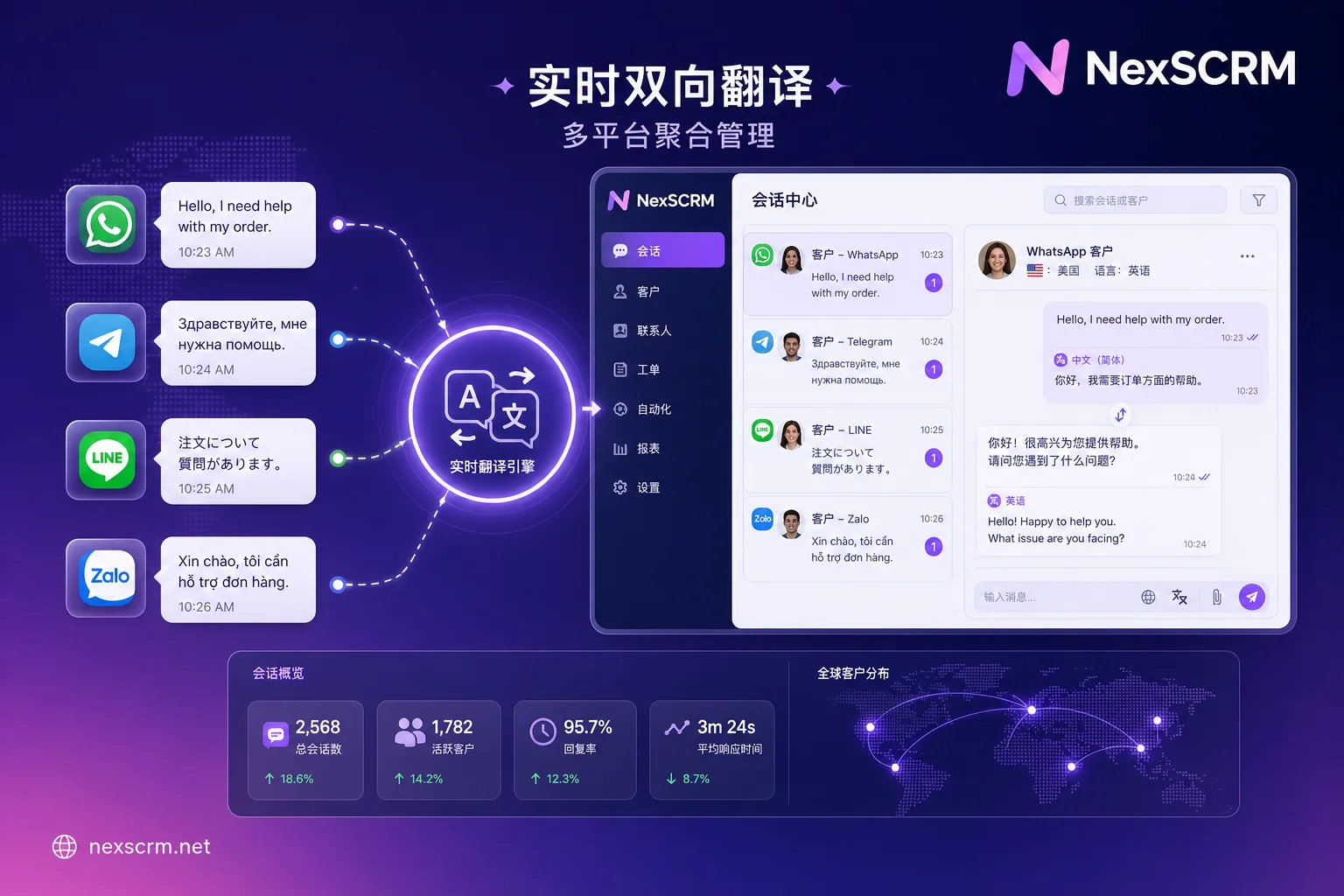
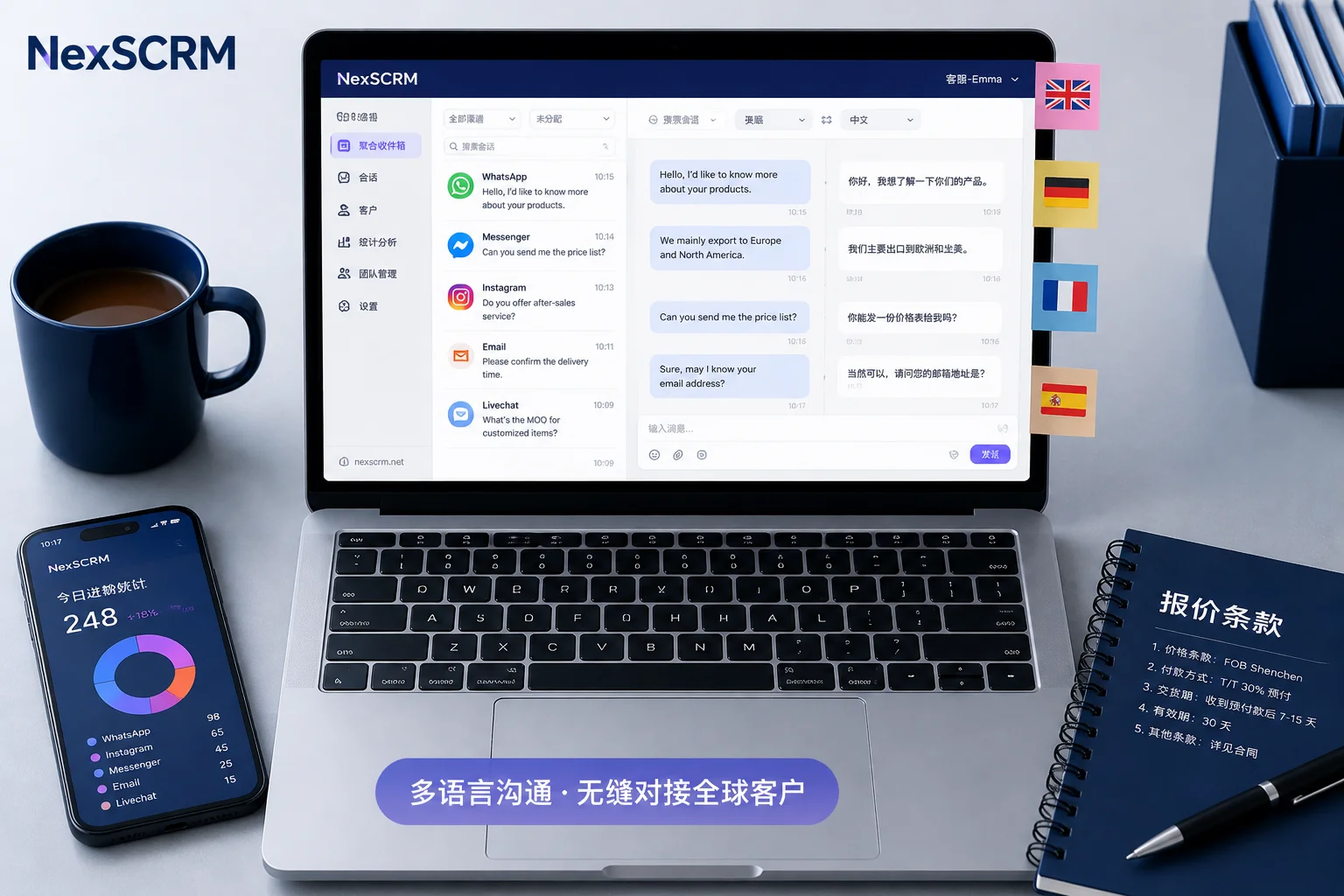
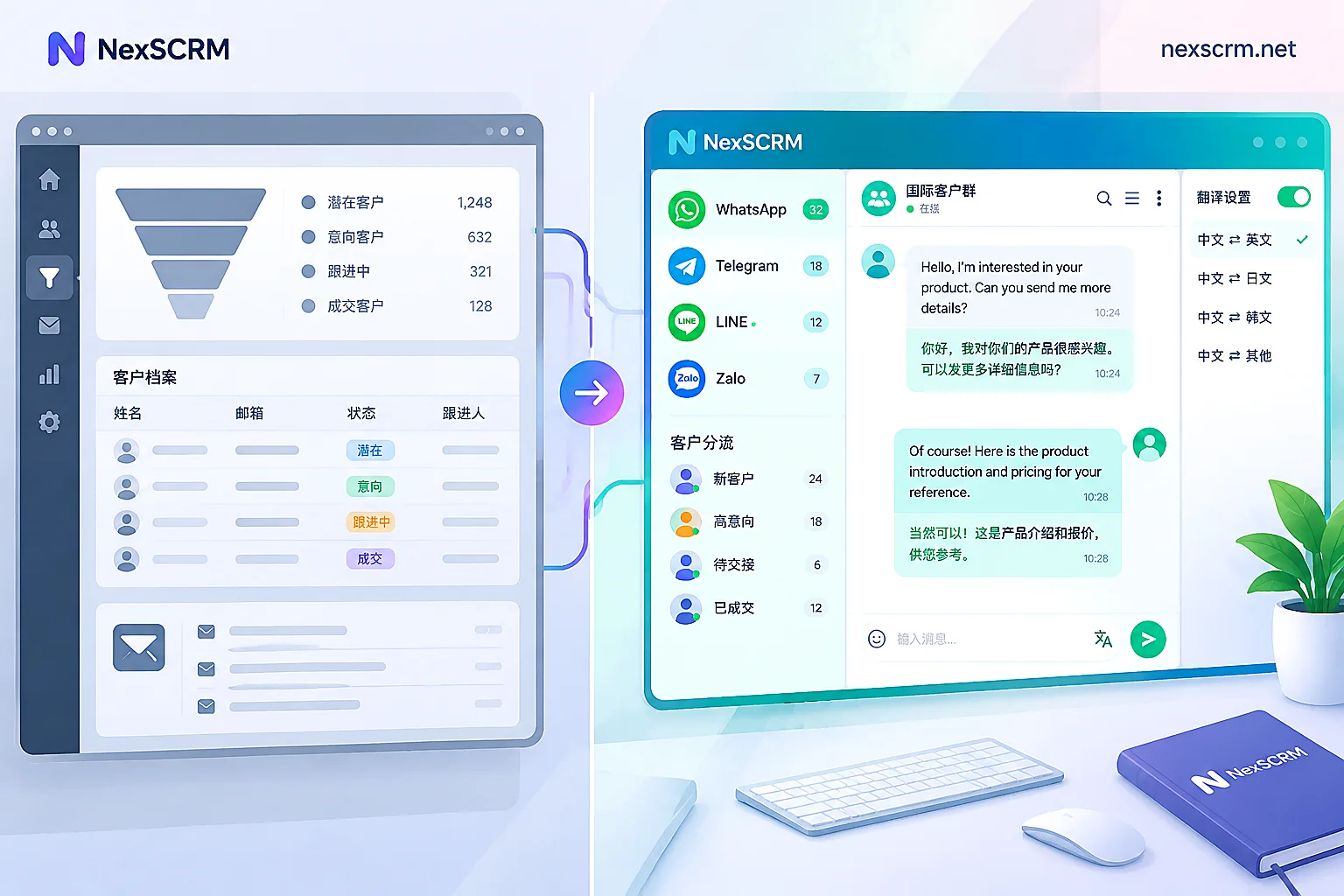
For companies with multiple customer service agents or multi-platform operations (such as simultaneously running Telegram, LINE, and Zalo), aggregation SCRM is a more systematic solution. NexSCRM, a global chat translation and aggregation marketing system, publicly offers real-time two-way translation and multi-platform, multi-account aggregation management across WhatsApp, Telegram, LINE, Zalo, etc., providing cross-border teams with independent environment isolation protection, message and marketing data statistics, message backup, and AI-assisted reply scenarios.
2. Four Core Dimensions for Cross-border Teams Choosing WhatsApp Translation Software
When selecting a specific translation tool, considering only "can it translate" is far from sufficient. Business decision-makers should focus on the following criteria:
- Two-way real-time translation and contextual accuracy
Translation software should not only accurately translate foreign language messages from customers into Chinese, but also precisely convert agent replies in Chinese into local slang or business expressions. Tools that support AI contextual understanding and industry-specific glossaries can significantly reduce communication misunderstandings. - Multi-platform and multi-account centralized control
Overseas private domain operations are often not limited to a single channel. If teams concurrently use WhatsApp Business, Telegram, and LINE, frequent window switching greatly reduces response speed. Aggregation tools that consolidate messages from multiple platforms into a unified interface are crucial. - Data asset security and backup mechanisms
Employee turnover or device failures can lead to loss of chat history. Software with message backup and cloud archiving capabilities ensures enterprise customer assets are not lost. - Operational data statistics and performance analysis
Management needs insights into inquiry volumes by language market, average response times, and post-translation conversion rates to optimize team scheduling and market investment.
3. From News Fact to Business Implementation: Building a Multilingual Customer Service Workflow
Continuous upgrades by platform officials to mobile translation features reflect the overarching trend towards barrier-free global communication. However, in actual enterprise operations, how can this barrier-free capability be translated into tangible order conversion?
Taking a typical order-taking scenario: when a customer from Southeast Asia or the Middle East initiates an inquiry via WhatsApp, combined with NexSCRM's aggregated sessions and real-time two-way translation, customer service agents can receive messages in a unified, isolated environment with automatic translation into Chinese. When replying, the system uses AI assistance to supplement product specifications and polite business language, instantly converting to the target language for sending.
Simultaneously, the system backend automatically performs message backup and marketing data statistics, helping managers review hot topics in each region and agent performance, forming a closed-loop chain of "reception - translation - conversion - archiving - analysis".
4. Practical Recommendations: 4 Steps to Build an Efficient Multilingual Order-taking System
To ensure smooth implementation of WhatsApp translation software in your team, follow these recommended steps:
- Step 1: Evaluate business scenarios and language distribution
Identify key target markets (e.g., Spanish-speaking, Arabic-speaking, Southeast Asia), clarify required languages and daily inquiry volume. - Step 2: Configure independent account operation environments
Avoid frequently switching between multiple WhatsApp accounts in the same browser. Utilize the independent environment isolation capability of professional SCRM systems to ensure long-term account stability. - Step 3: Standardize common replies and AI phrases
Pre-set high-frequency Q&A (such as shipping costs, payment terms, specifications) as multilingual shortcut phrases, supplemented by AI-assisted reply efficiency. - Step 4: Establish review and data analysis mechanisms
Regularly check translation quality and customer satisfaction, adjusting communication strategies based on backend message and marketing data statistics.
Through scientific selection and standardized processes, businesses can not only break down multilingual communication barriers but also make WhatsApp a core platform for efficient customer acquisition and retention.


Comments(0)