 NexScrm官方博客
How can Southeast Asian cross-border e-commerce use Zalo for precise customer retention? The answer is to anchor retention on two hard constraints: the "48-hour free consultation window" and "OA package tiering," then implement a four-step layered process: onboarding, tagging, closing within the window, and re-engagement outside the window—not just creating groups and broadcasting. Many teams mistakenly treat Zalo retention as "adding customers to groups and sending product images daily," resulting in soaring costs and declining response rates.
According to public data from Zalo's ecosystem in the first half of 2026, Zalo's monthly active users in Vietnam exceeded 80 million, with over 2.1 billion daily messages and a local penetration rate exceeding 80%. Simultaneously, Zalo officially implemented a new OA policy in June 2026, clarifying package tiers and messaging billing rules. This means that excelling at Zalo retention is almost an indispensable course for all Vietnamese e-commerce sellers.
First, Understand Two Hard Constraints: The 48-Hour Consultation Window and OA Packages Determine What You Can Do
The question of how Southeast Asian cross-border e-commerce uses Zalo for precise customer retention first depends on two numbers that determine cost and efficiency.
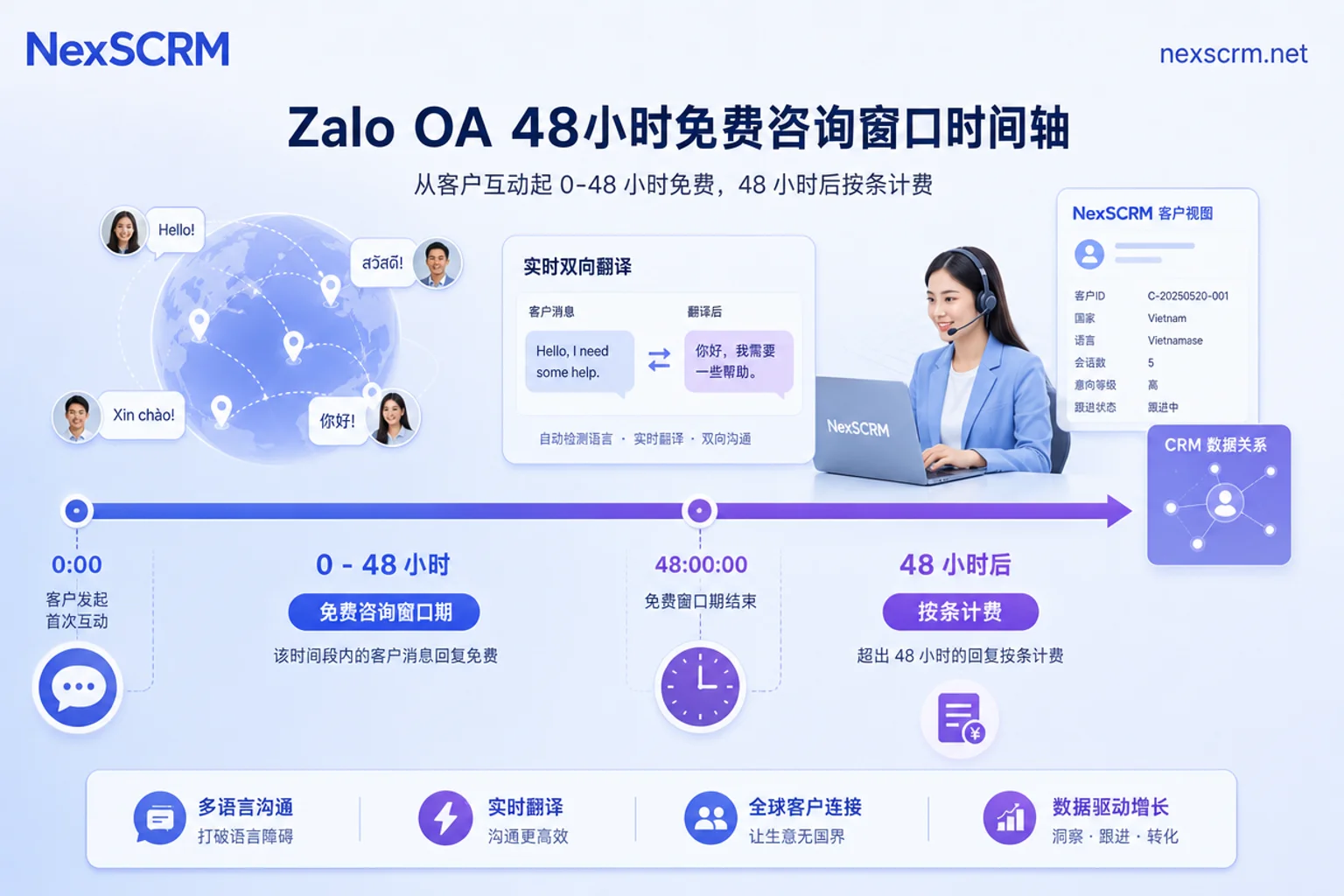
First, the 48-hour consultation window. Zalo OA sets a strict service window for consultation messages (Tin Tư vấn): from the user's last proactive interaction (sending a message, clicking a menu, calling customer service, etc.), your reply to consultation messages is completely free within 48 hours. Once beyond 48 hours, sending proactive consultation messages incurs a per-message fee.
Second, OA package tiers. Starting June 2026, Zalo OA certified accounts adopt a tiered package system. Public materials clearly define three tiers: Standard, Growth, and Comprehensive: Standard at approximately 1 million VND/year, Growth at approximately 2.5 million VND/year, and Comprehensive at approximately 6 million VND/year. The key dividing line is Growth; only at Growth and above do third-party API integration, automated Chatbot, and up to 15 agent seats unlock; Standard only supports 5 agent seats for manual one-on-one chats.
| Package Version | Annual Fee (VND) | Agent Seats | API/Third-Party Integration | Chatbot Automation |
|---|---|---|---|---|
| Standard (Tiêu chuẩn) | ~1 million | 5 | Not supported | Not supported |
| Growth (Tăng trưởng) | ~2.5 million (6 months ~1.4 million) | 15 | Supported | Supported |
| Comprehensive (Toàn diện) | ~6 million | 100 | High quota | Supported |
The above prices and rules are from the official Zalo OA policy page (effective June 2026); please refer to the official real-time page for specifics.
Step 1: Onboarding—How to Send the First Message After Customers Join from Ads, Independent Sites, and Offline Channels
Customers join from different channels, and the first message cannot be generic. Your goal is to confirm three things at the moment of onboarding: who they are, where they came from, and whether they are within the window.
Customers from ad forms: The first message should be sent within 1 minute, directly stating "I am the supplier you left your information with," and attach a product catalog PDF.
Customers from independent sites/social media: The first message should have a "low threshold" opening, such as asking "Which category are you interested in? I'll send you the corresponding quote," rather than immediately sending a massive price list.
Customers from offline trade shows/business card scans: Use voice or short video to introduce the factory's real environment, then ask "Which markets are you mainly in? I can send quotes by country."
After onboarding, ensure you record the time of first interaction in your CRM or spreadsheet—this is the starting point of the 48-hour window. Many teams miss this step, only realizing they've missed the free period after timeout.
Step 2: Tagging—What Fields Should You Record for Vietnamese Customers, and Why Must Language and Purchase Stage Be Stored Separately
"How to tier Zalo customer tags" is a pain point for many operators. Tiering isn't just adding a "Vietnamese customer" tag; you need to break it into multiple independent dimensions for precise filtering later.
It's recommended to at least tag the following five categories:
| Tag Dimension | Example Values | Purpose |
|---|---|---|
| Source Channel | Ads/Independent Site/Trade Show/Referral | Measure inquiry quality across channels |
| Communication Language | Vietnamese/Chinese/English | Determine later conversation templates and translation resource allocation |
| Product Category | Footwear/3C/Home | Push relevant new products and promotions |
| Purchase Stage | Price Comparison/Sampling/Ordering/Repurchase | Determine follow-up frequency and conversation focus |
| Last Interaction Time | Specific date and time | Determine if still within the 48-hour window |
Special reminder: Language and purchase stage tags must be stored separately. A local Vietnamese wholesaler might compare prices in Vietnamese, but the project team might have a Chinese-speaking leader—if you only store "Vietnamese," using Vietnamese language in follow-ups with the business leader will be less effective. Similarly, the purchase stage determines whether to use "urging" or "nurturing" language—never mix them up.
If you establish bilingual tags in step 2, it will be easier to execute both in-window manual follow-ups and automated tiered outreach using APIs unlocked by the Growth package outside the window.
Step 3: Closing Within the Window—Action Nodes to Push from Inquiry to Quote Within 48 Hours
Within the 48-hour free window, your only goal is: Pushing "interest" to a "clear quote." Break down actions by hour as follows:
| Time Node | Action | Conversation Points | Billing Status |
|---|---|---|---|
| 0-1 hour | First reply + confirm needs | "What products do you need? What target purchase quantity?" | Free within window |
| 1-4 hours | Send initial quote/options | Attach spreadsheet, note MOQ and lead time | Free within window |
| 4-24 hours | Address objections + adjust solutions | Provide alternatives for price/delivery objections | Free within window |
| 24-48 hours | Push for order + request sample address | Offer sample discounts or tiered pricing | Free within window |
Cost implication within the window: Every consultation message you send is free. The window starts from the customer's proactive interaction; reply alone doesn't refresh the timer. For specific determination, refer to the Zalo OA official billing page. Agent seats directly limit your in-window capacity. Standard only offers 5 seats and no API, so if inquiries are high, manual handling will be overwhelmed. This is why deep retention requires at least the Growth package (15 seats + API).
Step 4: Re-Engagement Outside the Window—Batch and Frequency Control of Lists Under Per-Message Billing
Most inquiries are difficult to close within 48 hours. After the window, sending proactive consultation messages becomes a cost of approximately 55 VND/message. This means the answer to "how to re-engage unresponsive Zalo customers" is batched, low-frequency, and precise.
Specific operations:
- First filter lists by tags: From the tag system in step 2, screen high-intent customers with "purchase stage = sampling/ordering" and "last interaction time = 3-7 days ago" as the first batch.
- Control frequency: For proactive outreach outside the window, at most 1 time per week per customer, and automatically stop after 2 consecutive non-responses to avoid harassment.
- Personalize content: Price-sensitive customers get "weekly special" info; hesitant customers get "similar purchase cases from other Vietnamese customers." Each content must provide new value, not just repeat quotes.
- Use template messages: If ZBS Template Message is enabled, you can send notifications (e.g., logistics alerts, order status) via pre-approved templates, which are often cheaper and more reliable.
| Batch | Filter Criteria | Content | Frequency |
|---|---|---|---|
| First | High intent + active in last 7 days | Limited-time tiered discounts | 1 time/week |
| Second | Medium intent + active in last 30 days | Cases/industry trends | 1 time/2 weeks |
| Third | Low intent + silent over 30 days | New product launches/holiday greetings | 1 time/month |
Regarding "how per-message billing works for Zalo OA," simply put: For proactive consultation messages beyond the 48-hour window, each costs about 55 VND. If you have 10,000 out-of-window customers, one round costs 550,000 VND, so precise lists are more important than quantity.
Three Pitfalls in China-Vietnam Communication: Titles, Units, and Addresses—How the Translation Layer Covers Them
When Chinese teams communicate with Vietnamese customers on Zalo, they most often encounter issues in three areas:
Titles: In Vietnamese, "Anh/Chị" are respectful forms depending on the other's age and gender; using them incorrectly appears unprofessional. It's recommended to ask "How should I address you?" at the start and store the answer in tags.
Units: Vietnam uses metric units like kilograms and meters, and unit prices are often quoted in "thousand VND." Always write "xx thousand VND/item" to avoid confusion between "ten thousand" and "thousand."
Addresses: Vietnamese addresses follow "house number-street-ward-district-province," opposite to Chinese order. When requesting sample addresses, send a formatted table template for them to fill.
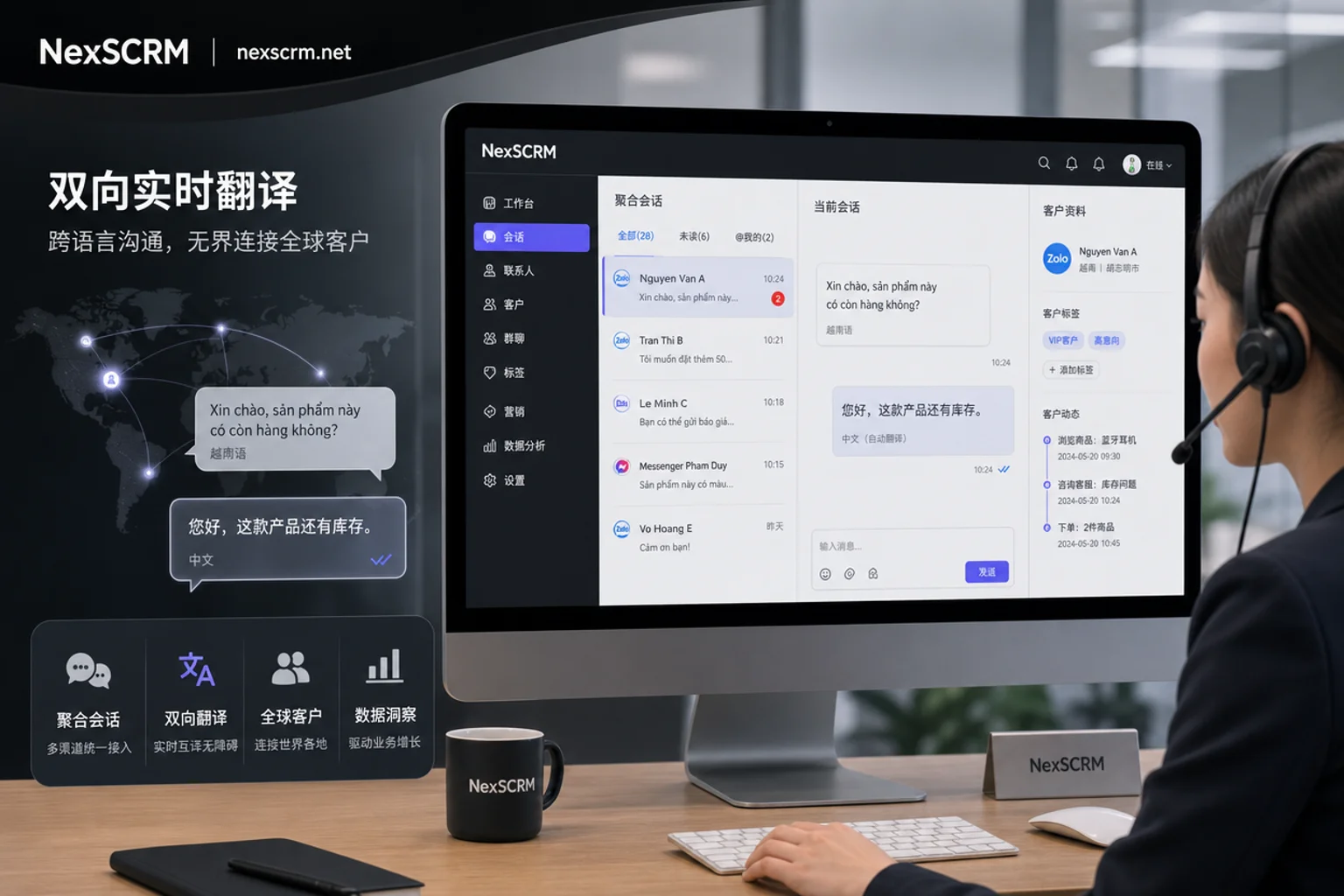
These three points can barely be handled with manual translation within the window, but batch reactivation or parallel sessions during promotions become difficult. At that point, you need tools that integrate Zalo OA conversations and support real-time bidirectional Chinese-Vietnamese translation. SCRM aggregation backends like NexSCRM consolidate multiple Zalo accounts into one workbench. With features like bidirectional real-time translation, Chinese customer service agents can directly send Vietnamese scripts, and after saving to the CRM, the other party confirms—significantly improving efficiency. This four-step retention process can also run within a similar social media aggregation customer service system.
Zalo Retention Configurations and Self-Check Checklist for Different Team Sizes
How Southeast Asian cross-border e-commerce uses Zalo for precise customer retention ultimately comes down to three configurations: package, seats, and tags. Back to the question "Does Zalo OA require payment for API access?" The answer is yes. Standard (approximately 1 million VND/year) and below do not open APIs at all; to use APIs and Bot automation, you must upgrade to Growth (approximately 2.5 million VND/year). This is a hard rule since June 2026.
| Team Size | Recommended Package | Agent Seats | Core Configuration |
|---|---|---|---|
| 1-3 people small team | Standard | 5 | Manual one-on-one chat + in-window follow-up |
| 3-10 people growing team | Growth | 15 | +API automation, tag-based tiered re-engagement |
| 10+ people multi-account | Comprehensive | 100 | +High-quota API, multi-account aggregation |
Self-Check Checklist:
- [ ] Have you recorded the first interaction time for each customer and set a 48-hour timeout reminder?
- [ ] Does each customer have five-dimensional tags: "source + language + category + purchase stage + last interaction time"?
- [ ] Do you have four sets of in-window scripts ready: "confirm needs → quote → handle objections → push for order"?
- [ ] Are out-of-window re-engagement lists batched by high, medium, and low intent, with frequency caps?
- [ ] Have you configured bilingual translation and conversation aggregation in your tools to avoid missing messages on individual accounts?
- [ ] If using an aggregation backend like NexSCRM, can you verify the five fields are complete in the customer tag panel?
Frequently Asked Questions
How exactly is the 48-hour window for Zalo OA calculated?
Starting from the customer's last proactive action (sending a message, clicking a menu, initiating a voice call, etc.), count backward 48 hours. During this period, enterprise proactive replies to consultation messages are free. If the customer doesn't interact, the window doesn't refresh, but your replies also don't incur costs—only after timeout do new proactive messages get billed per message.
What is the per-message billing cost for Zalo OA?
For proactive consultation messages sent after the window, the official rate is approximately 55 VND/message (June 2026 standard). We recommend filtering high-intent lists with tags before re-engaging to avoid high broadcast costs. Please refer to the official Zalo OA billing page for real-time rates.
How can I cost-effectively re-engage unresponsive Vietnamese customers?
Strictly batch by "high—medium—low" intent, with frequencies at 1 time/week, 1 time/2 weeks, and 1 time/month respectively. Content must offer new value (discounts, case studies, new products), and stop after two consecutive non-responses. Don't use personal accounts for high-frequency harassment; it's ineffective and can trigger risk controls.
Do Vietnamese customers prefer Zalo or WhatsApp?
Public data only supports that "Zalo's local penetration in Vietnam exceeds 80%"; there is no authoritative statistic for WhatsApp usage in Vietnam. In practice, it's more often seen in communication with overseas buyers. Base your decision on your actual customer list's usage. If you need to cover overseas buyers, you can learn about the WhatsApp private domain marketing solution.
Is it reliable to use a personal Zalo account for free broadcasting for retention?
Not recommended. Zalo has strict risk controls for high-frequency friend requests and messages from personal accounts, leading to restrictions or even bans. Moreover, there's no API or tag system to support refined operations. The proper approach is to certify an OA and choose the Growth package or above, operating compliantly through official APIs to run the full retention loop (in-window + out-of-window).


Comments(0)