 NexScrm官方博客
Customer service automation should first automate the initial greeting, common FAQ, and archiving/statistics. Intent recognition and information collection can only be semi-automated; quotation/negotiation and order modification/confirmation must have human fallback. This article provides judgment criteria for each of the six stages, but many teams first ask, "How many people can we save?" The better question is: In a cross-border conversation, which stages can be handed to machines without failure, and which stages should be handled by humans for safety?
The reason to redraw this line now is because two things are happening simultaneously: Telegram launched private welcome messages and in-message interactive buttons on August 25, 2026, adding native capabilities to the "automatable" stages; and Meta announced it will resume billing for Service non-template messages within the 24-hour window on WhatsApp starting October 1, 2026, reminding us that "automation does not equal free." Let's expand stage by stage.
Stage 1: Group Joining and Initial Contact — How Far Can Telegram's Private Welcome Message and In-Message Buttons Go?
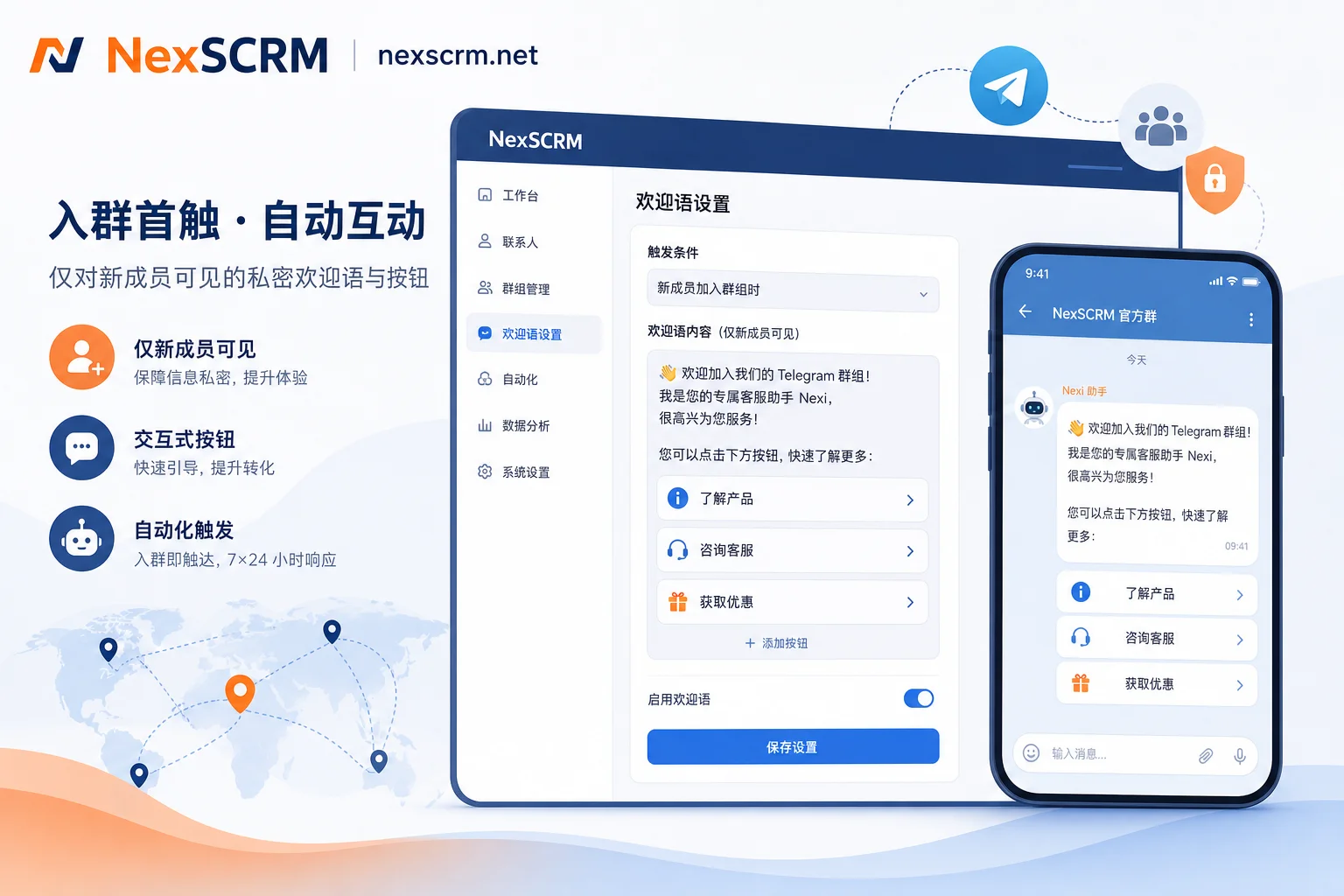
In its 13th-anniversary update on August 25, 2026, Telegram provided channel and group admins with private welcome messages visible only to new members, avoiding spam in the group. Additionally, multiple interactive buttons can be embedded in a single message, allowing lightweight flows such as questionnaires, product browsing, and intent registration.
The automatable actions in this stage are clear:
- Send a private welcome message with brand introduction, language selection, and common entry points.
- Use buttons to let new members choose product categories or business types.
- Auto-reply to frequently asked questions (FAQ).
But note the boundary: buttons are suitable for low-risk actions like "intent registration," not for directly "confirming a deal" — because deals involve pricing, terms, payment methods, and other sensitive information. A wrong button click could lead to order disputes. A safer approach is to use buttons as entry points, leading to human or semi-automated flows.
For more specific deployment details, refer to this Cross-Border Customer Service AI Auto-Reply Bot Full Configuration Guide. The welcome message and buttons handle post-community-joining operations, which can be further planned with Telegram Private Domain Operations.
Stage 2: Intent Recognition and Information Collection — What Can Automation Ask, and Where Must It Stop?
Intent recognition and information collection are the most commonly used parts of automation, but not all fields are suitable for machine collection.
Fields that can be automatically collected: Country/language, product category, quantity range, expected delivery time. These fields have clear options or ranges, so bots can use multiple-choice questions or dropdowns.
Fields that require human confirmation: Custom requirements (e.g., printing, dimensions), certification and compliance requirements (e.g., CE, FDA), payment terms (e.g., credit periods, deposit ratios). These involve professional judgment, and machines may misread or miss critical details.
The trigger conditions for transferring to human should be clear. It is recommended to transfer to human if any of the following is met:
- Two consecutive rounds without matching any intent.
- The customer switches to a third language (e.g., starts with English, then German, then French).
- Keywords like price, complaint, or refund appear.
- More than 6 rounds without progressing to the next stage.
Multilingual auto-reply accuracy should not be evaluated only in aggregate; it should be sampled per language. It is recommended to randomly extract 10 real conversations per language, perform back-translation checks (machine-translate the reply back to the original language), and record misjudged conversations. If a language's accuracy is below 80%, consider forcing human transfer for that language. The following rounds and accuracy thresholds are a practical starting point, but they need calibration based on your product and language performance; they are not platform or industry standards.
Stage 3: Quotation and Negotiation — Why This Stage Must Be Directly Connected to Humans
The quotation stage involves product unit prices, terms, exchange rates, payment terms, and authorization levels. If a robot gives a number, it could be screenshot and seen as a formal commitment. Therefore, quotation and negotiation should not be fully automated.
A compromise: automation provides price ranges and tiered discount rules, while a human provides the final quote. When the customer starts negotiating (e.g., sends "too expensive" or asks for a discount), automation should immediately trigger a handoff and pass the complete context to a human, including:
- Historical requirement records.
- Previously quoted prices.
- Original and translated text (keep both to avoid ambiguity).
Handoff scripts can be designed like: "I'll connect you with a dedicated consultant who has already seen your requirements and will reply shortly." This avoids the customer feeling passed around.
Stage 4: Order Modification and Address Confirmation — How to Sync Status When Messages Are Edited or Information Is Overwritten
The biggest risk in the order modification stage is "appending instead of updating." If the customer modifies an address or quantity in the group, and automation simply appends the latest message to the record, you might end up with two conflicting pieces of information, leading to shipment to the wrong address.
Therefore, order modification must:
- Read back confirmation after each change (the bot repeats the new order content and asks for confirmation).
- Use structured fields as the source of truth, not rely on chat log text parsing.
- Any automated change (e.g., address change, quantity adjustment) must be written back to the same customer profile, not create a new record.
- Set a manual secondary verification node, especially for changes involving amounts or delivery dates.
In multi-account customer service management, this is even more error-prone. It is recommended to refer to the unified customer profile approach in Multi-Account Customer Service Management to ensure synchronized modifications across platforms.
Stage 5: Archiving and Statistics — What Data Should Customer Service Automation Keep (Message Count, Intervention Rate)?
After automation goes live, you must archive the following metrics to evaluate whether it truly reduces workload and to feed cost estimation:
| Metric | Description |
|---|---|
| Automated conversation share | Percentage of conversations with no human intervention |
| Human intervention rate | Percentage of conversations escalated to a human |
| Average rounds to human | Number of dialogue rounds from first contact to handoff |
| Automated message count | Total messages sent by the bot (for cost calculation) |
| Misjudgment rate by language | Percentage of conversations misinterpreted per language |
| First response time | Time difference from customer message to first reply |
These data are not only for performance evaluation but also directly relevant to cost calculation, as discussed in the next section. For example, the more automated messages sent, the higher the cost under the billing policy.
Don't Miss This Cost Item: After Billing Resumes for In-Window Replies, How to Estimate Monthly Automation Costs
Meta's official update shows that the WhatsApp Business Platform will resume billing for non-template Service messages within the 24-hour customer service window starting October 1, 2026. If direct merchants or BSPs do not bind a valid payment method by September 30, 2026, their service messages will be suspended starting October 1. Additionally, from September 23, 2026, the terms of service for WhatsApp Business App and Business Platform will be split; the Business App is for small merchants, and end-to-end encryption policy remains unchanged.
Specific rates have not been announced yet; Meta promises to release the full rate card before September 1, 2026. So here we only provide a framework for estimation:
Monthly Automated Message Cost = Number of Automated Conversations × Automated Messages per Conversation × Cost per Service Message
Example: 5,000 conversations per month, 5 automated messages per conversation, means about 25,000 automated messages per month are billed. The per-message cost depends on the rate card Meta promises to release before September 1, 2026; we do not assume numbers in this article.
This policy directly affects script design — previously "sending one more auto-reply" was almost zero cost, but now every message counts. So automation scripts must be streamlined, sending only necessary messages and avoiding over-pushing.
Configuration Comparison for Three Team Sizes of Customer Service Automation and Pre-Launch Inspection Checklist
Based on team size, automation configuration recommendations are as follows:
| Team Size | Automation Coverage | Transfer-to-Human Threshold | Shift Scheduling Recommendation |
|---|---|---|---|
| 3-5 people | Only initial contact and FAQ | Transfer to human immediately on any unclear intent | Everyone serves as customer service, rotating shifts |
| 6-15 people | Initial contact, intent recognition, information collection (semi-automated) | Transfer on price, complaints, or 2 consecutive misses | 2-4 dedicated CS reps, with bot assistance |
| 16-30 people | Full automation, with human quality checks | Layered transfer by business rules | Build an automation operations team, including QA role |
Before launch, perform these checks to avoid "robot handles, then human can't pick up":
- Replay 10 real conversations per language to check accuracy and context continuity.
- Rehearse the transfer-to-human link to ensure seamless handoff without losing context.
- Verify payment methods and account qualifications to avoid message suspension due to missing payment binding.
- Validate data write-back to ensure all system fields sync after order changes.
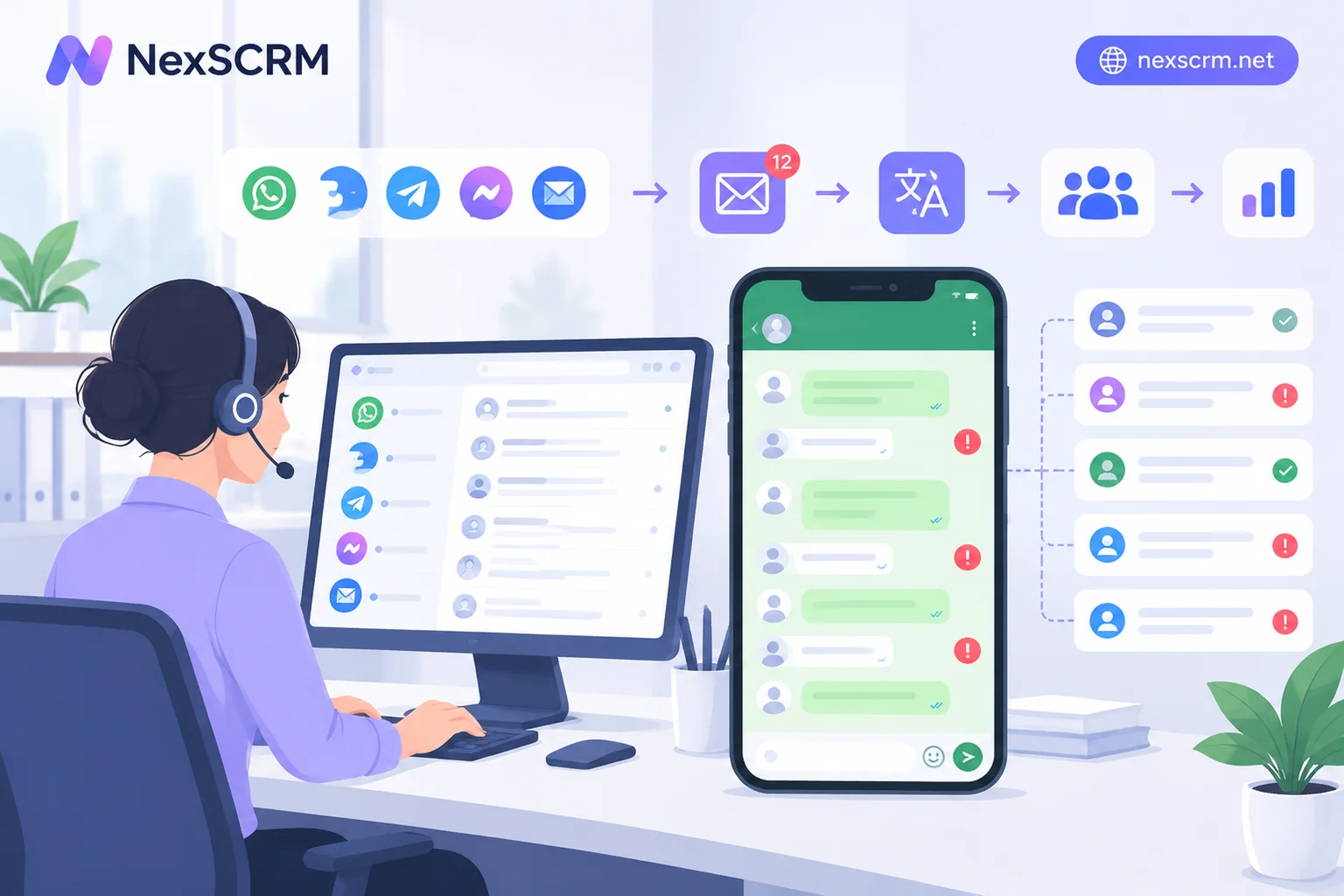
Additionally, conversations generated from automation should ideally be unified into one backend. For example, NexSCRM can aggregate WhatsApp, Telegram, LINE, and Zalo chats into a single inbox, with real-time two-way translation to help humans read the original and translated text, AI-assisted replies for common questions, message statistics for intervention rates and message counts for cost baselines, and message backup to retain order modification context. This way, after the bot handles things, a human can smoothly take over. When selecting a tool, you can refer to the evaluation dimensions in How to Choose an AI Customer Service Assistant.
FAQ
Can customer service automation replace human agents?
No, it cannot fully replace them. Automation suits repetitive, standardized tasks like initial contact, FAQ, and information collection. But for pricing, negotiation, complex complaints, and emotional support, human intervention is necessary. The best strategy is collaboration: automation reduces human workload, and humans handle high-value conversations.
How to set Telegram group welcome message?
This feature was launched on August 25, 2026, with Telegram's 13-anniversary update. Channel and group admins can set a private welcome message visible only to new members, avoiding spam in the group. Developers can embed multiple interactive buttons in a single message to guide users. For specific settings and available fields, refer to official Telegram announcements and Bot API documentation.
When should auto-reply transfer to a human?
Transfer immediately when: two consecutive rounds without matched intent, use of a third language, appearance of sensitive keywords like price/complaint/refund, more than 6 rounds without progress, or the customer explicitly requests "human service." During transfer, provide the full context to avoid redundant questions.
Can buttons in messages directly place an order?
Technically, buttons can handle order placement, but it is not recommended to use them to finalize a deal. Buttons can trigger product browsing, model selection, quantity entry, etc., but the final order requires human confirmation of price, stock, shipping, and terms to avoid misunderstandings. For order modifications, read-back confirmation and human review are needed.
Will costs decrease after customer service automation goes live?
Not necessarily. Automation reduces labor costs, but may increase message costs, especially with WhatsApp resuming Service message billing in October 2026. You need to calculate based on conversation volume, message count, and labor costs. If automation sends too many messages, total costs may increase.
How to test multilingual auto-reply accuracy?
Sample per language, extract 10-20 real conversations, and perform back-translation checks: translate the machine's reply back to the original language to assess semantic consistency. Record misjudgment rates. If accuracy is below 80% for a language, recommend switching to human handling. Also monitor user feedback.


Comments(0)