 NexScrm官方博客
First, make one change: switch the evaluation form from "how many messages sent, how fast replied" to "whether each conversation is efficiently resolved and whether it brings business." What are the KPI metrics for foreign trade team WhatsApp customer service? Directly four groups: Response (first response time, average response time, timeout conversation ratio), Quality (first contact resolution, conversation reopen rate, customer silent drop-off point), Cost (messages per conversation, free-form text ratio, cost per conversation), Conversion (inquiry to quote, quote to deal, repurchase win-back success rate). The reason it's necessary to redo now is that Meta updates its pricing policy in July 2026, ending the free service message (non-template free-form text/multimedia replies) policy within the 24-hour customer service window from October 1, 2026, and switching to per-message billing. That means every free-form text sent by an agent may incur a cost, and using the old "faster and more is better" evaluation will push costs up.
Why You Can't Just Copy the Call Center Approach
Call center metrics focus on answer rate, call duration, and call volume, but these become distorted on WhatsApp. WhatsApp is an asynchronous messaging channel, conversations are stretched across time zones, customers can silently leave anytime, and agents can split one sentence into multiple rounds, creating the illusion of "high interaction." Two typical consequences of blindly following call center metrics: agents use meaningless short messages to win the first response (e.g., just sending "Hello, I'm here" as the first response), and splitting one problem into multiple back-and-forths inflates message counts, directly increasing costs after per-message billing.
Response Metrics: What is a Qualified WhatsApp First Response Time and How to Collect Data
First Response Time: From Customer's First Message to Agent's First Meaningful Reply
The interval from the customer's first message to the agent's first substantive reply is the first response time. Automated replies and greetings are not counted because they are scripted, not human. The qualified line should not be borrowed from external numbers; instead, run your own team's historical data for two to four weeks and use the percentile distribution to set the benchmark. For example, if P70 is 5 minutes, set 5 minutes as the qualified line first, then gradually tighten it. So "what is a qualified WhatsApp first response time"? No universal number; establish a baseline first, then adjust by percentile.
Average Response Time and Timeout Conversation Ratio
Average response time is the average interval between each customer message and the agent's reply across the whole conversation; timeout conversation ratio requires defining the "qualified line" by work shift and time zone first (e.g., "no reply in over 30 minutes is timeout"). This definition must be based on your baseline; the default 30 minutes may not suit all teams.
Quality Metrics: FCR, Reopen Rate, and Silent Drop-off Points
First Contact Resolution (FCR) must be operationally defined: after the conversation is closed, if the same customer does not start a new conversation about the same issue within N days, it counts as resolved. The N value (e.g., 7 days) and the tagging rules for "same issue" must be defined in advance, otherwise the statistics will be chaotic. The reopen rate is the reverse check of FCR: if the reopen rate is high, it means you thought you resolved it but you didn't. Silent drop-off points refer to where the customer stops replying, used to locate script breakpoints.
Industry practice is not to use first response time as a standalone performance metric, but to combine it with FCR and average handling time (as summarized by Salesforce, Zendesk, and other top customer service SaaS in 2026). The problem with only measuring reply speed is that agents spam meaningless auto-response short messages, which lowers resolution efficiency.
Cost Metrics: After Per-Message Billing, Messages per Conversation and Free-Form Text Ratio Must Be in the Evaluation
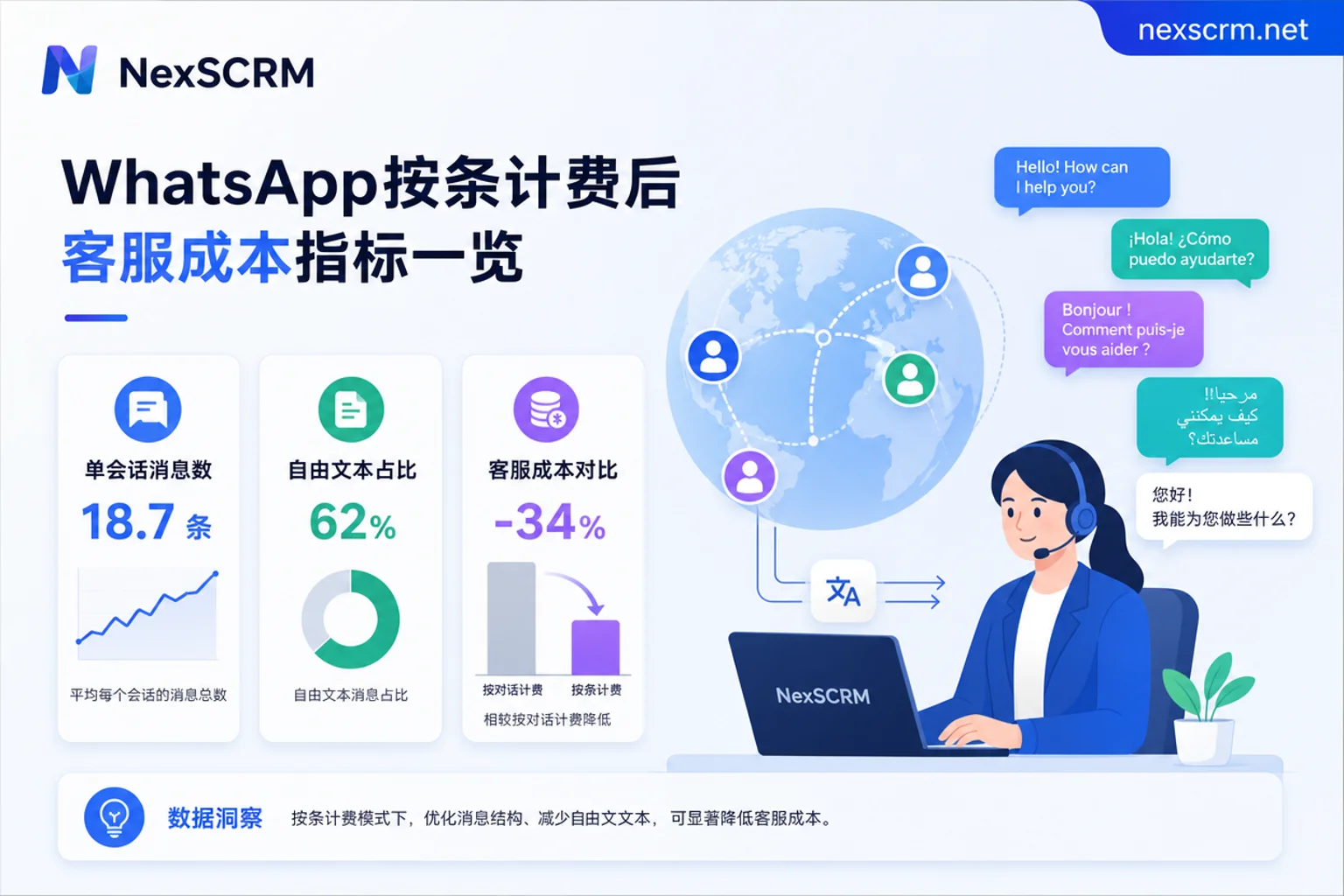
Back to "what are the KPI metrics for foreign trade team WhatsApp customer service," cost metrics are a must-add item in the second half of 2026. Official Meta and global BSPs like Twilio have confirmed: from October 1, 2026, the WhatsApp Business API will cancel the free service message (non-template free-form text/multimedia replies) policy within the 24-hour customer service window, and fully switch to per-message billing; also, from August 1, 2026, Meta will implement token billing for Business Agents, with non-template replies divided into Service and Business Agent messages. This means each free-form text sent by an agent is a cost unit; actual rates are per official and BSP bills. So the evaluation must include three metrics: messages per conversation, ratio of free-form text messages, and communication cost per conversation. Also, reverse-bind with FCR: low message counts but high reopen rates is not good—because the customer wasn't resolved and will come back. That's the answer to "does customer service evaluation need to change after WhatsApp per-message billing?" It's not whether to change, but how to embed cost metrics.
Conversion Metrics: From Inquiry to Quote, Quote to Deal, and Repurchase Win-back Success Rate
Connecting customer service metrics to business outcomes requires defining four conversion metrics with attribution rules:
| Metric | Definition | Attribution Rule |
|---|---|---|
| Inquiry Claim Rate | Proportion of inquiries in conversations actively claimed by agents | Attributed to the agent owning the conversation |
| Inquiry to Quote Rate | Proportion of inquiry conversations with valid quotes | Attributed to the sales or agent owning the customer |
| Quote to Deal Rate | Proportion of quotes that become orders | Requires cross-account deduplication of same customer |
| Repurchase Win-back Success Rate | Proportion of silent customers who are reactivated and repurchase | Aggregated by customer ID across multiple language leads |
When calculating average conversations per agent, you must first solve the cross-account deduplication problem for the same customer. If a customer has conversations on multiple WhatsApp accounts, not consolidating them will inflate average conversations per agent and conversion rates. This requires a multi-account customer service management tool to unify conversations and ensure accurate attribution. Multilingual agents should be compared within their language groups, not directly across languages, because the quality of inquiries and time zone distribution vary greatly. The difficulty in statistics for average conversations per agent and conversion rate usually lies in these two steps: cross-account deduplication and language grouping.
How to Design the WhatsApp Customer Service KPI Table: Weight Allocation and Examples for Three Team Sizes
Put the metrics from the four groups into a table, structured as follows:
| Metric Name | Definition | Data Source | Statistical Period | Weight | Red Line Item |
|---|---|---|---|---|---|
| First Response Time | Interval from customer's first message to effective human reply | Customer service system conversation records | Weekly | 20% | No |
| Average Response Time | Average interval between each customer message and reply | Customer service system | Weekly | 10% | No |
| FCR | Proportion of issues not reopened within N days after closure | System + manual tagging | Monthly | 20% | Yes |
| Conversation Reopen Rate | Proportion of same issue reopened within N days | System automatic | Monthly | 10% | Yes |
| Messages per Conversation | Average total messages per conversation | System automatic | Weekly | 15% | No |
| Free-form Text Ratio | Ratio of free-form text messages to all messages | System automatic | Monthly | 10% | No |
| Inquiry to Quote Rate | Proportion of inquiry conversations with quotes | CRM integration | Monthly | 10% | No |
| Quote to Deal Rate | Proportion of quotes that become deals | CRM integration | Monthly | 5% | No |
Weight orientation varies by team size. For teams of 3 or fewer, focus on response and conversion: first response time and inquiry to quote rate each over 25%. For teams of around 10, add cost and quality: messages per conversation and FCR each around 20%. For multilingual group teams, set baselines per language; e.g., Spanish and English groups do not share the same target value. Additionally, set 1-2 red line items (e.g., timeout conversation ratio, conversation reopen rate) that, if exceeded, result in one-vote veto to avoid gaming. The above proportions are only examples; calibrate with your own 2-4 weeks of historical data before setting.
Metric Fraud and Distortion: Identifying Queue Jumping, Conversation Splitting, and Message Padding
| Fraud Method | Manifestation | Identification Signal |
|---|---|---|
| Queue Jumping | Replying with template short messages within seconds | First reply lacks substance, low word count, high repetition |
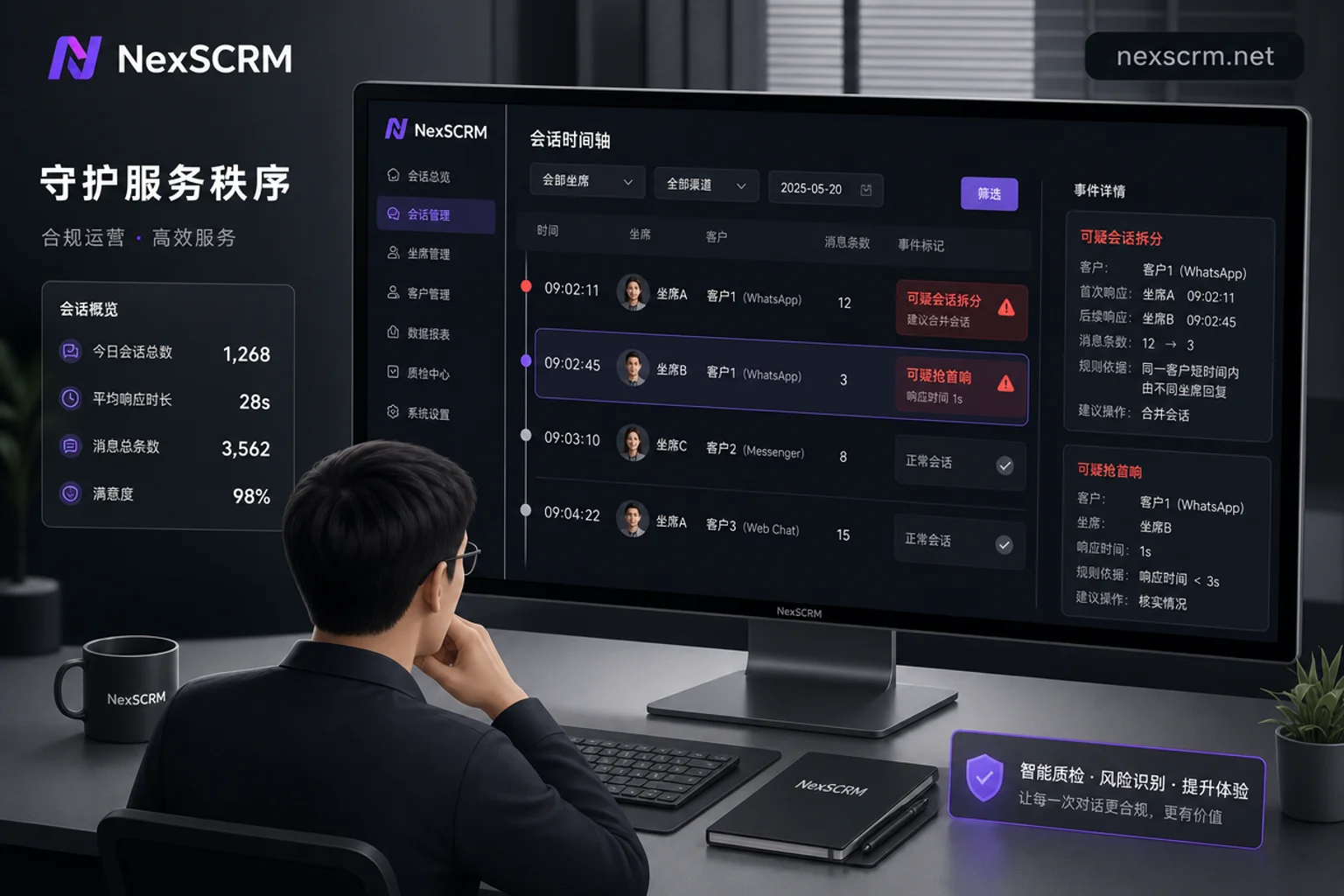
| Conversation Splitting | Frequently opening/closing conversations without resolving the customer's issue | Same customer opens multiple new conversations in a short time, each with very short duration |
| Message Padding | Deliberately sending extra messages to inflate message count | Messages per conversation abnormally high but FCR low |
| Cherry Picking | Answering only simple inquiries, abandoning complex customers | Claimed inquiries' value distributed unevenly, claim times show regular intervals |
Manual spot-check ratio can start at 5% and adjust based on team size and dispute rate; this is a design idea, not an industry standard. Spot-check dimensions include whether the first reply is effective, whether conversations are unnecessarily split, whether message count matches problem complexity, and whether inquiry claim times are abnormally concentrated. Spot-checks should cover all languages; multilingual agents using translation software may have script drift, so translation accuracy needs special attention.
Data Collection Implementation: Which Metrics Must Be Automatically Counted by System, and Which Only Manual Spot-check
Classify metrics by collection difficulty into three categories:
| Category | Metrics | Tool |
|---|---|---|
| System automatic | First response time, messages per conversation, average conversations per agent, conversation reopen rate | Customer service system, SCRM |
| System + manual tagging | FCR, problem classification, conversion attribution | SCRM + manual review |
| Manual spot-check | Script quality, tone, translation accuracy | Chat log review |
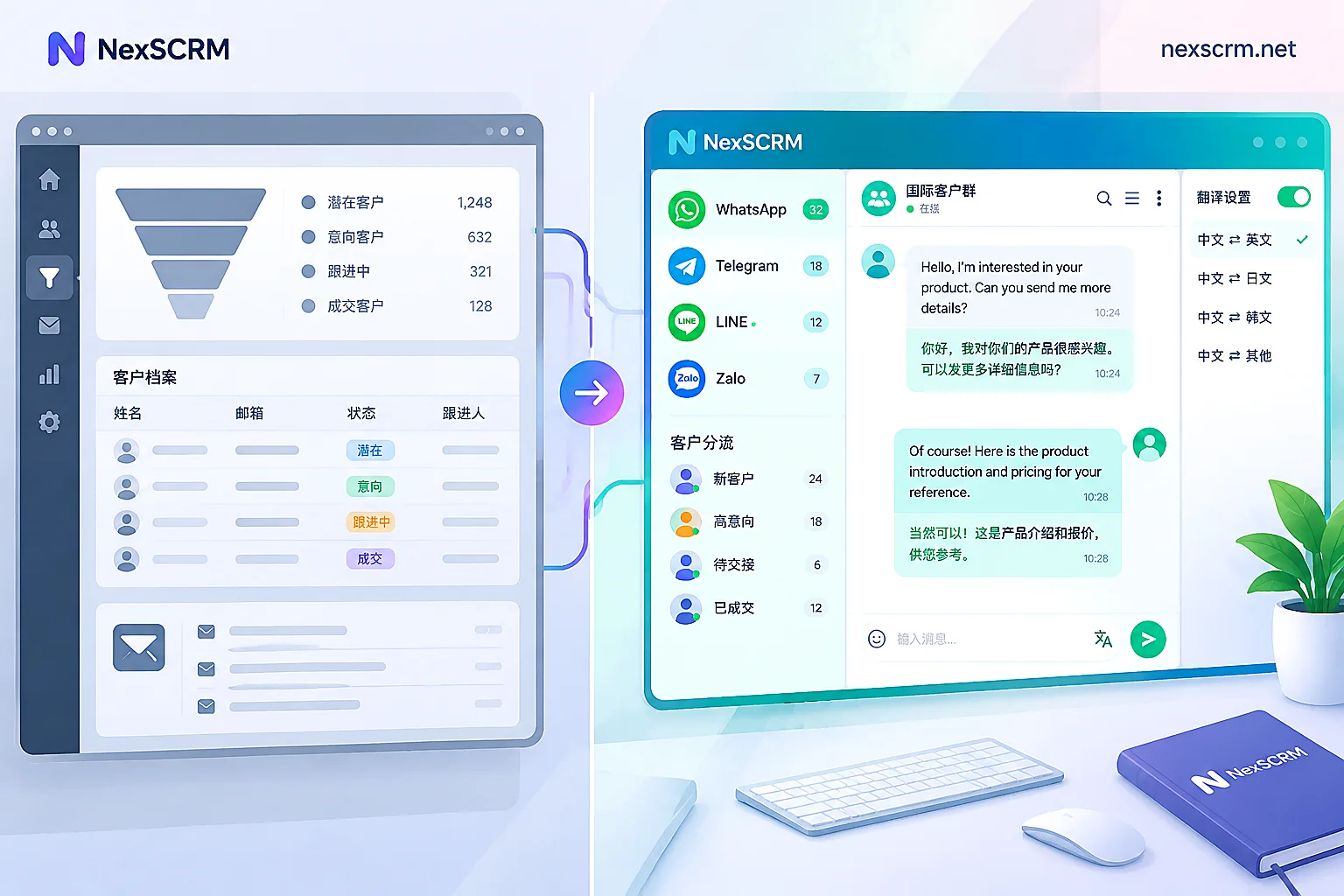
Whether the first two categories can be automatically reported depends on whether the tool supports multi-platform multi-account conversation aggregation. If a customer has conversations on multiple WhatsApp accounts and the tool cannot consolidate them, average conversations per agent and conversion attribution will be duplicated or missed. In that case, consider tools with aggregation, statistics, and chat log backup capabilities (like NexSCRM), which can use social media aggregation customer service to unify conversations from multiple accounts into one workspace, providing a basis for cross-account deduplication and metric statistics.
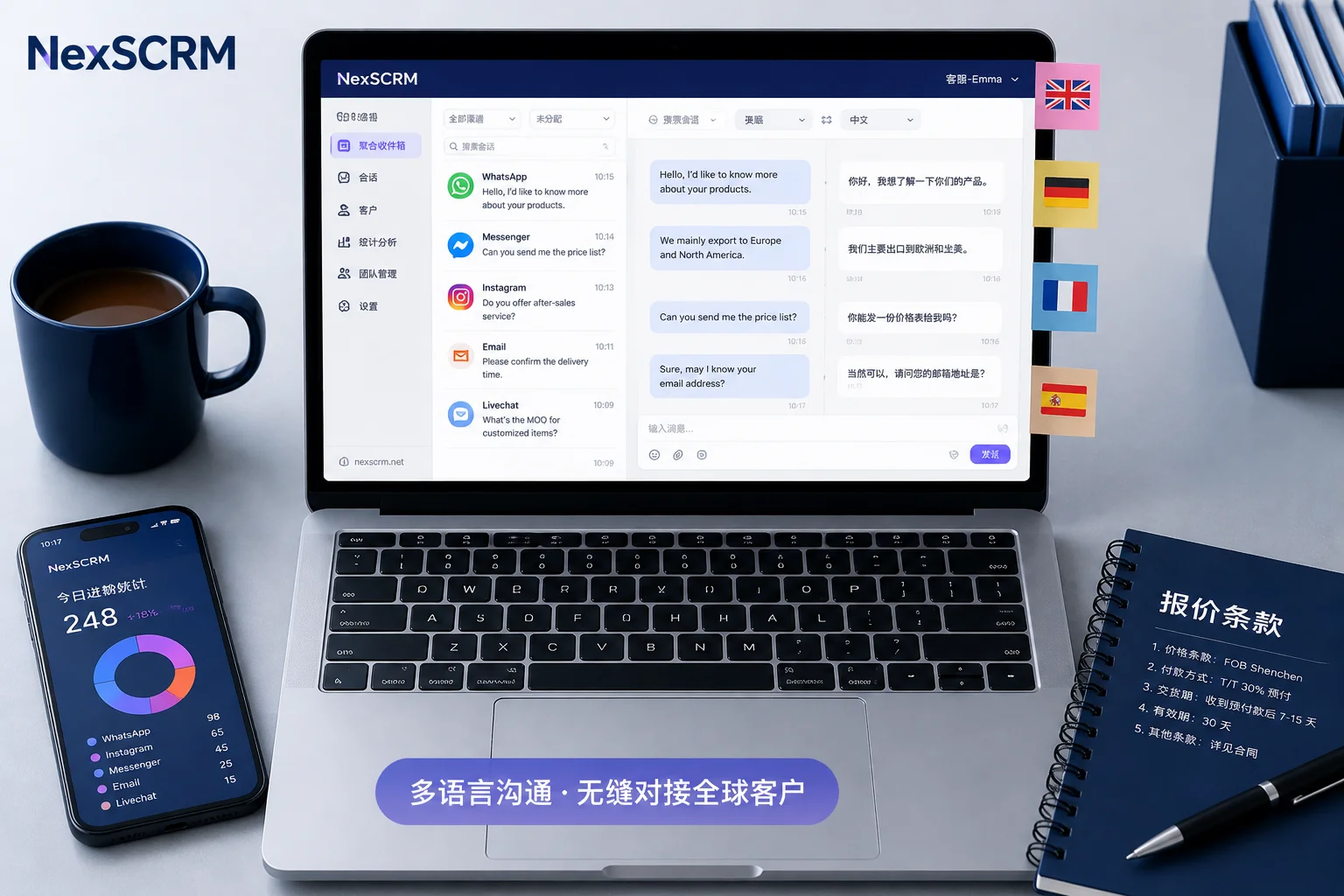
For multilingual agents, NexSCRM's real-time two-way translation and AI-assisted replies can reduce back-and-forth rounds, saving costs under per-message billing; message and marketing data statistics support automatic reporting of first response time, messages per conversation, and average conversations per agent; chat log backup provides raw evidence for spot-checks and performance appeals.
FAQ
What is a qualified WhatsApp first response time?
There is no industry standard. Record your team's first response time distribution for 2-4 weeks, take the P70 or P80 percentile as the initial qualified line, then gradually tighten. At the same time, consider FCR to prevent agents from using meaningless short messages to win first response at the expense of resolution quality.
How to set foreign trade customer service KPIs without only focusing on response speed?
Include FCR, messages per conversation, and conversion rate in the weight, accounting for at least 40%. Set red line items, e.g., if conversation reopen rate exceeds the threshold, veto, to prevent agents from only focusing on speed without solving problems.
How to design the WhatsApp customer service KPI table?
First define each metric, then confirm the data source. Suggested table headers: metric name, definition, data source, statistical period, weight, red line item. Adjust weights by team size and set 1-2 red line items to prevent gaming.
How to calculate average conversations per agent and conversion rate?
Average conversations per agent = total conversations handled / number of agents, provided that same customer is deduplicated across accounts. Conversion rate is calculated stepwise from inquiry to quote and quote to deal, attributed to specific agents or sales to avoid double counting.
Does customer service evaluation need to change after WhatsApp per-message billing?
Yes. From October 1, 2026, free-form text will be charged per message. The evaluation must include messages per conversation, free-form text ratio, and cost per conversation, and reverse-bind with FCR; otherwise, agents' extra messages will directly increase costs.
How to quantify performance for multilingual customer service agents?
Set baselines per language group and do not compare horizontally. Quantified indicators include first response time percentile, FCR, and inquiry to quote rate per language, with manual spot-checks on translation accuracy and customer feedback.


Comments(0)