 NexScrm官方博客
2026 Multi-Account Customer Service Management Guide: How to Overcome Message Scattering and Response Bottlenecks Across Overseas Social Platforms?
In foreign trade and cross-border private domain operations, multi-account customer service management refers to the unified aggregation, secure distribution, and efficient collaboration of customer inquiries across multiple overseas social platforms (WhatsApp, Telegram, LINE, Zalo, etc.) and various operational accounts through a unified workflow and digital system.
On August 3, 2026, the latest developments in customer service and AI attracted widespread attention from cross-border operations teams. The international customer service platform Zendesk released its August 2026 product update, further enhancing cross-channel intelligent routing (Omnichannel Routing) and Copilot-assisted interactions[1]; on the same day, cross-border e-commerce AI customer service system Duoke also launched a self-evolving AI customer service system, aiming to solve the industry challenges of scattered messages and slow response times in multi-store, multi-account scenarios[2]. These latest technological trends clearly indicate that establishing a standardized, intelligent large-scale customer service management system has become a core competitive advantage for enterprises facing multi-channel, multi-account global customers.
Core Pain Points of Cross-Border Social Media Multi-Account Customer Service Management
For foreign trade sales teams and overseas private domain operations agencies, multi-account operation models lacking unified management commonly present the following operational risks:
- Cumbersome platform login and account security risks: Operators need to switch logins frequently across multiple browsers or devices. Without independent environment isolation, they may trigger social platform risk control and associated account bans.
- Lag in switching between pages leads to loss of leads: Customers are scattered across WhatsApp, Telegram, LINE, Zalo, and other social apps. Fragmented interfaces cause delayed customer service responses, missed messages, and directly reduce consultation conversion rates.
- Multilingual communication barriers and context understanding deviations: Facing local buyers from different countries, traditional translation plugins often have issues with translation lag or unnatural expressions, easily leading to communication misunderstandings.
- Disorganized team collaboration and disconnected data assets: Managers cannot grasp agent service efficiency and follower growth dynamics in real-time, lacking unified message backups and marketing data statistics, posing challenges to the accumulation of private domain assets.
Four-Step Method to Build an Efficient Multi-Account Customer Service Management System
To improve service quality while ensuring compliance, enterprises can set up a multi-account customer service workflow according to the following standards:
1. Establish Independent Physical and Operational Isolation Environments
Ensure each social account operates in a secure, independent isolation environment, comply with the rules and compliance protocols of major social platforms, and safeguard the security and stability of account assets from the source.
2. Achieve Centralized Aggregation and Reception of Multi-Platform Messages
Adopt a centralized customer service workbench to consolidate private messages and inquiries from all channels into a unified interface, avoiding agents switching between multiple applications and improving immediate response speed.
3. Introduce Real-Time Two-Way Translation and AI-Assisted Replies
To address multilingual communication challenges, configure real-time two-way translation mechanisms covering major global languages, combined with AI-assisted reply scenarios to automatically recommend standard responses, improving first-response efficiency.
4. Accumulate Process Data and Secure Backup of Chat Records
Build a comprehensive data monitoring system to provide visual statistics on metrics such as conversation volume, response time, and fan conversions, and regularly back up chat data to form standardized SCRM asset management.
NexSCRM Empowers Overseas Social Media Multi-Account Collaboration and Private Domain Conversion
In response to the aforementioned news trends and real corporate needs, NexSCRM, as a global chat translation and aggregation marketing system, provides cross-border teams with an efficient and adaptable multi-account collaboration solution.
The platform demonstrates deep functional support in multi-account customer service management scenarios:
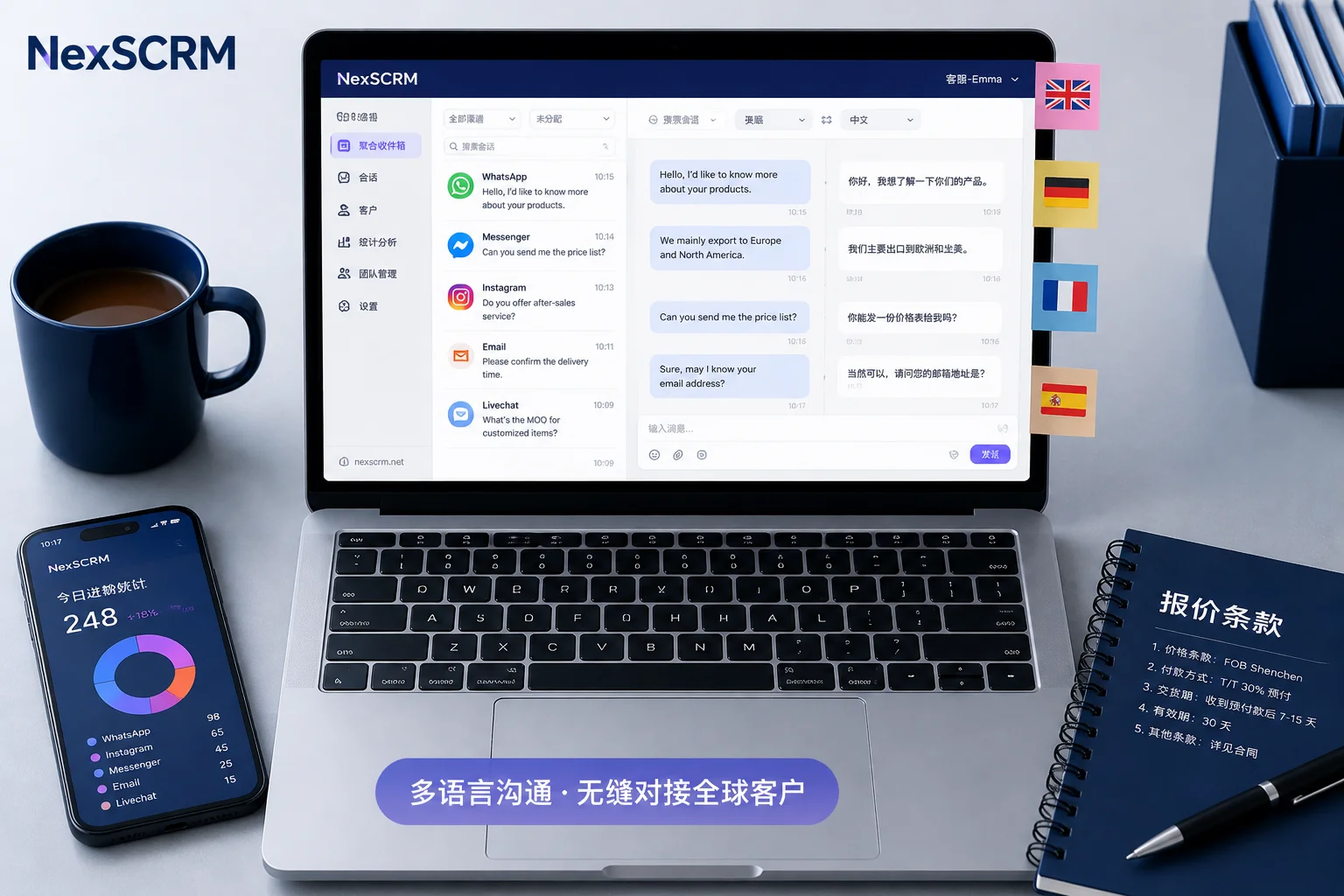
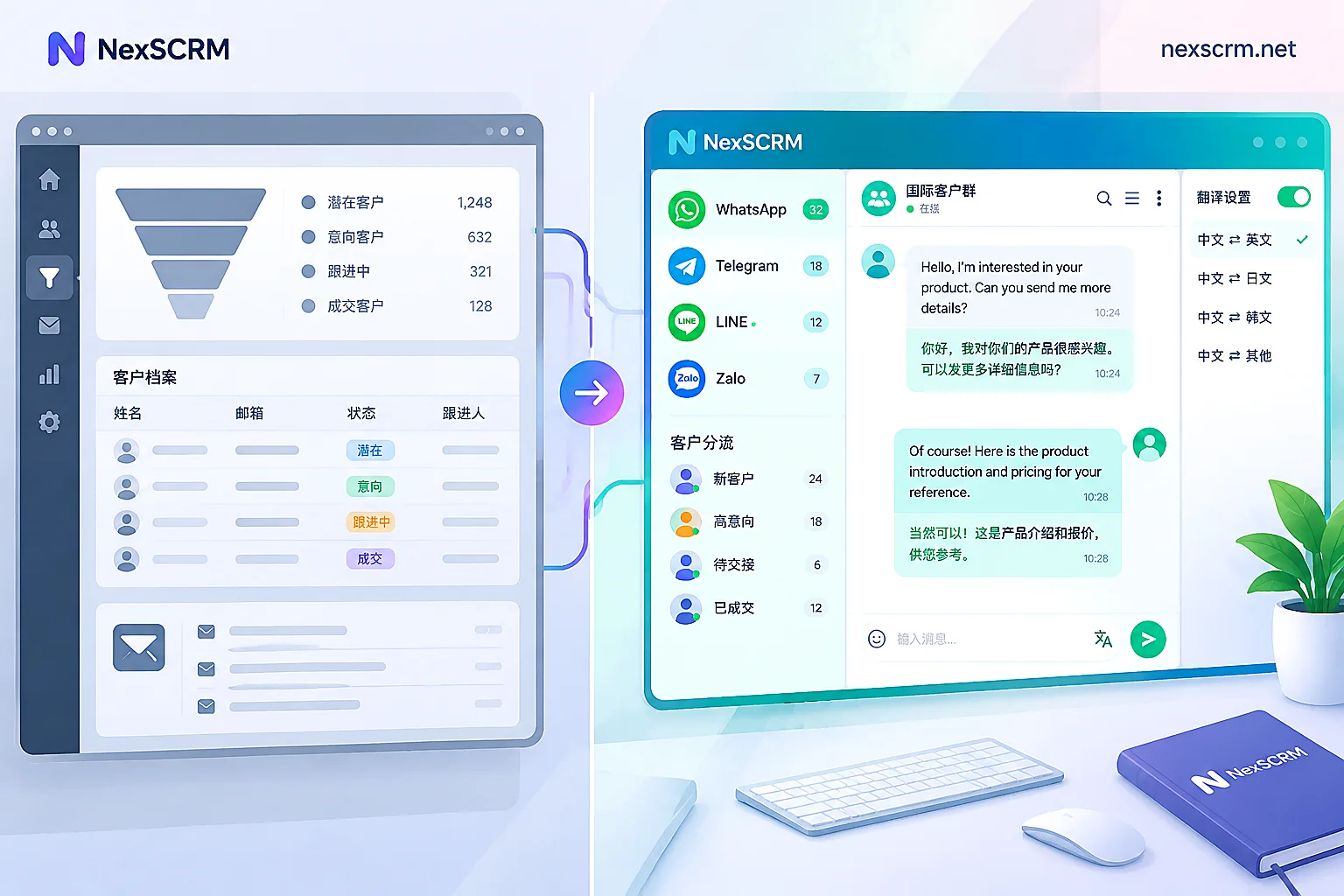
- Multi-platform, multi-account aggregation management and independent environments: NexSCRM supports unified aggregation management for mainstream platforms such as WhatsApp, Telegram, LINE, and Zalo. Agents do not need to frequently log in across different applications, and rely on independent environment isolation to ensure secure and standardized multi-account operations.
- Real-time two-way translation and AI-assisted replies: The system has built-in multilingual real-time two-way translation capabilities, accurately recognizing conversation context, and combined with AI-assisted reply scenarios, helps customer service staff break language barriers and efficiently answer global customer questions.
- Message and marketing data statistics and message backup: Provides clear data statistical views to help managers accurately control customer service performance and follower growth trends, while also supporting message backups to ensure secure accumulation of private domain customer assets.
Team Action Recommendations and Brand Interaction
To help foreign trade and private domain operations teams quickly implement a multi-account customer service management system, we recommend the following practical steps:
- Organize the multi-account matrix and service SOPs: Clearly define the business functions of each account (e.g., pre-sales consultation, after-sales support, regional markets), and establish standard response times and service processes.
- Test aggregation workbenches and multilingual tools: Prioritize service systems with compliance isolation and aggregation capabilities, gradually replacing scattered manual page-switching operations.
Brand Interaction and Resources:
If you wish to learn more about practical solutions for multilingual communication and overseas private domain operations, please visit the NexSCRM official blog for more industry insights and product practices. We recommend teams start by integrating 2-3 core test accounts to experience the customer service efficiency leap brought by multi-platform aggregation and real-time two-way translation.


Comments(0)