 NexScrm官方博客
To succeed in cross-border e-commerce customer service, the core is not to "hire a bunch of people who know various minority languages and guard the backend 24/7", but to first get four things running: use standardized scripts to capture conversions in pre-sales, rely on bilingual traceable tools for cross-language communication, proactively intercept disputes for after-sales exception scenarios, and use first-contact resolution to counter pure hand speed in evaluation. If the team also receives private domain inquiries on overseas social media channels like WhatsApp, LINE, Instagram, TikTok, etc., then add multi-account aggregation and enterprise retention of chat records. A small team of 2–5 people can also maintain response timeliness and reduce return and bad review rates.
Many sellers searching for "cross-border e-commerce customer service" are often stuck on two practical issues: either they have just set up a team and are not sure what actions to focus on daily, and whether hiring requires English majors or just translation tools; or the team is already running, but they find customer service busy replying to messages all day, yet refund rates, one-star bad reviews, and bank chargebacks remain high. Below, we will explain in detail according to frontline practical order.
1. What exactly does cross-border e-commerce customer service manage? First distinguish between "store backend" and "social media private domain"
From daily affairs, cross-border e-commerce customer service work revolves around three stages: pre-sales, in-sales, and after-sales:
- Pre-sales reception (directly determines conversion rate): Answer questions about sizing, materials, compatibility, tariffs, and shipping rules; make matching recommendations or coupon guidance based on customer needs; dispel order hesitation.
- In-sales fulfillment (determines whether complaints ignite): Verify shipping addresses, modify orders or cancel interception, synchronize shipping and customs clearance status, and soothe anxiety caused by cross-border transportation cycles.
- After-sales handling (determines bad reviews and financial risks): Handle damage/missing items reshipment, return/exchange approval, lost package compensation, and evidence interception for platform disputes and credit card chargebacks.
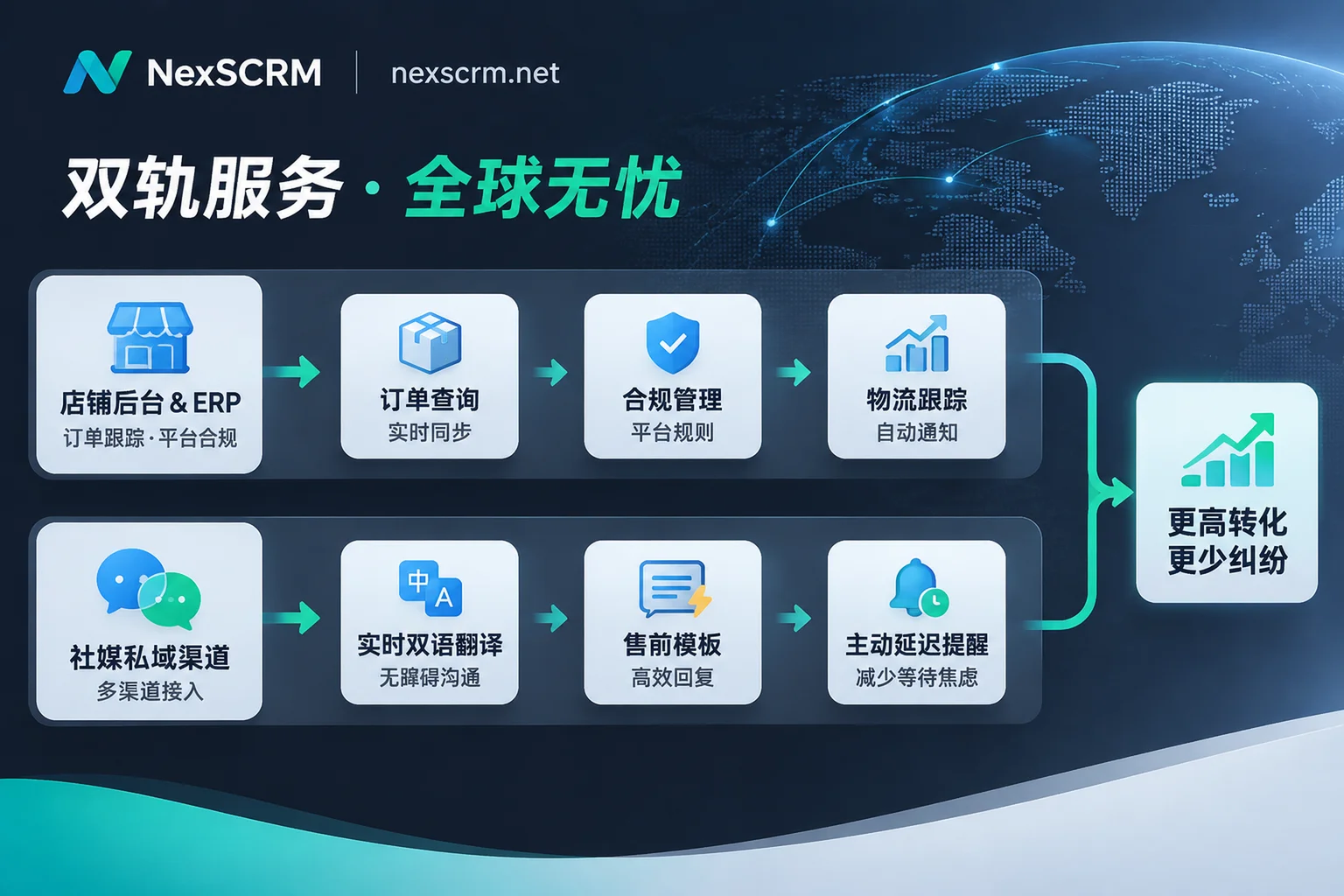
In actual operations, it is also necessary to clearly distinguish the two main battlegrounds: on the one hand, e-commerce platforms represented by Amazon are significantly advancing AI automated review, making it harder for small and medium sellers to reach human platform customer service and reducing communication flexibility, with increasingly rigid rule judgments. This means sellers must solidify evidence and responses in the first round. On the other hand, independent sites and overseas social media private domain channels that drive traffic from ads and short videos to WhatsApp, LINE, Instagram, TikTok, Telegram, Zalo, etc., are key positions where brands can recover orders and cultivate repeat purchases through warm communication.
2. Don't know minority languages and have nighttime time differences—how can a small team handle inquiries from multiple countries?
From recent cross-border recruitment and team configurations, more and more sellers no longer rigidly require customer service to "master multiple minority languages", but use native Chinese team + real-time translation tools + public script library to solve daily communication. However, directly using web translators to copy and paste will quickly encounter three pitfalls:
- Efficiency drops and language mixing: When chatting with buyers from the US, Japan, Vietnam, and Mexico simultaneously, copy-paste can easily send to the wrong window or mix polite expressions from different countries;
- Plugin failures and image blind spots: Overseas buyers are used to sending product screenshots, invoice images, or voice messages directly. Ordinary browser translation plugins often cannot read them, and they may fail when platform web pages are revised;
- Multi-account switching easily associates accounts, and customers leave with staff: Customer service logs into multiple social accounts using personal phones or web clones, which not only misses messages but also, once an employee leaves, chat records and old customers are taken away.
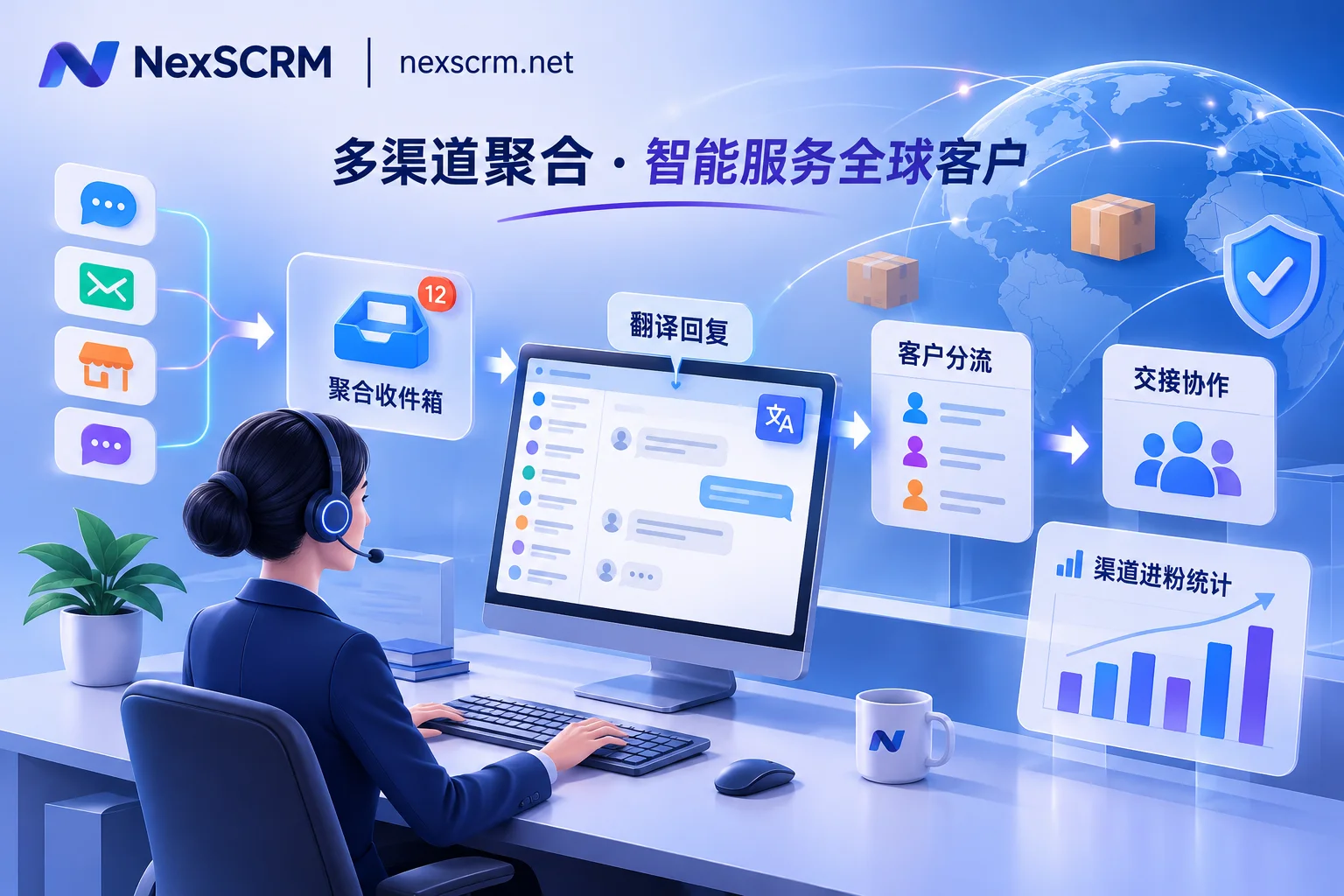
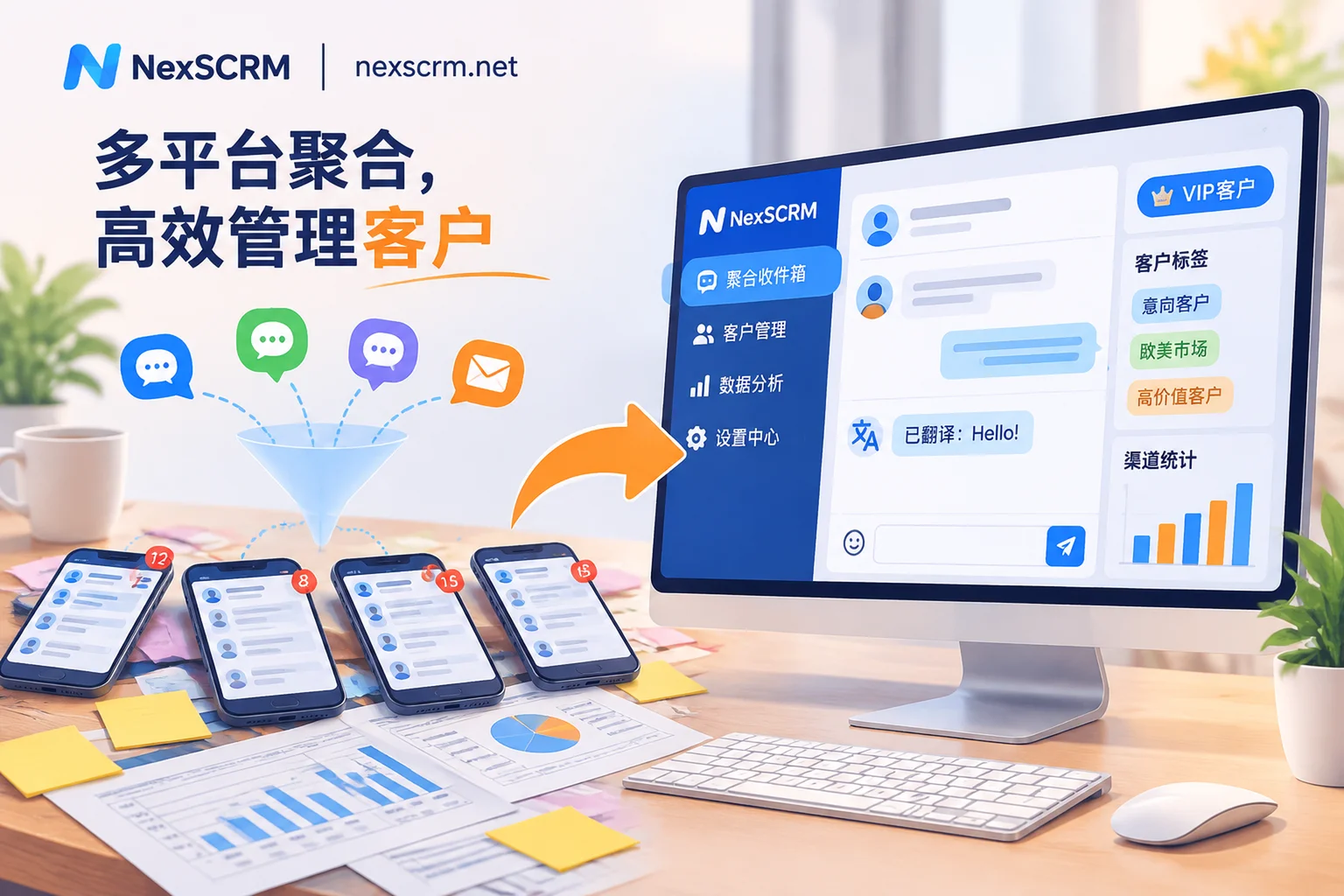
If your team has a large number of inquiries and after-sales on overseas social media and instant messaging apps, using a dedicated desktop aggregation tool will be much more stable than browser plugins. Take NexSCRM, a desktop software for cross-border e-commerce customer service and foreign trade teams, as an example. It can aggregate multiple groups of accounts from multiple platforms such as WhatsApp (both regular and Business accounts), Telegram, LINE, Zalo, Facebook, Messenger, Instagram, TikTok, X, Discord, Signal, etc., into one workbench, with unified reminders for unread messages and no need to repeatedly scan QR codes after restart; each account runs in an independent fingerprint environment and can bind session-level proxy IPs, reducing association risks from multiple accounts on the same screen.
Regarding language issues, the NexSCRM client has built-in two-way real-time translation without additional browser plugins: when buyers send foreign languages, they are automatically translated into Chinese; when customer service inputs Chinese, it is automatically translated into the other party's language, and both the original text and translation are retained for easy verification of prices, specifications, and delivery dates to avoid mistranslation; it supports automatic language recognition and can lock translation language for individual contacts, with multiple lines including Google, Microsoft, DeepL, and AI large models switchable, and image and voice messages can also be translated as versions allow.
As for the challenge of unattended nighttime across time zones, it is recommended to adopt "automated fallback + staggered shifts": during off-hours, rely on keyword auto-replies, welcome messages for new customers' first contact, and editable quick reply templates to first catch high-frequency questions such as shipping time, return/exchange policies, and size charts; leave complex after-sales and quotations for centralized handling in morning or evening shifts. For specific shift arrangements, you can directly refer to this article on the site: How to Schedule Cross-Border E-Commerce Customer Service? Comparison of Three Multi-Time Zone Shift Patterns.
3. Why do return rates, bad reviews, and chargebacks remain high even with fast replies?
Many teams feel wronged during reviews: "We clearly replied within 1 minute, why did the buyer still give a one-star bad review or even go directly to the bank for a chargeback?" The real reason is often not insufficient hand speed, but failure to pre-set defenses at the three after-sales nodes most likely to trigger emotions:
- Scenario 1: Logistics tracking stagnant, passively waiting for buyers to come and complain
Don't wait for customers to send a string of question marks before checking the order. It is recommended to spend 30 minutes before the morning shift each day filtering packages in the order/logistics system whose tracking has been stagnant for more than 48 hours, proactively send care messages to buyers explaining that the carrier has been urged, and give a clear "fallback deadline" (e.g., if there is still no update by a certain date, immediately reship for free or refund in full). Proactively providing certainty can block a large number of "item not received" disputes. - Scenario 2: Low-ticket cross-border returns/exchanges, forcing "pay to ship back"
For a product priced at $18, the shipping cost to return it to a Chinese warehouse across borders may be as high as $20. If customer service mechanically replies "must ship back for refund", the buyer will feel deliberately troubled and may initiate a credit card chargeback (Chargeback), leaving the seller with neither goods nor payment and also charged fees. Calculate the profit account in advance, and set tiered approval limits for customer service to "keep-it or partial refund to retain the item", which actually stops losses better. - Scenario 3: Reasoning first, comforting emotions later
Overseas buyers value empathy and clear solutions more. When encountering damage or wrong items, start with an apology and acknowledge emotions, then immediately ask for clear photos and order number, rather than questioning whether the buyer broke it. For multilingual expressions at different nodes, you can directly use the article on the site: Cross-Border E-Commerce Return/Exchange Customer Service Communication Scripts and Multilingual Templates: Copy 5 Nodes.
If you worry that new customer service staff cannot handle comfort and wording accurately, you can enable NexSCRM's AI reply suggestion feature: AI will generate authentic reply drafts based on the buyer's current question and historical chat context. Customer service clicks send only after confirmation, depositing good scripts into the team's public script library, improving efficiency without the "hallucination" risk of fully automated bots making random refund promises.
4. How to set performance evaluation? Never focus only on "first response time"
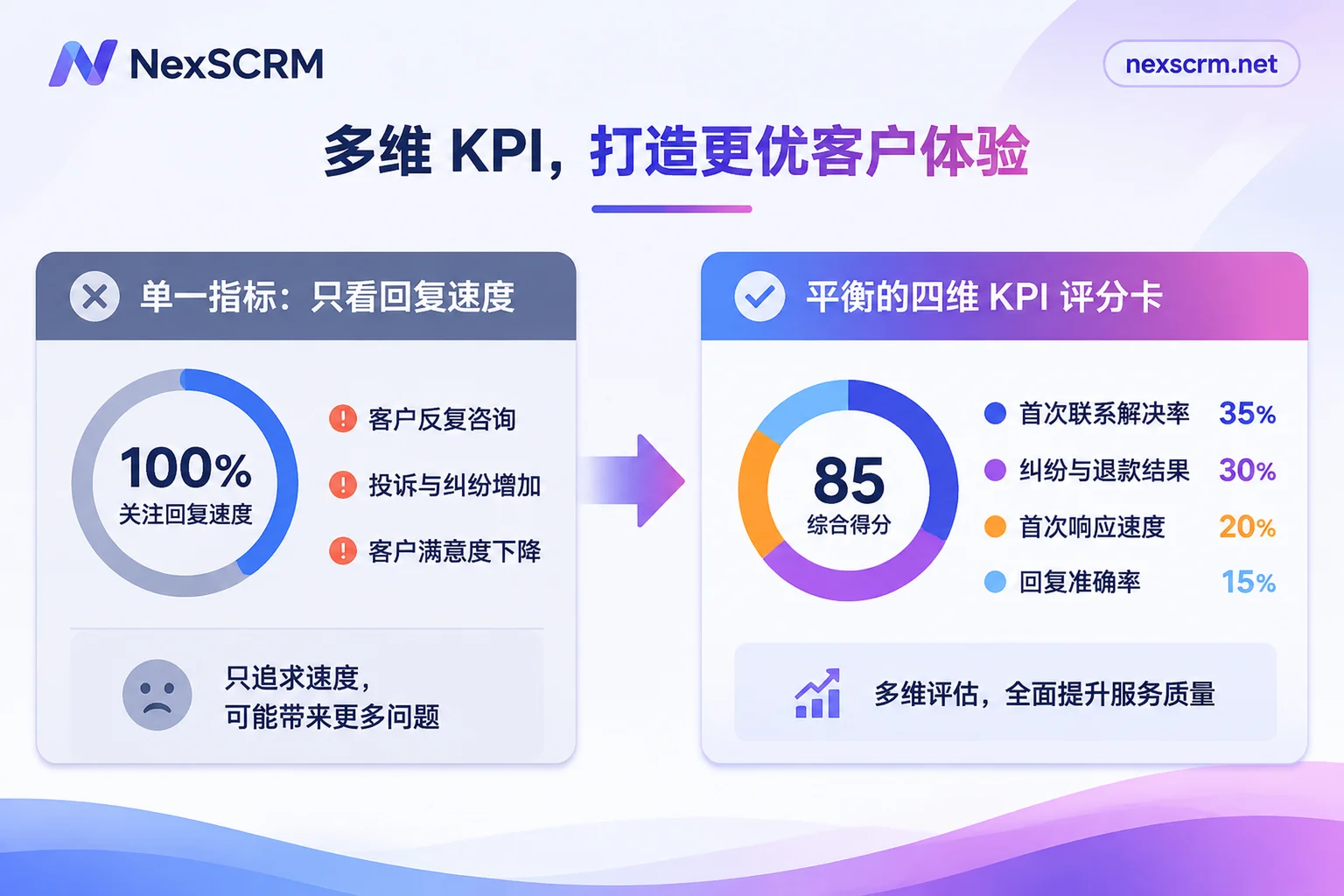
The most common mistake in cross-border e-commerce customer service evaluation is focusing only on "first response time" and "response rate". Speed is the easiest to quantify and rank. Once only speed is evaluated, customer service will learn to "reply with a standard meaningless sentence in seconds to cut off the timer", pushing complex issues later or to the next shift. On the surface, response reports are all green, but the backend's secondary inquiry rate and refund escalation rate soar.
To make "fast" and "get things done" happen simultaneously, a more reliable approach is to use four mutually constraining indicators for a percentage-based evaluation:
| Evaluation Indicator | Suggested Weight | Measurement Focus | Role in Preventing Deviation |
|---|---|---|---|
| First-Contact Resolution | 35% | Whether the buyer's same issue is completely resolved in one round | Forces clear troubleshooting and complete replies, reduces secondary inquiries |
| Return/Exchange and Dispute Handling Results | 30% | Recovery rate, dispute/chargeback escalation rate, compensation control per rules | Prevents arbitrary refunds for convenience or stiff attitudes that escalate bad reviews |
| First Response Timeliness | 20% | First response compliance during working hours | Maintains basic reception bottom line but does not let it dominate the score |
| Reply Content Accuracy | 15% | No errors in specifications, prices, logistics promises, and platform compliance red lines | Restrains new and old customer service to answer according to unified standards, reducing later disputes |
At the multi-customer service collaboration stage, having an evaluation table alone is not enough; data extraction and team internal control must also keep up. In NexSCRM, administrators can assign ports and role visibility scopes to sub-accounts through the main account; the backend data dashboard directly counts conversation volume, new followers, response timeliness, and customer service performance, and the ticket counter can also deduplicate and count diversion channels, facilitating precise review of the reception performance of each advertising entry. At the same time, chat records and media files are automatically backed up to the cloud, searchable by time, contact, and keywords. With sensitive word monitoring, private contact/private payment monitoring, and data masking, customer profiles and follow-up history are firmly retained on the enterprise side, avoiding customer loss when customer service staff leave.
5. Don't take detours with tools: which part do store backend tickets and social media SCRM each manage?
Finally, a selection detail: no single software can do everything. If your business is entirely completed within shelf e-commerce sites like Amazon or Shopee, prioritize using the store backend or an e-commerce ticketing system integrated with ERP to monitor orders and logistics; if your inquiries largely come from independent site pop-ups or social media private domains such as WhatsApp, Telegram, LINE, Zalo, Instagram, TikTok (if unsure how to divide selection, you can first read this article: Searching "cross-border customer service software" getting more confused? Which to choose among independent site tickets, store backend, and social media multi-account aggregation), then use a desktop workbench like NexSCRM that focuses on cross-language social communication and team collaboration to supplement "multi-account aggregation + real-time bilingual translation + customer retention + employee internal control".
NexSCRM currently offers a Windows client (billed by the number of simultaneous online ports, can be upgraded or downgraded at any time, and there are also unlimited translation character packs that can be added), and supports a limited-time free trial without a credit card. It is recommended to first use one or two main order-receiving accounts to run through a week of translation, quick replies, and deduplication statistics, then gradually expand ports based on actual reception concurrency.