 NexScrm官方博客
Let's first separate what can be caught from what cannot.
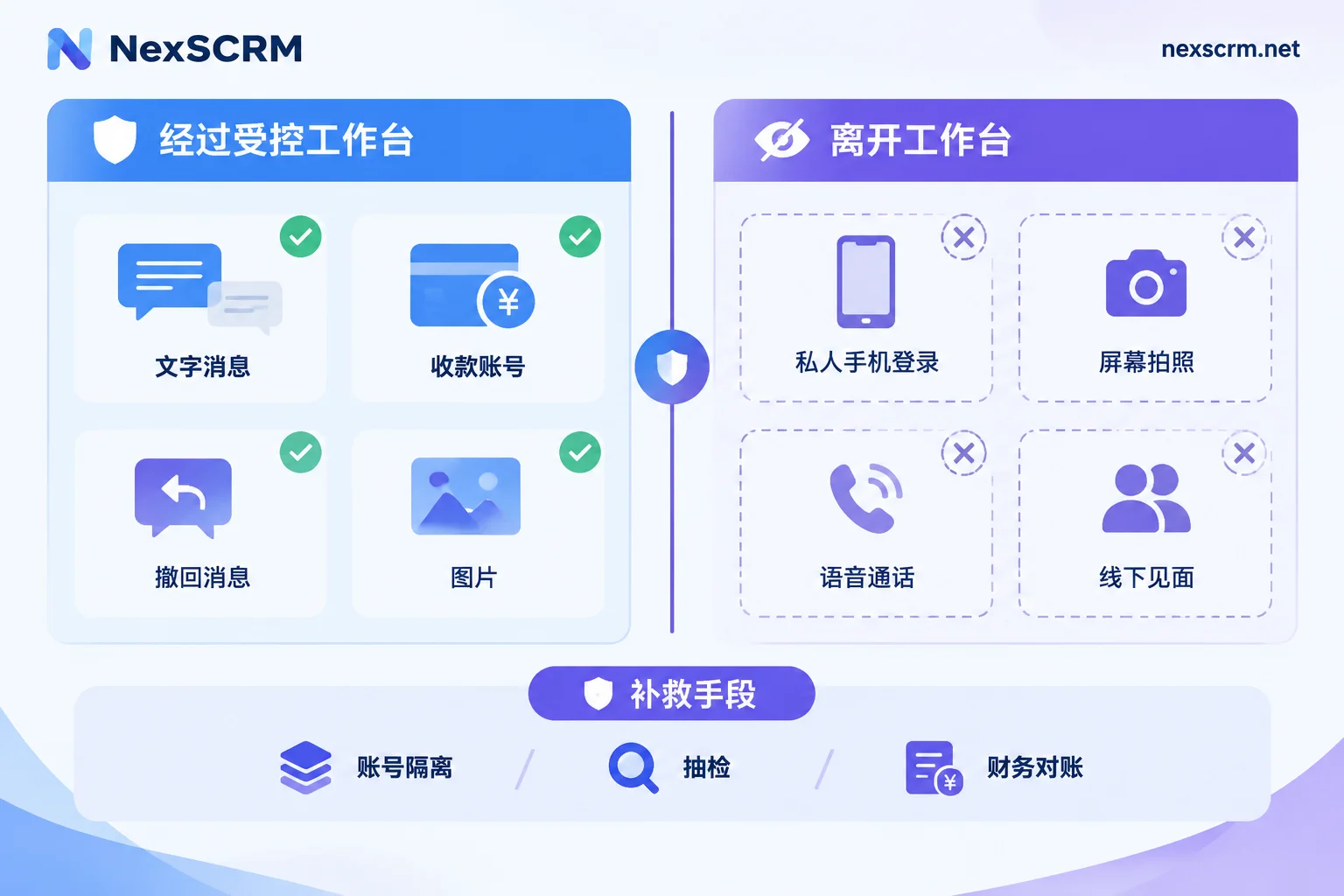
If an employee's conversations are sent and received within a unified workbench, then three types of actions can basically be detected, and they leave a record with context: writing a personal phone number, email, or off-platform account in a chat; using scripts to guide the customer to chat elsewhere; sending an unregistered payment account or wallet address.
What cannot be caught are actions that completely leave the workbench: using a personal phone to directly log into the same account and chat, using another device to photograph the screen, making a direct phone call, or meeting offline to talk.
This line is drawn at "whether the message goes through a controlled client," not at the person. So before spending time tuning rules, first confirm whether the team's communication channels have been consolidated into one workbench; if half the conversations are still on individual phones, even finely tuned rules will only cover part of the traffic.
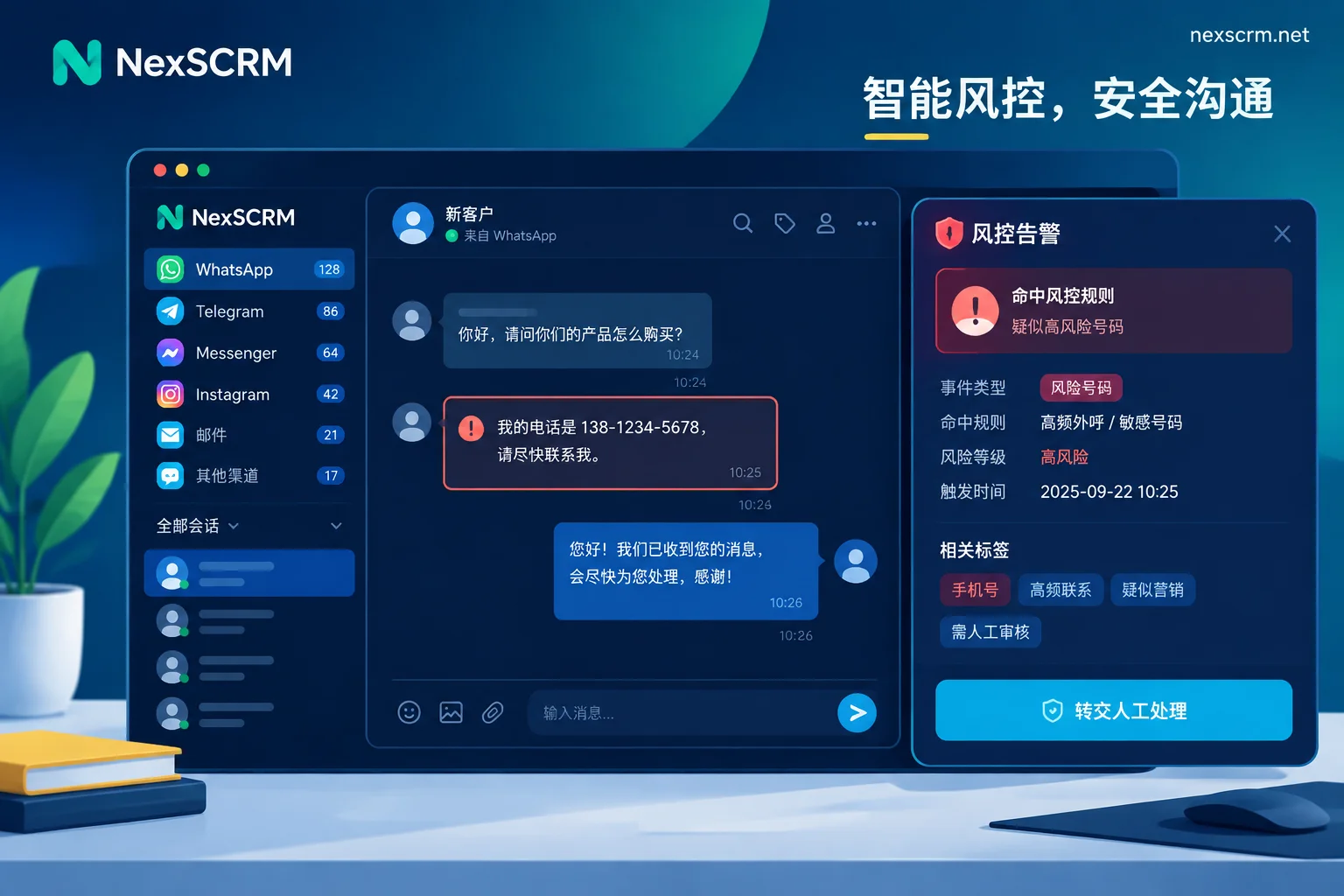
Private contact sharing: relies on format matching and word libraries, not understanding meaning
Rules that actually work in practice generally fall into four groups:
- Format rules for numbers and emails. Use regex to match phone numbers, landlines, emails, and other strings with fixed structures.
- Off-platform accounts and invite links. IDs from other social platforms, username formats, invite link domains.
- Private chat hint words. Expressions like "add me," "not convenient to say here," "let's talk elsewhere," "scan the code" that have no specific number but clear intent.
- Also monitor the receiving direction. Contact information actively sent by customers must also be recorded; it can easily become a deal that never enters the system.
Evasion writing needs separate consideration. Numbers split apart, spaces or symbols inserted, Chinese uppercase numerals, pinyin homophones—these can be handled for plain text rules: remove separators first then match, loosen the regex, at the cost of more false positives, requiring an observation period to tune.
Writing numbers into images or speaking them via voice depends on whether the product has image text recognition, QR code recognition, and voice transcription capabilities; implementations vary greatly. Do not assume it is covered; it is recommended to confirm the recognition scope directly on the official feature page or in a trial, and then decide whether to rely on manual spot checks for that part.
Off-platform payments: without a whitelist, detection is impossible
The order cannot be reversed: finance first registers official payment methods into a whitelist—company accounts, corporate payment links, registered wallet addresses—then the system monitors for payment information outside the whitelist.
Common hits include bank card numbers, personal payment accounts, USDT TRC20/ERC20 addresses, and transfer hint words like "transfer privately," "use my personal account," "pay privately for a discount."
Why the whitelist must come first: if you only monitor "whether a long string of account numbers appears in chat," normal quotes and reconciliation communications will be flooded with false positives, and after a few days no one will look at alerts. With a whitelist, the system can distinguish "sending the company account" from "sending one's own account," which is the category that truly matters.
Cryptocurrency wallet addresses deserve a separate rule. They have fixed length and character set, regex hit accuracy is high, and they almost never appear in normal chit-chat; one hit is worth one look.
What recalls and local deletions cannot block
The most common cover-up for private deals is recalling after sending, or clearing the conversation on one's own phone. Whether post-event review is possible depends on whether that message left a copy on the server.
Chat record cloud backup plus conversation-level search solves exactly this: search by employee, by account, by time period, by sensitive event tag, and see the full context, not an isolated alert.
In NexSCRM, this part corresponds to counters and cloud backup: aggregated multi-account sent and received messages (original and translation retained together) sync to the cloud, and sensitive word and sensitive behavior monitoring hits are recorded by event tag; during review, you can read dozens of messages before and after together. For specific search usage, refer to how to search historical messages by keyword in chat records. Searching single chat, searching globally, and searching all accounts are three different things.
One point to clarify upfront: a rule hit only means "triggered a condition," not "definitely violated." A customer actively sending their own account, a colleague sending company payment info on behalf, or a quote with contact info will all trigger hits. The handling process must include a manual step to review context, otherwise it quickly becomes mutual distrust.
Also tighten the path for customer data exfiltration
Outbound message monitoring manages "content already sent"; there is another path where customer information is accumulated on personal devices and contacted later. The corresponding measure is masked display: full customer numbers and real accounts show only partially in lists, while batch copy and export permissions are restricted.
This is separate from sensitive word monitoring—one manages the exit, the other the entrance—and combined they provide complete coverage.
Four blind spots and their respective fixes
- Private phone logging into the same account for private chat. Expose via account isolation and login control: each account is bound to a fixed fingerprint environment and session-level proxy; logging in from a different device or region leaves traces. You can manage uniformly from multi-account aggregation; for proxy parameter configuration details, see how to configure different proxy IPs for each social account.
- Photographing or hand-copying customer information. The system cannot catch real-time actions; only rely on masking to compress the amount of copyable information, plus regular spot checks.
- Voice and phone calls. In-platform voice messages with transcription and translation can be stored for review; direct voice calls cannot.
- Offline meetings and other private channels. Only rely on a closed-loop business reconciliation: a closed customer with no corresponding follow-up record in the system, or a payer inconsistent with the registered payee, is a harder signal than any keyword.
Implementation order
- First consolidate communication channels into one workbench, otherwise coverage of subsequent steps cannot be guaranteed.
- Finance provides a list of official payment methods and enters them as a whitelist.
- Configure three rule groups: contact format, external accounts and private chat hint words, non-whitelist payments. In the first week, only alert without intervention, specifically to observe false positives.
- Tune the word library and thresholds based on false positives, and solidify the handling process: who reviews, within what time, how to preserve evidence, when to escalate.
- Monthly, use orders and payments to cross-check follow-up records, covering the part that in-system monitoring cannot see.
Two points vary by product version; it is recommended to verify on the official website or in a free trial on the spot before writing them into internal control policies: first, to what extent text in images and QR codes can be recognized; second, after a sensitive rule hit, whether it is real-time alert plus trail, or can directly block the message from being sent. Different answers here will greatly affect your review manpower investment.


Comments(0)